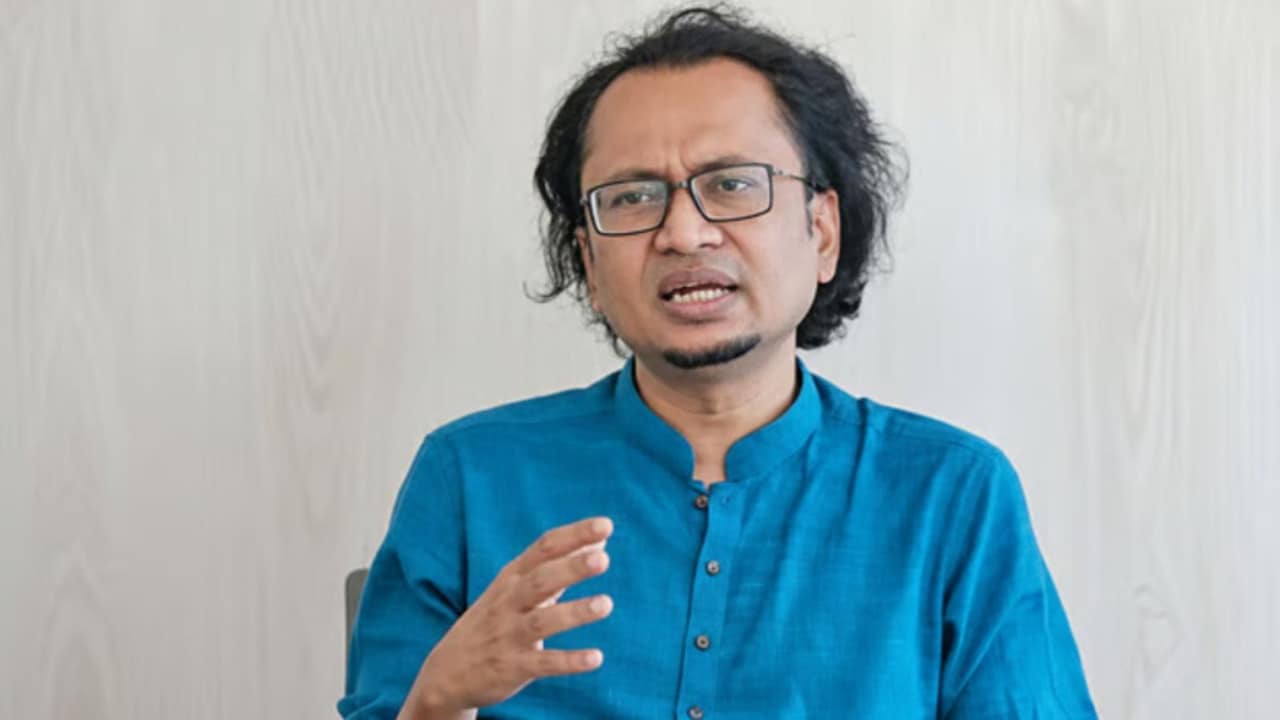
Airports are liminal spaces where diplomacy goes to get stripped of its dignity. For Zahed Ur Rahman, the top information adviser to Bangladesh’s Prime Minister Tarique Rahman, a recent incident at an airport security checkpoint could have easily become an excuse to withdraw behind a wall of diplomatic outrage. It is the kind of friction that makes bureaucratic hearts turn cold.
But statecraft is rarely about personal pride. It is about geography, survival, and the heavy flow of shared water.
When asked if he would still step foot on Indian soil after the airport incident, Rahman did not hesitate. His response cut through the typical theatrical anger that defines modern geopolitics.
"I will certainly go," he said. "I am making this very clear that if I receive a proper invitation, I will certainly go because I want to engage with India, logically and rationally."
Logically. Rationally. These are heavy words in a region where history is usually written in poetry and blood.
The Liquid Border
To understand why an adviser would swallow his pride and demand a rational dialogue with a giant neighbor, you have to look past the political speeches and focus on the silt.
Consider a farmer named Farid. He is a hypothetical composite of the thousands of men who live along the banks of the Teesta River in northern Bangladesh. Farid does not read diplomatic cables. He reads the mud. When the Teesta dries to a trickle in the scorching summer months, his crops wither, and his family goes hungry. When the monsoon gates open upstream in India, the river transforms into a monster, swallowing his homestead overnight.
For decades, the Teesta has been a source of anxiety. Bangladesh wants a formal water-sharing treaty; India has internal political gridlocks that have stalled it for generations.
Now, Dhaka is moving forward with the Teesta River Comprehensive Management and Restoration Project. It is a massive, ambitious effort to tame the river, build reservoirs, and secure the livelihoods of millions of people like Farid.
But whenever Bangladesh builds something big near the border, eyes in New Delhi narrow. The subcontinent is a room full of mirrors, where every domestic infrastructure project looks like a strategic maneuver. Rumors of foreign influence—specifically from Beijing—always swirl around these massive water works.
Rahman chose his words carefully to defuse this exact anxiety. He made it plain that the river project is an act of internal preservation, not geopolitical aggression.
"No country should be worried," Rahman insisted, addressing the quiet panic that often ripples through regional intelligence hubs.
The message was clear: managing the water is about survival, not taking sides in a cold war.
Beyond the Airport Gates
It is easy for outsiders to view South Asian diplomacy through the lens of zero-sum games. If Bangladesh speaks to China, India loses. If Bangladesh opens its arms to India, it is turning its back on its sovereign independence.
This view is wrong. It misses the human element.
Dhaka and New Delhi share more than just 4,000 kilometers of border. They share families, culture, and a deeply intertwined economic destiny. A truck driver waiting at the Petrapole-Benapole border crossing with a cargo of perishable onions knows this. A student from Dhaka studying engineering in Chennai knows this. The relationship isn't a luxury; it is a structural necessity.
When Rahman demands a logical and rational engagement, he is acknowledging that the emotional baggage of the past cannot dictate the reality of the present. Friction at an airport checkpoint is an irritation. A failure to manage a shared river is a catastrophe.
The new administration under Prime Minister Tarique Rahman is signaling a shift. They are not looking for subservience, nor are they seeking conflict. They are looking for a baseline of mutual respect where hard conversations about resources can happen without the immediate threat of a diplomatic freeze.
The invitation Rahman is waiting for isn't just a piece of paper with an official stamp. It is a signal from New Delhi that India is ready to talk to its neighbor not as a sphere of influence, but as a sovereign partner.
The mud on Farid’s boots will dry up soon if the river isn't managed. The political actors in Dhaka and New Delhi know the clock is ticking. The line in the dirt matters, but the water flowing across it matters much more.