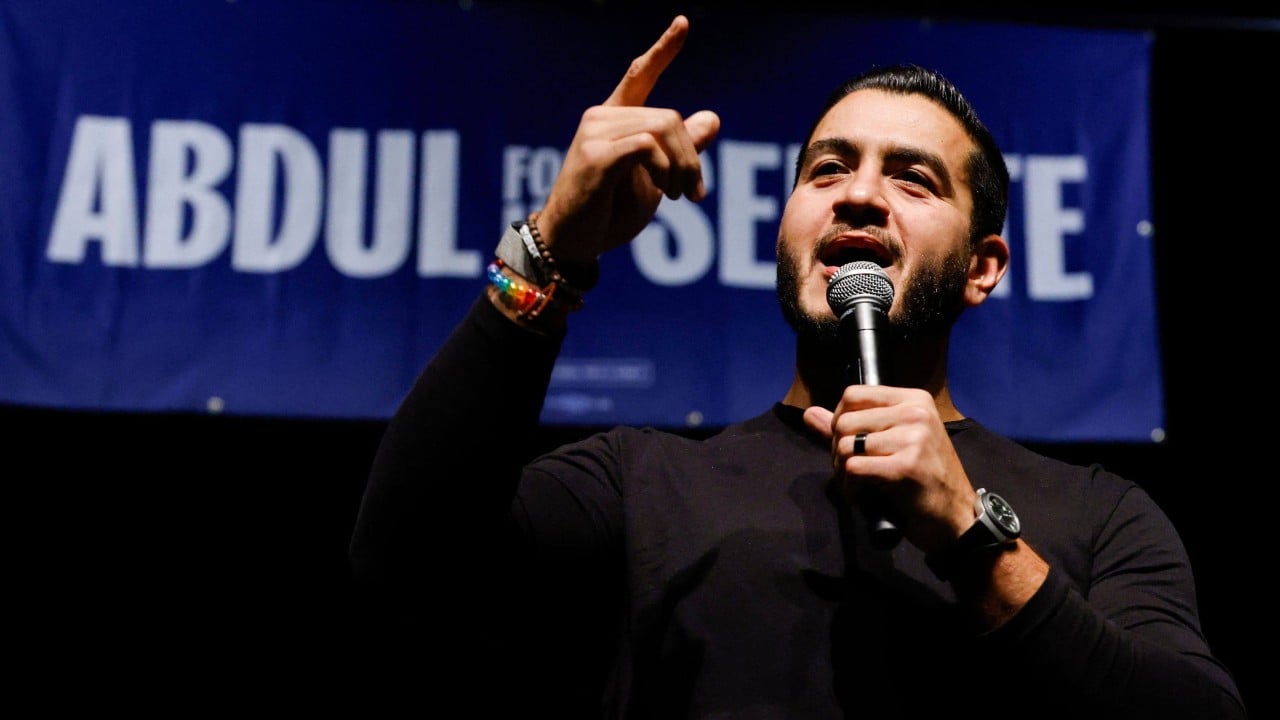
Political discourse relies heavily on symbolic identification. When public figures misname opponents or candidates, analysts often debate whether the error stems from cognitive fatigue, strategic signaling, or simple distraction. This phenomenon gained renewed attention following an incident where Donald Trump referred to Abdul El-Sayed, a prominent Muslim political figure, as "Mohammed" during a public appearance.
The immediate reaction across media channels centered on accusations of deliberate alienation or cultural carelessness. Yet, examining such errors through the lens of political communication reveals a more complex machinery of association. Public speakers operating under relentless schedules frequently rely on mental categorization rather than precise biographical recall. When an individual belongs to a demographic group that a speaker associates with a specific cultural or religious archetype, the brain often substitutes a common placeholder name from that category. Discover more on a related topic: this related article.
The Anatomy of Verbal Substitution
In high-stakes public speaking, cognitive load reaches extreme thresholds. Speeches are rarely read word-for-word from teleprompters without deviation; extemporaneous remarks introduce moments where the speaker must retrieve proper nouns on demand.
Memory retrieval relies on associative networks. If a speaker connects a candidate's background to a broad cultural category, the most frequently encountered name within that category acts as a cognitive magnet. For figures operating within certain political ecosystems, names like Mohammed function as generalized defaults when referencing individuals of Middle Eastern or South Asian descent, regardless of the individual's actual identity. More reporting by NPR delves into related perspectives on the subject.
This error pattern is not unique to any single political figure. Across decades of campaign coverage, politicians from all major parties have stumbled over names, titles, and geographic locations. The significance assigned to these slips usually depends less on the linguistic mechanics of the error and more on the pre-existing narrative surrounding the speaker.
Strategic Ambiguity Versus Cognitive Fatigue
Critics argue that repeated verbal substitutions serve a dual purpose. On one hand, they reflect genuine disorientation or lack of preparation. On the other hand, defenders and detractors alike recognize that these slips rarely face severe electoral penalties among the speaker's core constituency. In some cases, detractors view the substitution as a form of Othering—a subtle linguistic mechanism that distances the opponent from the mainstream by imposing a foreign or generalized identity.
Distinguishing between malice and mere incompetence remains one of the perennial challenges of modern media analysis. When a candidate misnames an opponent, the event is immediately weaponized by opposing campaigns to demonstrate cultural illiteracy or disregard. Meanwhile, supporters often dismiss the incident as a trivial misstatement amplified by hostile outlets.
To understand the weight of these moments, one must look at how language shapes political tribalism. Names are markers of individual identity and dignity. When a public figure strips away a person's actual name in favor of a demographic proxy, it signals to the audience either a lack of basic attention or an implicit refusal to recognize the subject on their own terms.
The Broader Impact on Political Discourse
The cycle surrounding such incidents follows a predictable trajectory. An offhand remark occurs. Social media amplifies the clip out of context or highlights the raw footage. Cable news networks dedicate hours to panel discussions debating intent. By the following news cycle, a new controversy supplants the previous one, leaving the underlying dynamic unchanged.
This rapid turnover desensitizes the public to precision in language. As political rhetoric becomes increasingly performative, factual accuracy regarding opponents' names and backgrounds takes a backseat to emotional resonance. The focus shifts from policy debate to symbolic warfare, where every slip is parsed for hidden meanings.
Ultimately, public scrutiny serves as the primary check on these lapses, yet the polarization of media consumption ensures that interpretations remain deeply fractured. Whether viewed as a symptom of cognitive overload or a calculated rhetorical maneuver, the misnaming of political figures highlights the fragility of civil discourse in an era dominated by instantaneous amplification.
The persistent friction between rigorous factual representation and opportunistic political theater continues to define contemporary campaigns, ensuring that every stumbled syllable remains loaded with unintended consequence.