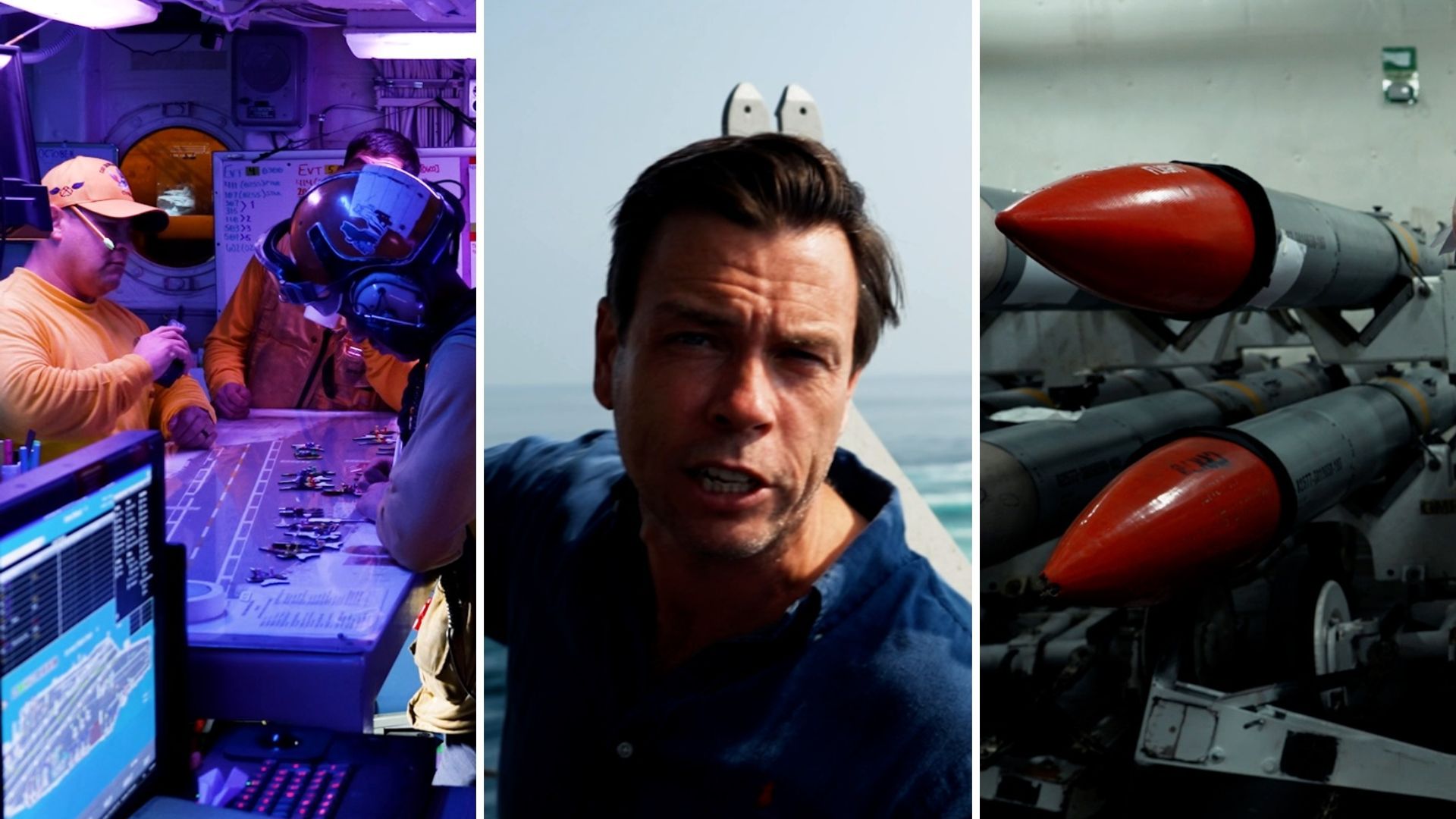
Watching a hundred-thousand-ton flattop haul pallets of aviation fuel and missiles across open water looks like raw invincibility. It is not. It is a symptom of an empire running on a tightrope.
Standard media coverage treats underway replenishment like a flexing bicep. Big ship. Big cranes. Helicopters buzzing between decks with crates of ordnance and gallons of JP-5 jet fuel. The lazy consensus says that because the United States Navy can transfer cargo while steaming at twelve to fifteen knots in contested waters, a carrier strike group is self-sustaining and ready for any fight.
That story sells clicks. It also gets naval logistics backward.
What Everyone Gets Wrong About Carrier Resupply
The usual assumption goes like this: once a carrier is topped off and "fully restocked," it becomes an unstoppable floating fortress. Pallets come aboard, magazines fill up, tanks hit capacity, and war readiness is checked off the list.
Logistics does not work like a smartphone battery hitting one hundred percent.
A nuclear-powered carrier does not need bunker oil to turn its propellers. Its twin reactors handle propulsion for years at a time. People hear "nuclear aircraft carrier" and assume the ship barely needs outside help. Wrong. Aviation fuel, munitions, spare parts, medical supplies, and food for roughly five thousand sailors burn down every single day of flight operations. Even nuclear propulsion cannot launch a Super Hornet or drop a precision-guided bomb.
Resupply at sea is not a sign of effortless dominance. It forces a warship to slow down, hold a predictable course and speed parallel to a supply ship or oiler, string heavy rigging or fuel probes across open ocean, and expose itself while non-combatant auxiliaries feed its appetite. In a high-end conflict against long-range anti-ship missiles, drones, and submarines, that choreography turns a peak moment of readiness into a glaring tactical vulnerability.
Stop Asking If the Carrier Is Restocked. Ask Who Feeds the Feeder
Whenever a video of a massive resupply operation goes viral, the public asks the same surface-level questions. How much food does it take? How many missiles fit below deck? How fast can sailors move pallets?
Those are parlor tricks. The real questions sit further back in the supply chain.
- Where do the supply ships and oilers come from? Military Sealift Command auxiliaries and dry cargo/ammunition ships carry the load, and there are never enough hulls to cover every theater simultaneously.
- Where do the munitions come from? Firing expensive standoff weapons or air-defense interceptors at high tempo can exhaust stockpiles faster than domestic factories replace them.
- Who protects the logistics tail? Every oiler and cargo ship needs escorts, fuel of its own, and safe transit corridors far from shore-based strike threats.
Imagine a scenario where a carrier strike group spends two weeks conducting sustained strike and air-defense sorties in a contested sea. Every night, flight decks launch and recover aircraft. Every few days, a replenishment ship pulls alongside to top off JP-5 and replace expended missiles and bombs. On camera, the carrier looks pristine and lethal. Behind the scenes, the replenishment ship has to sail back hundreds or thousands of miles to an ammunition depot or fuel hub to reload while defense contractors race to replenish specialized parts and munitions.
A carrier is only as sustainable as the logistics chain behind it. If the tail breaks, the teeth starve.
The Mechanics Behind Underway Replenishment
To understand why resupply at sea is both a triumph of seamanship and a strategic headache, strip away the drama and look at the actual physics and workflow.
Connected Replenishment and Vertical Replenishment
Naval planners rely on two primary methods to move goods while underway:
- Connected Replenishment (CONREP): Two ships steam side by side, typically separated by roughly 120 to 180 feet, matching speed and heading. High-tension steel spanwires carry sliding trolleys loaded with pallets of dry goods, spare parts, or ordnance from the supply ship to the carrier. Fueling rigs pass thick hoses across the gap to pump aviation fuel and ship fuel.
- Vertical Replenishment (VERTREP): Helicopters lift cargo off the deck of a supply ship and fly it to the carrier's flight deck or designated transfer spots, bypassing congested rigging lines and moving high-priority items quickly.
Both methods demand tight coordination, calm-enough sea states, disciplined deck crews, and zero room for sloppiness. A parted line, a fouled hose, or a mechanical failure mid-transfer can halt operations or cause serious injury.
The Hidden Bottlenecks
Deck crews get the spotlight because swinging heavy loads between moving hulls looks dramatic. Real logistics bottlenecks usually hide below decks and ashore.
- Magazine and stowage limits: Even a massive carrier has finite space for specific munitions, parts, and aviation fuel.
- Sortie generation trade-offs: Flight deck time is a zero-sum game. Every minute spent receiving cargo or managing flight movements around replenishment is time not spent generating combat or reconnaissance sorties.
- Transit distances: Operating far from friendly ports stretches replenishment cycles and multiplies the fuel burned just moving supply hulls back and forth.
Battle Scars From Trying to Out-Lift Reality
I have watched defense programs, logistics plans, and commercial supply chains get seduced by impressive-looking throughput numbers while ignoring surge capacity. Teams obsess over peak day metrics—how fast a pallet moves, how big a single shipment looks, how flashy a demo appears—and treat steady-state endurance as an afterthought.
When surge hits, peak-day theater falls apart.
In supply chains, whether civilian or military, throughput is how much moves through the system over time, while surge capacity is how much extra the system can deliver under stress without breaking. Analysts and commentators constantly confuse a dramatic one-off resupply or a high-output day with sustainable endurance.
Decades of naval strategy—from Alfred Thayer Mahan's focus on sea lines of communication to modern logistics debates analyzed by naval thinkers like Wayne Hughes and Milan Vego—point to the same unforgiving truth: fighting power at sea depends on sustainment. Even the best hardware fails if fuel, munitions, and repair parts run dry.
Where This Contrarian View Can Bite Back
Push the contrarian argument too far and you end up with a different kind of delusion: assuming carriers are fragile sitting ducks that cannot fight at all.
That overcorrection is just as wrong as the hype.
A carrier strike group is not a brittle glass cannon. It is a layered combat system with escorts, air and missile defense, intelligence sensors, nuclear endurance for propulsion, and unmatched mobile airpower projection over open water. Dismissing underway replenishment as a liability ignores how vital it is to keeping forward forces on station without begging every coastal nation for port access or airfield rights.
The honest balance is sharper than either extreme. Underway replenishment keeps the fleet in the game far from home—and simultaneously reveals how much work it takes just to stay in the fight.
Actionable Steps for Reading Defense and Supply Chain News
Stop letting dramatic footage do your thinking for you. Use these four checks whenever you read about a major military resupply or high-stakes logistics operation:
- Separate propulsion from mission fuel: Never confuse nuclear ship propulsion with infinite combat endurance. Always ask what burns down during active operations.
- Trace one step backward: Look past the hero asset on screen and ask which ships, depots, factories, or transport routes feed it.
- Watch the tempo, not just the tonnage: Big numbers mean less if consumption outpaces resupply over weeks rather than days.
- Separate capability from invulnerability: Respect the skill required to execute a complex operation at sea without pretending it erases risk.
Next time a headline claims a warship is "fully restocked" and ready for war, look past the cranes and ask how long the pipeline behind it can hold.