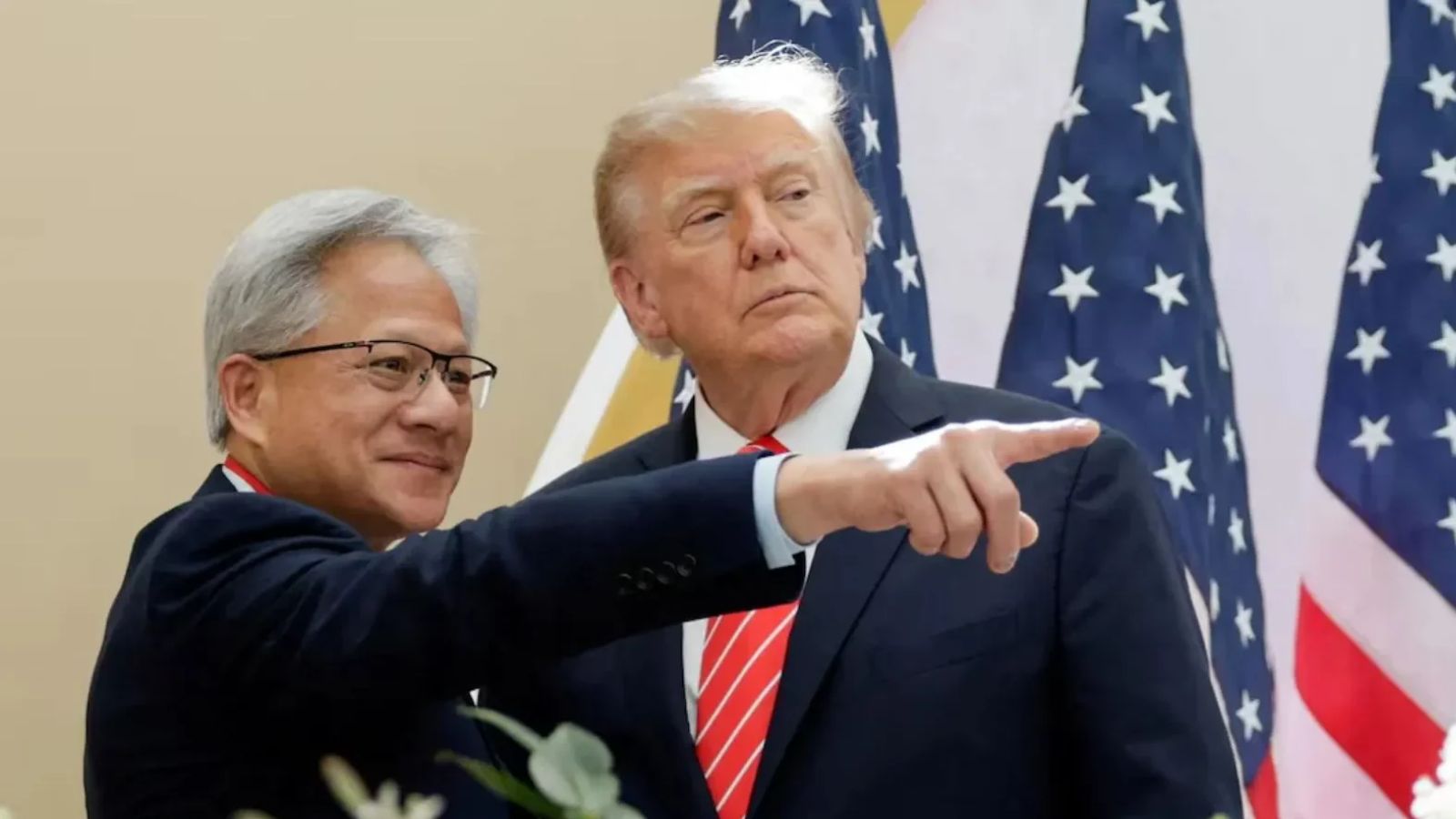
The political crowd wants a savior. They see a dip in market dominance, hear a soundbite about bringing back the legendary founder, and suddenly everyone is chanting for the return of the leather jacket.
They are completely missing the point.
First, let’s address the elephant in the room regarding the headline circulating in political circles: Jensen Huang is not an "ex-CEO" waiting in the wings like Steve Jobs in 1997. Whether the viral commentary stems from a slip of the tongue, a hypothetical scenario, or a misunderstanding of corporate governance, treating Nvidia's leadership as a simple "bring back the founder" switch ignores how modern semiconductor empires actually function. Even in a scenario where Huang had stepped away and was brought back by executive mandate or board panic, expecting a single charismatic leader to outmaneuver geopolitical gravity is a fairy tale.
Wall Street and Washington share the exact same blind spot. Both believe that hyper-scale technology companies are driven entirely by the sheer willpower of a founder-CEO. When things go right, the founder is a genius. When export controls tighten, supply chains fracture, and hyperscalers start building their own custom silicon, the pundits scream for a strongman to fix it.
It is lazy analysis. And if investors buy into the myth that one man is the sole engine of American AI supremacy, they are going to get burned.
The Myth of the Indispensable Founder
I have spent two decades watching enterprise hardware companies rise, bloat, and collapse. I have sat in boardrooms where executives burned hundreds of millions of dollars chasing a founder’s pet architecture long after the market had moved on.
Founders are built for zero-to-one warfare. They are paranoid, relentless, and willing to bet the entire company on a single roll of the dice. Jensen Huang did that multiple times—most notably when he bet Nvidia’s future on CUDA (Compute Unified Device Architecture), a proprietary parallel computing platform and programming model, years before deep learning became a commercial reality. At the time, Wall Street hated it. The margins were compressed, the R&D spend looked reckless, and nobody outside a few academic labs cared about general-purpose GPU computing.
Huang was right. He built a moat so deep that competitors spent a decade drowning in it.
But here is the uncomfortable truth nobody in Silicon Valley wants to admit: the exact traits that make a founder brilliant at building a monopoly become liabilities when the company becomes critical national infrastructure.
When your market cap crosses into the trillions and your hardware dictates the geopolitical balance of power, the job stops being about product vision. It becomes a grind of regulatory compliance, sovereign trade negotiations, and supply chain diplomacy. You cannot out-innovate an export ban. You cannot charisma your way past a lithography bottleneck at TSMC.
What the "Bring Him Back" Crowd Gets Wrong About Silicon
To understand why leadership worship fails here, you have to look at the actual mechanics of the AI hardware market. The consensus narrative treats Nvidia like a software company that happens to sell physical boxes. It isn't. It is a fabless semiconductor designer completely beholden to a fragile, hyper-concentrated physical supply chain.
Let’s look at the actual bottlenecks holding back AI deployment right now:
- Advanced Packaging Capacity: Even if you design the greatest chip on earth, it is useless without CoWoS (Chip-on-Wafer-on-Substrate), a high-precision packaging technology pioneered by TSMC that integrates logic dies with high-bandwidth memory. For over two years, packaging—not chip design—has been the hard ceiling on supply.
- High-Bandwidth Memory (HBM): AI accelerators are starved for data. Feeding them requires vertically stacked memory dies from a tiny oligopoly: SK Hynix, Samsung, and Micron. One yield issue in South Korea stalls server racks in Virginia.
- Power and Thermal Limits: Data centers are hitting the physical limits of the electrical grid. Modern racks pull over 100 kilowatts, forcing a messy, expensive transition from air cooling to direct-to-chip liquid cooling.
Notice what is missing from that list? The identity of the CEO.
Whether Jensen Huang is in the building, out of the building, or reinstated by a presidential decree, he cannot bend the laws of thermodynamics. He cannot magically conjure cleanroom capacity out of thin air in Arizona.
The Hyperscaler Rebellion Is Already Underway
The biggest threat to Nvidia—and by extension, American hardware dominance—isn't a lack of leadership. It is the economic reality of its biggest customers.
Right now, a massive portion of Nvidia’s revenue comes from a handful of tech giants: Microsoft, Meta, Alphabet, and Amazon. These companies are spending tens of billions of dollars on capital expenditures, and they are tired of paying a massive margin tax to a single vendor.
I have seen this exact movie play out in networking and storage. When one supplier captures too much of the value chain, customers do not passively accept it forever. They fund alternatives.
- Custom ASICs (Application-Specific Integrated Circuits): Google has been running its own TPUs (Tensor Processing Units) for years. Amazon is scaling Trainium and Inferentia. Microsoft has Maia. Meta has MTIA. These chips do not need to beat Nvidia’s flagship GPUs at everything; they just need to run specific internal workloads at a lower total cost of ownership.
- Open Software Ecosystems: The real moat was never the silicon; it was CUDA. Now, projects like OpenAI’s Triton, PyTorch 2.0, and the UXL Foundation are systematically abstracting away the hardware layer. Developers are writing code that compiles across multiple chip architectures without touching proprietary Nvidia libraries.
- The Inference Shift: Training massive frontier models requires immense, tightly coupled clusters where Nvidia dominates. Serving those models to users—known as inference—is a completely different workload. It prioritizes latency, power efficiency, and cost per token. That opens the door wide for specialized challengers like Groq, Cerebras, and AMD.
Political rhetoric framing Nvidia’s dominance as a simple matter of putting the right captain at the helm completely misses this structural erosion. You cannot stop four trillion-dollar customers from building their own chips by giving a great keynote speech in a leather jacket.
The Geopolitical Trap
When politicians chime in on corporate leadership, they view the company through the lens of national security. The logic goes like this: Nvidia is an American champion, China wants to catch up, therefore America needs Nvidia’s fiercest wartime CEO at the controls.
This is where the strategy backfires.
Every time Washington tightens export controls on advanced semiconductors to China, it does two things simultaneously. In the short term, it cuts off Nvidia from one of its largest historical markets, forcing the company to design nerfed, compliant chips that Chinese buyers increasingly reject. In the long term, it acts as the ultimate state-sponsored stimulus package for China’s domestic semiconductor industry.
Huawei isn't thriving in AI chips because it has better engineers than Nvidia. It is thriving because US policy handed it a captive domestic market with zero American competition. When Chinese tech giants like Baidu, Alibaba, and Tencent are barred from buying top-tier American silicon, they have no choice but to pour billions into domestic alternatives like Huawei’s Ascend series, tolerating lower yields and clunkier software until the domestic stack matures.
A CEO—even a legendary one—is caught in the crossfire of this policy. If the CEO pushes back against export restrictions to protect shareholder revenue, Washington accuses them of putting profits over national security. If they embrace the restrictions, they permanently surrender market share to foreign rivals who will eventually compete with them globally.
Calling for a founder's reinstatement as a silver bullet for US competitiveness is political theater. It distracts from the actual policy levers that matter: permitting reform for energy infrastructure, immigration pathways for specialized electrical engineers, and sustained funding for basic materials science.
Why Founder-Led Companies Eventually Stall
Let’s look at the counter-argument, because ignoring the upside of founder leadership would be intellectually dishonest.
Founder-led tech companies routinely outperform professionally managed ones over long horizons. Look at Lisa Su at AMD (a technical leader who operated with founder-like conviction to save the company from bankruptcy) or Mark Zuckerberg’s brutal "Year of Efficiency" pivot at Meta. Founders possess moral authority inside an organization. When a founder tells three thousand engineers to abandon a profitable product line and pivot to an unproven architecture, the engineers listen. A hired-gun MBA CEO tries that, and the middle management quietly sabotages the project until the CEO gets fired.
That is the real value of a leader like Huang. His flat organizational structure—where dozens of executives report directly to him without traditional layers of corporate insulation—allows information to travel at the speed of light. There are no curated slide decks hiding bad news. If a tape-out fails, he knows immediately.
Here is the downside nobody talks about: flat structures and founder-centric cultures do not scale infinitely without creating massive single points of failure.
When every major strategic decision funnels through one person’s intuition, the organization loses its ability to develop independent second-tier leadership. Look at what happened to Apple after Steve Jobs, or Disney after Bob Iger’s first exit, or Starbucks during Howard Schultz’s endless boomerangs. When a company relies on the myth of the indispensable founder, the board neglects succession planning. The executive bench atrophies.
If Nvidia—or any generational tech titan—actually needed its founder reinstated to survive, that wouldn't be a sign of strength. It would be proof that the founder failed at the most important job of a CEO: building an institution capable of outliving them.
What Investors and Operators Should Actually Watch
Forget the political noise. Forget the soundbites about who is sitting in the corner office or who ought to be put back there. If you want to know whether Nvidia—and the broader US AI hardware lead—will hold over the next five years, stop watching cable news and start tracking the metrics that actually move the needle.
- Gross Margin Compression: Watch Nvidia’s gross margins quarter over quarter. When margins sit above 75%, the company has absolute pricing power. The moment those margins slide toward the low 60s, it means custom hyperscaler ASICs and AMD’s Instinct accelerators are forcing price concessions. No CEO can talk margins back up once a commodity cycle begins.
- Data Center Power Hookup Timelines: Follow the utilities, not the chipmakers. If transformer lead times and grid interconnection queues remain stuck at three to five years, AI hardware demand will hit a brick wall regardless of how fast new GPU architectures launch.
- Developer Mindshare Outside CUDA: Pay attention to how many AI startups are deploying on non-Nvidia hardware in production. If major foundation model labs start training significant runs on alternative clusters without massive engineering friction, the software moat is officially breached.
- TSMC’s Geographic Diversification: Track the actual wafer yields and cost structures of fabs outside Taiwan. Until leading-edge nodes can be manufactured at scale in the US or Europe without a 30% to 40% cost penalty, the entire industry remains one geopolitical crisis away from a total halt.
Stop Looking for a Messianic CEO
The obsession with putting a specific individual back at the helm of a tech giant reveals a deep misunderstanding of how modern technology works. We love a hero narrative because complex systems are hard to understand. It is much easier to believe that one man in a leather jacket controls the fate of artificial intelligence than it is to grasp the mind-numbing complexity of extreme ultraviolet lithography, supply chain logistics, and sovereign trade wars.
Great leaders build the machine. Once the machine reaches planetary scale, physics, economics, and geopolitics take the wheel.
Stop betting on the savior and start watching the supply chain.