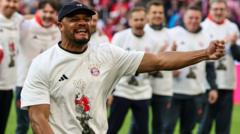
The rain in Munich doesn't just fall; it judges. On a Saturday night at the Allianz Arena, as the final whistle cut through the humid air, the sound wasn't just a signal of a game ending. It was the sound of a record shattering. Bayern Munich had done it. Again. A record-breaking Bundesliga title secured with the kind of clinical efficiency that makes rivals weep and statisticians scramble for new adjectives.
But if you looked closely at the faces in the technical area, you didn't see the frantic, unburdened joy of an underdog. You saw relief. You saw the grim satisfaction of a master craftsman who had just avoided a catastrophic mistake.
To understand why a record-breaking domestic title feels like a deep breath rather than a scream of triumph, you have to look back at the scars. In the footballing soul of Bavaria, there is a phantom pain known as the Finale dahoam. In 2012, Bayern lost the Champions League final in their own stadium. It was a trauma that reshaped the club’s DNA. It turned them from a team that wanted to win into a machine that refused to lose.
The Weight of the Shield
Winning the Bundesliga is often described by outsiders as a foregone conclusion. They see the financial gap, the depth of the squad, and the history, and they dismiss the achievement as "business as usual." That perspective misses the human cost of being the favorite.
Imagine being Thomas Müller. You have won everything. Your trophy cabinet is more a warehouse than a shelf. Every time you step onto the pitch, the baseline expectation is perfection. Anything less than a three-goal margin feels like a crisis. When the media talks about "The Bayern Pressure," they aren't talking about a metaphor. They are talking about the physical sensation of 75,000 people expecting you to dominate, every single week, without fail.
This season wasn't a cakewalk. It was a marathon run at a sprinter’s pace. The statistics tell one story—most goals scored, fewest conceded, the earliest title clinch in history—but the eyes of the players tell another. They tell a story of grueling Tuesday morning tactical sessions where the manager, sweating through his tracksuit, demanded a level of pressing that felt borderline masochistic.
The record isn't just a number. It is a shield against the creeping fear of irrelevance.
The Architect in the Shadows
In the middle of this triumph stands the manager. In the modern game, the coach is often treated like a replaceable part in a high-performance engine. But this season, the leadership felt different. It wasn't just about the 4-2-3-1 formation or the high defensive line. It was about managing the egos of multi-millionaires who have already won it all.
Think of a hypothetical youth player, let’s call him Lukas. Lukas has grown up in the Bayern academy. He has seen legends come and go. For him, the first team isn't a group of athletes; they are icons of a standard he can barely grasp. When he watches the veterans celebrate this record-breaking win, he sees the secret. They don't celebrate the trophy. They celebrate the fact that they didn't let the standard slip.
The manager’s greatest trick this year wasn't a tactical innovation. It was convincing players who have ten league titles that the eleventh one matters just as much as the first. He tapped into that primal, human desire to be the best to ever do it. He didn't ask them to win the Bundesliga; he asked them to make it impossible for anyone else to ever catch them.
The Invisible Stakes of the Treble
Now, the conversation shifts. The trophy is hoisted, the beer showers have soaked the suits, and the fans are singing into the night. But in the locker room, the air is already changing. The word "Treble" isn't a dream anymore. It’s an assignment.
The Treble—winning the league, the domestic cup, and the Champions League in a single season—is the Everest of European football. Only a handful of teams have ever touched that peak. For Bayern, it is the only way to truly silence the critics who say the Bundesliga is "too easy."
The stakes are invisible because they are internal. If Bayern wins the league but falls in the Champions League semi-finals, the season is labeled a failure by the local press. That is the madness of the elite. You are playing a game where the only acceptable outcome is total, continental conquest.
Consider the physical toll. The muscles don't care about records. The hamstrings of a world-class winger are frayed wires held together by grit and high-end physiotherapy. Every sprint in the 80th minute of a dead-rubber league game was a gamble taken to ensure this moment of domestic glory. Now, they have to do it all over again against the giants of Madrid, London, or Paris.
The Anatomy of a Dynasty
Why do we care about a team that wins all the time? Is it boring? Some say yes. They argue that Bayern’s dominance is "killing" the league.
But there is a different way to look at it. There is a beauty in witnessing the absolute limit of what a collective can achieve. When you watch this team move the ball, you aren't just watching a sport. You are watching a decade of institutional knowledge. You are watching a club that turned a 2012 heartbreak into a 2026 juggernaut.
The fans who fill the stands don't go there expecting a miracle. They go there to witness a standard. They want to see the Red Machine operate at 100% capacity. They want to see the record-breaking win because it confirms that their world is in order. In an uncertain world, Bayern Munich winning the Bundesliga is a constant. It is the North Star of German football.
The Ghost of 2012
As the players headed toward the fans to celebrate, many of them walked past the tunnel where the 2012 heartbreak happened. That memory is the fuel. It is the reason they don't stop at 2-0. It is the reason they broke the points record. It is the reason they are already thinking about the next final.
The record-breaking title is a masterpiece, but in the minds of these players, it is merely the frame. The painting itself—the Treble—is still being colored in.
Success at this level is a lonely place. There are no peers, only challengers. There is no rest, only the next kickoff. The celebration will be short. By Monday morning, the analytics will be out, the film will be rolling, and the hunt for the next trophy will begin.
The rain in Munich eventually stopped. The lights at the Allianz dimmed, leaving the stadium glowing like a red ember in the dark Bavarian night. The record was in the books. The history was made. But the hunger remained.
Winning isn't an event for this club. It's a pulse. And tonight, that pulse was faster than ever.