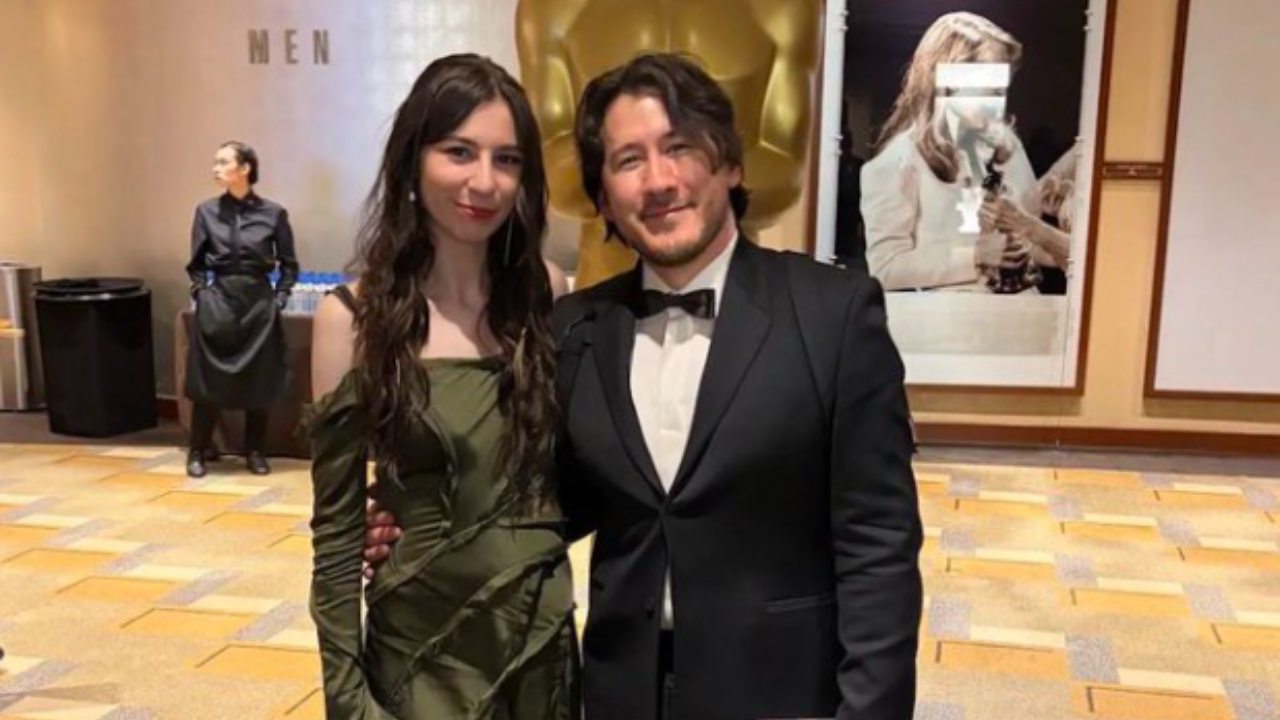
The Dolby Theatre breathes a specific kind of recycled air on Oscar night. It smells of expensive lilies, industrial-strength hairspray, and the frantic, electric ozone of a thousand cameras firing at once. This is the traditional altar of celebrity. For nearly a century, if you weren't walking that velvet gauntlet under the blinding glare of the flashbulbs, you simply didn't exist in the eyes of the cultural elite.
But this year, the most deafening sound at the Academy Awards wasn't the applause for a Best Picture winner. It was the silence of a missing person. Expanding on this theme, you can find more in: How The Pitt Finally Gets the Chaos of Psychosis Right.
Mark Fischbach—known to tens of millions as Markiplier—wasn't there. He wasn't in a tuxedo. He wasn't dodging questions about "who he was wearing." He wasn't even in the building. Yet, as the A-list elite pivoted for the lenses, the digital world was obsessed with his absence. The internet didn't just notice he was missing; it staged a digital sit-in.
This isn't just a story about a YouTuber skipping a party. It’s a autopsy of the old world’s ego. Analysts at Variety have provided expertise on this matter.
The Invisible Guest
To understand why a missing gamer caused more digital friction than the actual awards, you have to look at the math of modern devotion. Imagine a hypothetical theater. In this theater, every seat is filled by someone who has spent at least one hour every day for the last decade listening to one specific voice. That voice has guided them through bouts of depression, late-night study sessions, and the mundane loneliness of the digital age.
That theater wouldn't fit in Los Angeles. It wouldn't fit in California. Markiplier commands an audience of over 36 million subscribers. That is not a "fanbase." It is a mid-sized nation-state with its own customs, inside jokes, and a fierce, protective loyalty that traditional movie stars haven't felt since the Golden Age of Hollywood.
The controversy began with a whisper. Rumors had swirled that Markiplier, having transitioned into the high-stakes world of feature filmmaking with his upcoming project Iron Lung, would make his "official" debut into the Academy’s graces. The red carpet was supposed to be his coronation. The moment where the "Internet Person" became a "Real Person."
Then, the carpet rolled up. The lights dimmed. Mark was nowhere to be found.
The reaction was immediate and visceral. On X, TikTok, and Reddit, the sentiment wasn't just disappointment—it was a feeling of systemic exclusion. Fans didn't see a creator skipping an event; they saw an institution failing to recognize the changing of the guard. They saw a wall built of limestone and tradition that refused to let the new world in.
The Friction of Two Worlds
We are currently living through a tectonic shift in what it means to be "known."
In the old world—the world of the Oscars—fame is granted. It is a gift bestowed by studios, publicists, and secret committees. You climb a ladder, you play the game, and if you are very lucky and very compliant, you are invited to walk the carpet.
In the new world—Mark’s world—fame is built. It is a grueling, decade-long conversation between a creator and an audience. There are no gatekeepers. There is only the "Upload" button and the terrifying honesty of the comments section.
When the Oscars "snub" or overlook a figure like Markiplier, they aren't just ignoring one man. They are telling 36 million people that their time, their attention, and their emotional investment don't count as "cinema."
Consider the irony. While the Academy struggles with dwindling ratings and a desperate, sweating need to remain "relevant" to a younger demographic, they have a figure like Fischbach sitting right there. He is a man who has raised millions for charity, directed his own films, and maintained a scandal-free career in a medium designed to produce car crashes. He is the personification of the engagement they crave.
Yet, the gap remains.
Why? Because the old world is terrified of the lack of control. On the red carpet, every move is choreographed. Every interview is a pre-approved soundbite. A creator like Markiplier is a wild card. He doesn't need the Academy’s validation to fill a theater. He doesn't need a studio head to greenlight his dreams.
That independence is a threat.
The Iron Lung and the Weight of Expectation
There is a deeper, more human layer to this absence that the "controversy" headlines miss. Markiplier hasn't just been sitting on his hands. He has been submerged in the production of Iron Lung, a self-funded, self-directed horror film based on the indie game of the same name.
Think about the stakes of that for a moment.
He is a man who could have spent the rest of his life reacting to scary games and making a comfortable, astronomical living. Instead, he chose the sweat and the blood of production. He chose to bleed his own money into a project to prove that a "YouTuber" can master the craft of traditional filmmaking without the permission of the silver-screen elite.
The absence at the Oscars might not have been a snub at all. It might have been a choice.
There is a specific kind of exhaustion that comes with true creative obsession. When you are deep in the edit, when you are color-correcting frames at 4:00 AM, when the weight of a multi-million dollar independent production is resting entirely on your shoulders, a red carpet doesn't look like an opportunity. It looks like a distraction. It looks like a costume party for a club you aren't sure you want to join anyway.
The "controversy" assumes that every creator is dying for a seat at the Oscars' table. We rarely stop to ask if the table is even worth sitting at anymore.
The New Prestige
The fans who were "outraged" by his absence were actually expressing a profound insecurity we all share: the fear that the things we love aren't "legitimate."
We want the Oscars to recognize Markiplier because we want the world to recognize us. We want the hours we spent watching him to be validated by an "official" body. We want the 1920s to shake hands with the 2020s and tell us we aren't wasting our lives.
But the reality is far more interesting.
The Oscars need Markiplier infinitely more than Markiplier needs the Oscars. The red carpet is a narrow strip of fabric. The internet is an infinite ocean. While the Academy debates which period piece had the best costume design, a new generation is busy building its own studios, its own distribution networks, and its own myths.
The invisible stakes of this "absence" are the future of storytelling itself. If the institutions that celebrate art cannot find a way to bridge the gap between a silver screen and a smartphone screen, they will eventually become a museum of a dead language.
They will be the beautiful, gilded lobby of a hotel that no one stays in anymore.
The Ghost in the Machine
Late that night, after the statues had been handed out and the after-parties were in full swing, the digital chatter didn't die down. It morphed. It became a celebration of the absence.
Fans began sharing clips of Mark’s old videos, his moments of vulnerability, his goofy laughs, and his intense, focused updates on his film. They realized that they didn't need to see him in a tuxedo to know he was successful. They didn't need a 70-year-old actor to announce his name to know he was important.
The controversy evaporated, replaced by a strange, quiet pride.
The "Red Carpet Ghost" had sent a message without saying a word. You don't have to show up to the party to be the most important person in the room. You just have to build a room of your own.
Somewhere in a dark editing suite, far away from the flashbulbs and the forced smiles, a man sat in front of a monitor. He wasn't thinking about the Best Picture winner. He was thinking about a frame, a sound, a story. He was working.
The cameras were all pointed at the Dolby Theatre, but the future was happening in the dark, lit only by the glow of a computer screen.