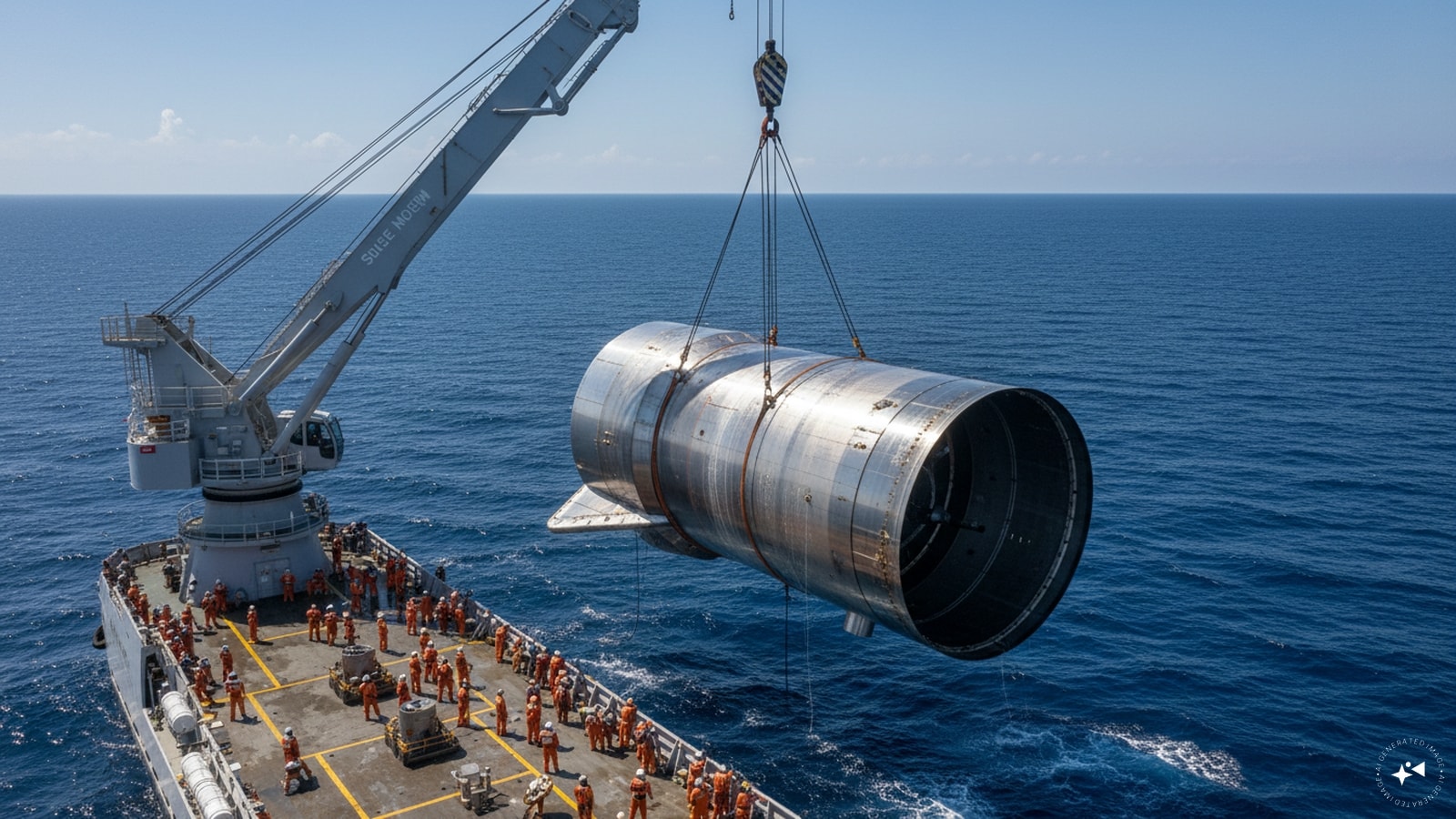
People laughed when rockets splashed down into the ocean and sank forever. It felt wasteful. It felt like an expensive dead end in the race for orbital dominance. Then SpaceX dragged a battered, salt-crusted Starship out of the Indian Ocean a month after flight, put it on a cargo ship, and started hauling it back to Texas.
That single move alters the economics of heavy-lift rocketry.
If you think Starship is just another rocket, you aren't paying attention. Most aerospace analysts missed the true significance of this maritime recovery operation. They focused on the dramatic telemetry feeds and the fiery explosions during reentry. They missed the dirty, grueling reality of hardware recovery. Space isn't just won on the launchpad. It is won in the teardown bay.
The Brutal Reality of Ocean Salt and Titanium
Saltwater is brutal. It eats welds, ruins sensitive electronics, and turns expensive aerospace-grade alloys into expensive lawn ornaments. When Starship executed its controlled splashdown in the Indian Ocean, engineers knew the vehicle would take a beating.
Yet, bringing that steel hull back to McGregor or Starbase gives SpaceX something money can't buy. Real flight data.
You can run CFD simulations until your servers melt. You can test thermal protection tiles in plasma wind tunnels all year long. None of that replaces putting a physical object through the actual hell of orbital reentry, dunking it in cold seawater, and inspecting the structural fatigue with your own eyes.
SpaceX doesn't learn from pristine CAD models. They learn from scorched steel.
When teams cracked open the recovered sections back in Texas, they checked how the secondary heat shield tiles held up under extreme hydrodynamic loads. They measured thermal soak. They checked where the plasma tried to sneak past the flaps. Every scorched square inch tells a story about what works and what completely fails when you push stainless steel past Mach 25.
Why Orbital Refueling Depends on This Scrap Metal
You cannot go to Mars with a single-use rocket. It is mathematically impossible unless you want to bankrupt entire nations for a single payload. Full and rapid reusability is the holy grail.
Critics love to point out that Starship keeps blowing up or getting dented. They miss the iteration cycle entirely. While old-school aerospace contractors spend a decade designing a bolt, SpaceX builds ten prototypes, launches three, blows up two, and recovers the wreckage of the last one to build a better version next Tuesday.
Recovering this ship from the Indian Ocean proves that even when things don't go according to plan—even when a ship has to ditch in the water instead of catching on the Mechazilla arms—the vehicle can still be secured, salvaged, and autopsied.
Mars missions require orbital refueling depots. You have to launch tankers repeatedly, dock them in low Earth orbit, and pump super-chilled propellants back and forth. To make that economically viable, the ships doing the hauling have to be inspected, serviced, and flown again within days.
Studying this ocean-recovered booster helps engineers understand fatigue limits. How many times can a steel frame endure the thermal shock of reentry before micro-fractures compromise the pressure vessel? You can't guess that number. You have to harvest the metal and look at the grain structure.
The Competitive Panic Nobody is Talking About
Traditional aerospace is sweating right now. For decades, the industry operated on cost-plus contracts. If a rocket cost three billion dollars and took six years to build, the customer just paid the bill.
SpaceX operates on a brutal iterative loop. They treat orbital-class hardware like prototype race cars. When a rival company sees a charred Starship hoisted onto a barge after surviving a hypersonic plunge, they aren't looking at trash. They are looking at a decade-long competitive lead vanishing in real time.
Look at the hardware specs. Starship relies on Raptor engines burning liquid methane and liquid oxygen. Methane burns cleaner than kerosene, meaning less soot buildup in the turbopump internals. That helps with rapid turnaround. But does the plumbing survive salt spray intrusion during a water landing? This recovery answered that exact question.
If you want to understand why SpaceX keeps breaking launch cadence records, look right here. They don't wait for perfection. They launch, they break things, they collect the pieces from the middle of the ocean, and they fix the blueprint before the sun comes up.
What Happens Next in Starbase
The recovered hardware is currently sitting in a high bay being sliced apart for metallurgy testing. Every sensor, every actuator, and every weld is under a microscope.
Expect the next batch of prototypes to feature subtle, invisible upgrades based on what engineers find in this wreckage. Thicker thermal blankets in specific shear zones. Better seals on the actuation motor housings. Different alloy blends in the aerodynamic control surfaces.
The public wants flashy orbital captures every single time. Real engineers want the messy wreckage because that is where the actual engineering happens. Starship is growing up through trial, error, and deep-sea salvage. Stop betting against the guys who are willing to drag their mistakes out of the ocean and weld them into the next generation.



