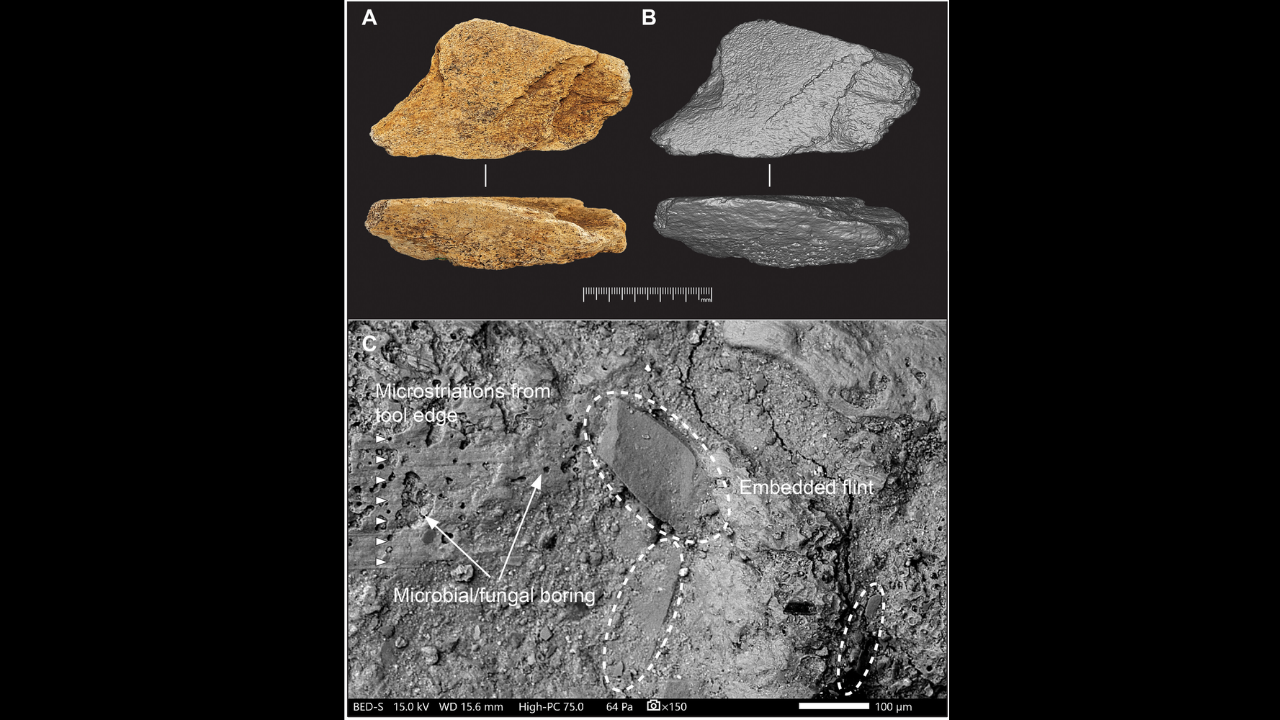
The recovery of a 500,000-year-old elephant bone tool from the marine silt deposits at Boxgrove in West Sussex demands a complete structural reevaluation of early human technological capability. Rather than treating this artifact as an accidental byproduct of raw butchery activity, technical analysts must evaluate the specimen through the lens of material science and intentional manufacturing optimization. The tool demonstrates an advanced, codified understanding of mammalian cortical bone mechanics, specifically anisotropic fracture resistance and controlled energy transfer during percussion flaking. This evaluation deconstructs the physical constraints, operational sequences, and energetic trade-offs that characterize this early hominin intervention, establishing a baseline for how archaic populations solved complex manufacturing bottlenecks long before the Upper Paleolithic.
The Physical Constraints of Megafauna Substrates
Mammalian bone is not a homogeneous medium. It operates as a natural composite material composed of a flexible collagen protein matrix reinforced by rigid hydroxyapatite mineral crystals. When evaluating a half-million-year-old artifact crafted from the leg bone of a straight-tusked elephant, the baseline material properties dictate the entire manufacturing boundary conditions. Elephant long bones possess exceptionally thick cortical walls designed to support massive dynamic loads across varied locomotor cycles. This structural density introduces specific engineering challenges for any hominin artisan attempting to shape the material.
Unlike flint, chert, or obsidian, which exhibit isotropic fracture properties and conchoidal breakage patterns predictable under Hertzian indentation, bone displays significant mechanical anisotropy. Its tensile strength differs markedly from its compressive strength, and its fibrous grain structure tends to deflect crack propagation away from desired trajectories. To bypass these physical limitations, an early human manufacturer had to account for variable moisture content, organic degradation rates, and internal stress gradients within the fresh skeletal element. If the bone was too dry, it shattered uncontrollably into unusable splinters; if it was excessively green or saturated, the material absorbed impact energy without fracturing cleanly along the intended cleavage plane.
The Boxgrove artifact reveals an acute operational awareness of these constraints. The maker did not treat the bone as an improvised hammerstone or a simple discard. Instead, the piece exhibits targeted shaping that aligns with the longitudinal axes of the osteons, maximizing structural integrity along lines of high mechanical stress. The preservation of specific negative scar attributes indicates that the artisan selected skeletal sections with optimal density profiles prior to impact application.
Operational Sequence of Bone Reduction
The production of a functional bone implement requires a strict sequence of operational decisions, structurally analogous to modern industrial manufacturing workflows. This reduction sequence involves raw material acquisition, primary processing, secondary shaping, and final edge maintenance.
- Raw Material Selection: The artisan bypassed smaller cervid or bovid bones in favor of massive elephant elements, targeting specific anatomical sections with optimal cortical thickness-to-weight ratios to ensure maximum energy transfer during use.
- Initial Preparation: Systematic removal of soft tissue, periosteum, and greasy trabecular marrow cavities to stabilize the substrate and prevent microbiological decay or slippage during the shaping phase.
- Controlled Percussion: Application of heavy hammerstones to detach large flakes or shape the perimeter through direct hard-hammer percussion, mimicking traditional lithic reduction strategies but modified for elastic-plastic material deformation.
- Finishing and Retouch: Secondary retouch via soft-hammer or controlled pressure application to create working edges capable of sustained shearing, chopping, or scraping operations without immediate edge collapse.
Each step in this sequence requires continuous feedback loops. If an impact fails to propagate a clean fracture through the dense cortical layer, the artisan must alter the striking angle, adjust the backing support, or modify the core geometry. The presence of standardized scars on the Boxgrove specimen indicates that these feedback loops were mastered, resulting in a repeatable output rather than an erratic, opportunistic anomaly.
Energetic Efficiency and Resource Allocation
Every technological choice involves a cost function balancing energy expenditure against functional return. Procuring and processing an elephant carcass in the Middle Pleistocene required coordinated group labor, significant caloric investment, and exposure to intense ecological competition from large carnivores.
The decision to invest further cognitive and physical energy into manufacturing a bone tool from this carcass must be evaluated through economic efficiency frameworks. Flint was locally abundant in the West Sussex raised beach deposits where Boxgrove is situated. If stone tools were readily available and technically superior in edge retention for simple cutting tasks, why manufacture a bone handaxe or scraper?
The answer lies in specialized functional performance metrics:
- Shock Absorption: Bone absorbs high-velocity impact energy better than brittle flint, reducing the risk of catastrophic tool failure when applied to heavy-duty percussion tasks such as butchering dense hide or breaking major skeletal joints.
- Interface Friction: The surface chemistry and micro-texture of worked bone interact differently with organic materials, preventing the binding or wedging common in flat stone profiles during deep incision work.
- Repairability: Bone tools can be reshaped, ground down, or resharpened using abrasive sandstone blocks, extending the active lifecycle of the implement beyond the typical failure threshold of brittle lithics.
By trading the immediate convenience of raw flint for the complex processing requirements of elephant bone, early humans optimized for task-specific durability rather than initial fabrication speed.
Technical Attribution and Cognitive Capacity
Attributing this level of technological sophistication to Homo heidelbergensis refines our understanding of archaic cognitive architecture. Traditional anthropological models often framed Middle Pleistocene hominins as reactive foragers reliant on hardwired behavioral repertoires. The Boxgrove artifact dismantles this linear assumption.
Executing a multi-stage bone reduction sequence demands forward planning, working memory capacity, and abstract spatial reasoning. The artisan had to visualize the final three-dimensional form of the tool while staring at an irregular, curved segment of an elephant femur or tibia. This mental projection requires abstract mapping between two entirely different material domains—transferring the conceptual geometry traditionally applied to stone knapping onto a biological, viscoelastic medium.
Furthermore, the presence of standardized tools at Boxgrove implies social transmission of technical knowledge. Such specialized operational sequences are rarely invented independently by isolated actors without cumulative cultural mechanisms. The consistency observed in the manufacturing signatures points toward shared pedagogical frameworks where younger members of the group learned complex material processing techniques through observation, emulation, and guided practice.
Strategic Implications for Pleistocene Technological Evolution
The isolation of single spectacular finds often distorts public perception, framing them as historical anomalies. From a systemic perspective, the Boxgrove bone tool represents a predictable inflection point in hominin evolutionary adaptation. As early human groups expanded their ecological niches into seasonal, cold-temperate European environments, their reliance on high-caloric animal resources intensified.
This dietary shift created an evolutionary pressure gradient. Toolkits could no longer remain static or rely exclusively on basic stone technology when processing massive, thick-skinned fauna. The innovation was not merely the accidental utilization of a broken bone, but the systematic codification of bone as a primary industrial material. Future archaeological assessments of Middle Pleistocene sites must look beyond lithic assemblages, measuring technological complexity through integrated material indices that capture both stone and osteological processing economies.
Operational deployment of osteological toolkits requires establishing multi-tier supply chains where faunal remains are selectively curated during butchery events for subsequent industrial transformation rather than immediate nutritional discard.