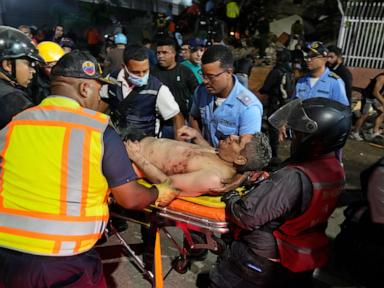
Two powerful earthquakes measuring 7.2 and 7.5 magnitude struck northern Venezuela on Wednesday evening, killing at least 32 people and injuring more than 700 according to early government reports. The initial tremors originated near the coastal town of Morón, collapsing buildings in Caracas and turning the nearby coastal region of La Guaira into what officials call a disaster zone. While international promises of aid have begun pouring into the country, the true scale of the devastation remains obscured by severe communication blackouts and a crippled domestic infrastructure.
The immediate counts released by acting President Delcy Rodríguez deliberately excluded La Guaira. This coastal strip, situated just 19 miles north of the capital, bore the brunt of the shockwaves. Entire multi-story residential blocks have pancake-collapsed, leaving rescue crews and local citizens to claw through heavy concrete debris with standard power tools and bare hands. The official death toll will inevitably skyrocket as communication links are slowly restored.
The Anatomy of a Seismic Doublet
What happened along the Caribbean coast was not a standard earthquake followed by typical aftershocks. Seismologists classify the event as a seismic doublet. Two massive tectonic fractures occurred less than sixty seconds apart, a phenomenon that confounds standard disaster response models. The first 7.2 magnitude event fractured at a depth of 22 kilometers. While the ground was still convulsing, a second, more destructive 7.5 magnitude quake tore through a shallower fault line just 10 kilometers beneath the surface.
Shallow earthquakes inflict far greater surface destruction because the seismic energy has less rock to travel through before hitting structures. The U.S. Geological Survey noted that the overlapping wave signals made it exceptionally difficult to instantly isolate the epicenters. The rapid succession meant that structures weakened by the first shock wave were instantly obliterated by the second.
Buildings do not just fall down. They shatter when subjected to reverse-phase acceleration before they can settle from an initial impact. In neighborhoods like Altamira and Los Palos Grandes in Caracas, witnesses described seeing walls sheer completely off, exposing intact living rooms to the open air before the remaining supports gave way. Plumes of thick gray concrete dust rose above the capital, choking the streets where thousands of panicked residents gathered after fleeing their homes.
The Fragility of an Unprepared Capital
Caracas is structurally vulnerable.Decades of erratic enforcement of building codes, combined with economic stagnation, have left the city filled with high-density structures that cannot withstand sustained lateral ground movement. The problem is split between two distinct urban environments: the unregulated hillside barrios and the older concrete high-rises in the valley center.
The hillside slums comprise thousands of self-built brick and cinderblock homes stacked precariously on top of each other. These structures lack steel reinforcement bars or proper foundational tie-ins to the bedrock. When a 7.5 magnitude quake hits, these hillsides risk massive soil liquefaction and landslides, causing entire communities to slide downward. In the formal sectors of the city, many apartment complexes built during the oil booms of the late twentieth century have suffered from prolonged maintenance neglect. Concrete carbonates over time, losing its internal structural integrity and rusting the internal rebar support networks.
The primary transport hub for international aid is entirely out of commission. Simón Bolívar International Airport in Maiquetía suffered extensive structural damage to its runways and terminal buildings, forcing an immediate and indefinite closure. Without this critical gateway, heavy international rescue machinery and medical teams cannot land near the capital, forcing incoming assistance to rely on severely damaged highways or distant regional ports.
The Mirage of International Aid
Promises of assistance arrived quickly from foreign governments. The United States announced the mobilization of a disaster assistance team, while regional neighbors including Colombia, Brazil, Ecuador, and Chile offered search and rescue personnel and medical supplies. Even distant nations like Qatar, India, and China pledged immediate humanitarian intervention.
Logistics tell a very different story than political press releases. Getting aid into a nation with a paralyzed transport network and an ongoing political transition is a monumental hurdle. Roads leading from the coast to the valley of Caracas are carved into steep mountainsides. These routes are currently blocked by massive rockfalls triggered by the twin tremors.
Emergency aid distribution requires a highly coordinated domestic command structure. The Venezuelan government currently lacks the operational transport fleets, fuel reserves, and heavy earth-moving machinery required to clear paths and distribute incoming goods effectively. International teams arriving at the borders will encounter a bottleneck of paperwork, fuel shortages, and broken supply lines. Past humanitarian crises in the region demonstrate that without local logistical capacity, pallets of medical supplies often sit rotting on airport tarmacs hundreds of miles away from the people who need them.
The Realities on the Ground
In the immediate aftermath of the disaster, regular citizens have become the primary first responders. Lacking specialized acoustic listening devices or thermal imaging equipment, neighbors are organizing bucket brigades to clear heavy rubble. They are using car jacks, crowbars, and hammers to reach individuals trapped under collapsed roofs.
The domestic medical system was already under immense stress before the tectonic plates shifted. Public hospitals face chronic shortages of basic antibiotics, surgical sterile water, and reliable electrical power. The sudden influx of hundreds of severely injured patients has completely overwhelmed the remaining emergency rooms in Caracas and Maracay. Doctors are performing triage in parking lots under the headlights of idling vehicles because internal structural cracks have made the hospital buildings themselves unsafe to occupy.
Power grids across northern Venezuela failed instantly when the first quake severed major high-voltage transmission lines. Cell phone towers lost backup battery power within hours, plunging a terrified population into an information vacuum. Families cannot verify if their relatives are alive, and municipal authorities cannot coordinate rescue deployments between different sectors of the city. The state of emergency declared by the executive branch provides the legal framework for martial law and resource requisition, but it cannot instantly manifest the physical tools needed to restore basic human survival infrastructure.
The tectonic threat is far from over. Seismologists warn that more than twenty significant aftershocks have already rattled the region, and further structural collapses are highly probable. Weakened buildings that managed to survive the initial doublet remain structurally compromised, threatening to cave in on unsuspecting rescue teams or residents attempting to salvage belongings. The immediate focus remains on the survival window for those trapped beneath the concrete, a window that closes rapidly with each passing hour amid water shortages and tropical heat.