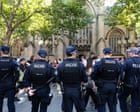
Twenty-five political demonstrators will stand trial together in a Sydney courtroom next year, a sweeping legal maneuver that has fundamentally shifted the battle over free speech and state overreach in New South Wales. The decision to grant a joint hearing inside the Downing Centre Local Court transforms a series of isolated minor offenses into a coordinated constitutional showdown over how Australia polices dissent. It directly targets the legality of extraordinary police powers deployed during the February 2026 visit of Israeli President Isaac Herzog, exposing deep fissures in the state's legal framework.
What began as a chaotic public clash outside Sydney Town Hall has evolved into a high-stakes corporate and civil liberty dispute. Defense lawyers successfully argued that the individual cases share common factual and legal roots, paving the way for a massive six-week trial slated for July 2027. High-ranking officials, including NSW Police Commissioner Mal Lanyon and state parliamentarians, are expected to be called to the witness stand. By attempting to efficiently process dozens of activists facing charges like resisting arrest and assaulting police, the state has inadvertently built a unified stage for its own policing methods to be put on trial.
Shifting Ground and Truncated Power
The upcoming joint trial hinges on a crucial legal reality: the statutory foundations used to justify the initial police crackdown have already buckled. On the night of the February demonstrations, authorities treated the assembly as unauthorized. Police relied heavily on a sweeping public assembly restriction law rushed through parliament following a tragic mass stabbing at Bondi Beach late the previous year. That legislation effectively criminalized unapproved marches across critical corridors of the Sydney central business district.
The legal reality shifted dramatically two months later. In April 2026, the NSW Court of Appeal struck down those anti-protest provisions, declaring them unconstitutional after a challenge brought by civil liberties advocates and the Palestine Action Group.
This creates an immense headache for police prosecutors. Defense counsel Felicity Graham has made it clear that because the underlying restrictive law was invalid, the protesters' original formal notification of intent to march from Town Hall to Parliament House should have stood as an authorized public assembly. If the march was lawful from its inception, the entire justification for the aggressive physical dispersal of the crowd collapses.
Weaponizing the Major Events Act
Beyond the defunct anti-protest laws, the trial will put a harsh spotlight on the state's expanding reliance on the Major Events Act. Originally designed to manage crowd safety, traffic, and commercial interests during international sporting matches or massive cultural festivals, the Act was invoked by the state government to fortify security during Herzog’s official visit.
The mechanism provides police with broad, discretionary authority within designated geographic zones, including:
- Extensive, warrant-free stop-and-search powers for anyone entering the zone.
- The power to demand personal identification without traditional reasonable suspicion.
- The authority to issue immediate "move-on" directives backed by steep fines of up to $5,500.
Human rights monitors argue that utilizing commercial event legislation to suppress political demonstrations is a dangerous form of legal mission creep. It bypasses the traditional checks and balances required for standard public policing, swapping individual suspicion for geographic blanket authority. By merging twenty-five separate cases into one, the defense can systematically dismantle the validity of using these commercial crowd-control tools to handle complex geopolitical protests.
Accountability and the Admissibility Battle
The collective nature of this trial will also force a public reckoning regarding the level of force used on the streets. The Law Enforcement Conduct Commission is already independently investigating allegations of police brutality stemming from that February night. Independent observers and human rights groups documented incidents of pepper spray deployment, physical strikes, and aggressive crowd dispersion techniques that appeared heavily disproportionate to the actions of a static crowd.
In a standard courtroom setup, a single defendant alleging police misconduct faces an uphill battle; it often becomes their word against that of multiple uniform officers. A joint trial completely alters that dynamic. The defense intends to challenge the admissibility of police evidence across the board, citing a systemic, unlawful response by the state on the night. When twenty-five distinct cases are heard together, patterns of behavior become impossible to dismiss as isolated incidents or rogue officers reacting under pressure.
Police prosecutors strongly fought against the joint trial format, arguing that individual variations in behavior—such as specific allegations of physical resistance or property damage—would complicate the proceedings. Their resistance speaks to a deeper tactical anxiety. It is far simpler for the state to secure quick convictions by isolating defendants one by one than it is to defend the systemic legality of an entire operational deployment under a single, sustained judicial microscope.
The pre-trial arguments set for March 2027 will determine exactly how far the defense can go in questioning the political motivations behind the deployment. With members of parliament and the police commissioner on the witness list, the state cannot treat this as a routine public order matter. The Downing Centre Local Court is no longer just deciding whether two dozen individuals failed to follow a police order; it is deciding whether the state itself stepped outside the boundaries of the law to silence an inconvenient public protest.