A gummed-up valve and a false sense of security almost leveled a chunk of Orange County this week. When a 34,000-gallon industrial tank at the GKN Aerospace Transparency Systems facility in Garden Grove began overheating, first responders initially thought they had the situation under control. They sprayed water. They checked drone data. They assumed the temperature was dropping.
They were wrong.
The emergency, which forced the mandatory evacuation of 50,000 residents across six Southern California cities, exposed a systemic vulnerability in how hazardous industrial materials are monitored and managed when they sit right next to dense residential neighborhoods. While local authorities announced on Monday that the immediate threat of a catastrophic Boiling Liquid Expanding Vapor Explosion, or BLEVE, is now off the table, the incident reveals how close a major suburb came to disaster because of a sequence of mechanical failures and data misinterpretations.
The Mechanics of Thermal Runaway
The crisis centers on methyl methacrylate, or MMA. This clear, colorless liquid is a baseline chemical block used to fabricate the high-strength resins and acrylic plastics found in commercial and military aircraft canopies. It is highly volatile, highly flammable, and carries a flashpoint of just 50 degrees Fahrenheit.
When MMA gets hot, it does not just sit there. It polymerizes.
[Liquid MMA] + Excess Heat ---> [Exothermic Polymerization] ---> [Rapid Gas Expansion & Pressure Spike]
This chemical reaction is exothermic, meaning it generates its own heat as it cures. If the liquid enters a state of thermal runaway inside a sealed container, the internal energy builds exponentially. The liquid transforms into an expanding gas, turning a standard industrial storage tank into a massive pipe bomb.
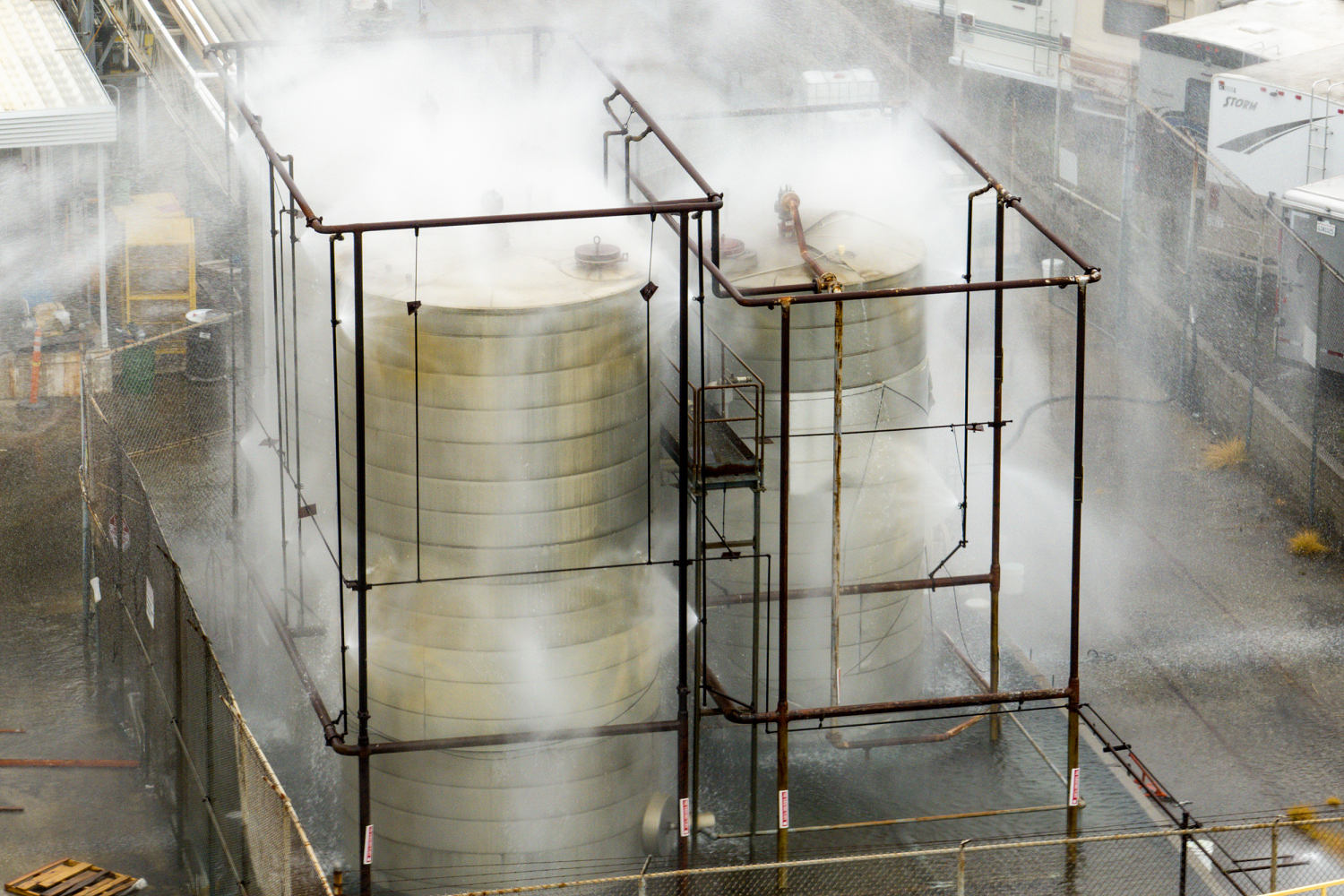
The tank in Garden Grove held roughly 7,000 gallons of the chemical. When the facility alerted the Orange County Fire Authority to a hazardous materials incident, the tank was already off-gassing vapor. Responders encountered an immediate obstacle that transformed a routine containment operation into a multi-day standoff: the tank's mechanical valves were completely broken and gummed up with hardened chemical residue.
Crews could not drain the tank. They could not pump in neutralizing agents. They were left with a single, blunt-force option: spray the exterior shell with water hoses from a distance and hope the cooling counteracted the internal chemical reaction.
The Drone Illusion and the Data Gap
For the first twenty-four hours, official briefings suggested the strategy was working. Incident commanders believed the tank was cooling.
That assessment was based on thermal data gathered by aerial drones hovering over the facility. It proved to be a dangerous illusion.
On Friday night, emergency crews pulled back after drone readings indicated an exterior shell temperature of 77 degrees Fahrenheit. But on Saturday night, a specialized hazard team made a high-risk manual approach to physically read the analog temperature gauge mounted on the tank itself.
The internal temperature was actually 90 degrees Fahrenheit. By Sunday, it climbed to 100 degrees.
The drones had been measuring the temperature of the outside metal shell, which was being cooled by thousands of gallons of continuous water spray. Inside, insulated by the volume of the material and the thickness of the steel, the chemical core was still cooking. This blind spot delayed a full understanding of the crisis and forced officials to rapidly expand the evacuation zone from a few local blocks to a massive nine-square-mile grid encompassing parts of Garden Grove, Anaheim, Buena Park, Cypress, Stanton, and Westminster.
The Structural Failure That Saved the Day
In a bizarre twist of mechanical engineering, the structural failure of the tank is what ultimately prevented a mass-casualty explosion.
By late Saturday, the immense internal pressure had caused the metal container to visibly bulge outward. During a midnight reconnaissance operation, firefighters discovered a physical crack near the top of the structure. While a cracked hazardous material container is usually cause for panic, in this specific scenario, it acted as an unplanned pressure release valve.
"Think of a soda can," says Andrew Whelton, an engineering professor who has analyzed major chemical disasters. "If you leave it in a hot car, it can explode. But if you put a hole in the can, the product is released and the can itself doesn't explode."
Because the crack allowed pressurized gases to escape into the immediate atmosphere rather than building to a structural bursting point, the internal temperature finally began to recede, dropping back down to 93 degrees by Monday morning. The structural breach effectively stopped the countdown to a blast that would have sent heavy metal shrapnel and a toxic fireball into surrounding businesses and homes.
The Lingering Risk and the Regulatory Fallout
The immediate blast threat has ended, but the corporate and environmental fallout is just beginning. A state of emergency remains active in Orange County.
The Environmental Protection Agency has established air monitoring stations around the perimeter of the facility. While sensors have not yet detected dangerous levels of toxic vapors in the broader community, health officials warn that MMA exposure causes acute respiratory distress, severe eye irritation, and neurological symptoms. The chemical is heavier than air, meaning any major liquid spill from the compromised tank will settle into low-lying areas and parking lots rather than dissipating quickly.
To prevent a secondary environmental disaster, crews have built extensive sandbag containment barriers around the GKN facility. The objective is to dam and divert any potential liquid leak before it reaches local storm drains, which lead directly into Southern California river channels and the Pacific Ocean.
+------------------------+----------------------------------+-----------------------------------+
| Disaster Matrix        | Worst-Case Scenario              | Current Status                    |
+------------------------+----------------------------------+-----------------------------------+
| Blast / Shrapnel Risk  | BLEVE destroys adjacent fuel     | Eliminated via structural crack   |
|                        | tanks and infrastructure.        | pressure release.                 |
+------------------------+----------------------------------+-----------------------------------+
| Air Pollution / Fumes  | Broad toxic vapor plume drifting | Monitored; currently within       |
|                        | into residential zones.          | normal limits.                    |
+------------------------+----------------------------------+-----------------------------------+
| Waterway Contamination | Liquid MMA entering storm drains | Mitigated via sandbag dikes and   |
|                        | and flowing to the ocean.        | emergency retention barriers.     |
+------------------------+----------------------------------+-----------------------------------+
The long-term crisis for the aerospace manufacturer is now moving to the courtroom. Local residents filed a class-action federal lawsuit against GKN Aerospace Transparency Systems over weekend displacements, lost wages, and localized property devaluation. The litigation will focus heavily on why a facility handling thousands of gallons of volatile, self-reacting chemicals was operating with critical tank valves so poorly maintained that they failed to function during an emergency.
Industrial facilities holding volatile compounds frequently sit directly across the street from suburban tract housing in older Western municipal zones. This incident proves that relying on external cooling and remote sensor data is insufficient when a chemical reaction goes rogue. If the tank steel had been slightly stronger, resisting the crack that relieved the pressure, the outcome on Monday morning would have been measured in tons of debris and civilian casualties.
The immediate task for operators is to safely neutralize the remaining liquid inside the compromised structure, but the broader challenge is addressing the thousands of similar unmonitored chemical tanks ticking away behind suburban zoning lines.