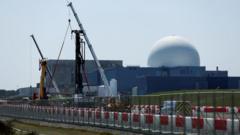
The British government has granted the Sizewell B nuclear power station a 20-year lifetime extension, keeping the Suffolk plant operational until 2055. This agreement with French state utility EDF and British investor Centrica averts a catastrophic supply cliff that threatened to cripple the country's carbon-neutral ambitions. Under the newly signed contract for difference, the station will receive a guaranteed, inflation-linked price of £70.50 per megawatt-hour from 2035 to 2055. While officials trumpet this as a victory for energy security, the reality exposes a deeper desperation within Whitehall over delayed mega-projects and an increasingly fragile electric grid.
This extension is not an aggressive forward stride. It is a defensive maneuver.
The Anatomy of a Nuclear Panic
To understand why the state scrambled to keep a 1990s reactor humming for another two decades, one must look at the rapidly approaching black hole in British electricity generation. The UK’s civil nuclear fleet is old, tired, and retiring faster than engineers can build replacements.
Apart from Sizewell B, every single operational nuclear station in Britain is scheduled to go offline by the end of this decade. Heysham 1 and Hartlepool have been pushed to their absolute thermal limits, with their lifespans artificially stretched to March 2028. Heysham 2 and Torness in Scotland will follow them into decommissioning by March 2030. When those plants go dark, a massive chunk of zero-carbon baseload power vanishes from the grid overnight.
The math simply does not add up. The highly publicized flagship replacement project, Hinkley Point C in Somerset, has been plagued by chronic design adjustments, labor shortages, and billions in cost overruns. It will not generate a single commercial watt until at least the early 2030s. Its sister site, Sizewell C, remains a massive blueprint that will not see commercial operation until closer to 2039, assuming no further administrative delays.
The Missing Baseload
Without Sizewell B, the country faces a multi-year gap where wind and solar are expected to shoulder the entire burden of a modern economy. This creates an unmanageable risk. Renewable energy is highly variable. When the wind drops across the North Sea during a freezing January cold snap, the grid requires heavy, reliable, spinning turbine mass to keep the lights on.
Sizewell B single-handedly supplies 3% of the nation’s entire electrical demand. That equates to roughly 1.2 gigawatts of continuous power, enough to supply 2.5 million homes. Losing that volume of power while waiting for Hinkley Point C would leave the country heavily dependent on volatile international gas markets or emergency power imports from continental Europe. This contract is less about a calculated transition and more about surviving the interim years.
The True Cost of the 800 Million Pound Patch
Squeezing another twenty years out of a nuclear reactor is not as simple as signing a piece of paper. It requires deep, invasive, and highly complex mechanical maintenance. EDF and Centrica have committed to spending £800 million over the next 15 years to upgrade the facility.
This cash injection will be funneled into major component overhauls during scheduled maintenance outages. Sizewell B is unique in the British fleet because it is a Pressurized Water Reactor (PWR), whereas its retiring peers are Advanced Gas-cooled Reactors. The advantage of a PWR is that its core architecture is more akin to standard international designs, making components slightly easier to source. The disadvantage is that after thirty years of intense radiation exposure, the primary steel pressure vessel cannot be replaced.
Overcoming the Metal Fatigue Barrier
Engineers must monitor the structural integrity of the reactor pressure vessel with extreme precision. Over decades of operation, constant neutron bombardment changes the microscopic structure of the steel, making it more brittle. This phenomenon is known as neutron embrittlement.
To satisfy the Office for Nuclear Regulation, EDF will have to prove that the vessel can withstand sudden thermal shocks without cracking. If the regulatory body discovers that the metal has degraded faster than forecast, the 20-year extension could be cut short, rendering the £800 million investment a sunk cost for shareholders.
| Metric | Details of Sizewell B Extension |
|---|---|
| Extended Operating Horizon | April 2035 to March 2055 |
| Guaranteed Strike Price | £70.50 per MWh (2025 prices) |
| Required Capital Expenditure | £800 million over 15 years |
| Grid Contribution | 1.2 Gigawatts (3% of UK total) |
| Employment Impact | Sustains 900 on-site roles |
The Financial Reality of the Strike Price
The financial architecture of this deal deserves close scrutiny. The agreed strike price of £70.50 per megawatt-hour is being framed by government officials as an excellent bargain for billpayers, particularly when compared to the eye-watering prices agreed for newer projects.
For context, the contract signed for Hinkley Point C back in 2013 was set at £92.50 per megawatt-hour, which has since ballooned with inflation to well over £120. More recently, offshore wind contracts have cleared at over £91 per megawatt-hour. On paper, securing nuclear baseload at roughly £70 appears to be a major win.
The Consumer Risk Factor
A contract for difference is a double-edged sword. If wholesale electricity prices soar due to geopolitical instability, consumers are protected because the operator must pay the excess profits back to the state. However, if massive rollouts of cheap solar and wind drive wholesale electricity prices down to an average of £40 or £50 over the next two decades, the taxpayer will be forced to subsidize the difference directly to EDF.
This means British households are effectively locked into a 20-year insurance premium. Given the rapid drop in renewable generation costs, there is a very real possibility that this contract will end up transferring billions from the public purse to a state-owned French utility company to keep an aging plant on life support.
The Regulator Elephant in the Room
Politicians like to announce deals as if they are final. They are not. The Department for Energy Security and Net Zero can sign all the financial agreements it wants, but the ultimate authority rests with the independent regulators.
The Office for Nuclear Regulation has already made its position clear. While life extensions do not require a completely new licensing application, they must operate under a continuously updated and fiercely scrutinized safety case.
The Hidden Supply Chain Constraints
To maintain this safety case through 2055, EDF must solve a human resource crisis that the industry rarely discusses openly. The specialized engineering skills required to maintain 20th-century nuclear control systems are evaporating. The generation of engineers that designed and built Sizewell B is reaching retirement age.
At the same time, the broader British nuclear supply chain is stretched to its absolute limit trying to support the construction at Hinkley and the early works at Sizewell C. Finding the specific technicians, inspectors, and safety auditors required to execute an £800 million refurbishment on an active, aging reactor will mean competing for a highly limited pool of domestic talent. If those manpower shortages cause refurbishment deadlines to slip, the plant's operational availability will plummet, undermining the very grid stability the extension was designed to secure.
Britain has bought itself time, but time is exceptionally expensive when it is radioactive. The country must now rapidly accelerate its new-build programs or accept that short-term financial patches on aging infrastructure will become the permanent state of affairs.