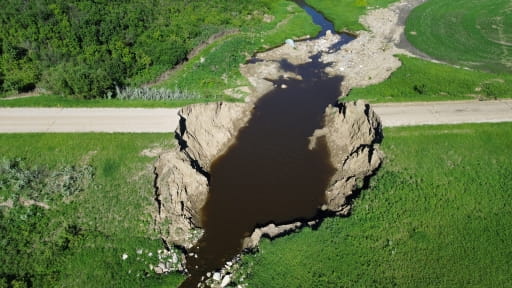
Saskatchewan just dramatically overhauled its Provincial Disaster Assistance Program (PDAP), retroactively doubling maximum payouts for individuals to $500,000 and sextupling the limit for small businesses to $3 million. On paper, it looks like a compassionate response to a volatile spring and summer that triggered 107 emergency designations—well over double the ten-year average.
The uncomfortable truth is that the province had no choice. The math behind natural disasters has fundamentally broken. Skyrocketing construction inflation and strict new federal funding mandates forced the province's hand, proving that the old model of paying out depreciated property value is entirely obsolete in an era of relentless, multi-million-dollar infrastructure failures.
The Failure of the Depreciation Model
For decades, disaster assistance programs operated on a blunt fiscal logic. If a 30-year-old municipal culvert or an aging livestock barn washed away in a spring thaw, the government cut a check based on the depreciated value of that asset.
The policy protected provincial coffers, but left rural municipalities and agricultural operations with a massive funding gap. In 2026, you cannot purchase steel, concrete, or specialized labor at a depreciated price.
By shifting to a standard replacement-value model, Saskatchewan is finally acknowledging that paying out a fraction of a loss does not result in a partial recovery; it results in permanent bankruptcy for small operations and broken infrastructure for rural towns.
A farmyard grain bin built in the 1990s might have had a book value of next to nothing before a storm tore it from its foundation. Under the previous rules, the owner faced financial ruin trying to replace it at modern market rates. The new framework ends this asset erosion, ensuring that assistance aligns with the actual invoices required to rebuild.
Federal Leverage and the Escalating Bill
The sudden policy shift was not conceived in a provincial vacuum. Ottawa has been steadily rewriting the rules of the federal Disaster Financial Assistance Arrangements (DFAA), tightening its belt and signaling to provinces that they must modernize their programs or carry the financial burden alone.
Saskatchewan’s adjustment directly mimics these evolving national standards. When severe weather hits, the province pays the immediate costs and later bills the federal government for a percentage of the recovery. To qualify for maximum federal cost-sharing, provincial programs must align with modern baseline recovery costs.
The financial scale of recent weather makes this federal alignment critical. Consider the timeline of the current fiscal year:
- Late April: A massive, unseasonal snowstorm paralyzes rural municipalities like Corman Park, burying infrastructure and demanding immediate, extraordinary cleanup budgets.
- May: Rapid thaws trigger severe flooding across eastern regions, washing out highways and compromising local water management systems.
- June and July: Persistent severe summer storms and northern wildfire threats push the total number of approved disaster designations to 107 by mid-July.
With volumes tracking far above the historical norm of 43 designations per year, the total provincial liability is ballooning.
The Mitigation Gamble
Perhaps the most telling component of the updated program is a new clause allowing claimants to receive an extra 25 percent on top of their claim value—provided that money is spent directly on reducing future disaster risks.
It is a transparent attempt to buy out future risk. The government has realized that repeatedly rebuilding the exact same vulnerable infrastructure is fiscal suicide.
| Recipient Type | Old Maximum Cap | New Maximum Cap | Strategic Mechanism Change |
|---|---|---|---|
| Individuals | $240,000 | $500,000 | Shifted from depreciated value to standard replacement cost. |
| Small Businesses / Farms | $500,000 | $3,000,000 | Massive cap lift to protect commercial and agricultural supply chains. |
| Municipalities | Variable Deductible | Lowered Deductible | Financial rewards tied explicitly to meeting emergency preparedness targets. |
This 25 percent bonus applies to proactive upgrades like enhanced drainage networks, structural erosion control, and fortified livestock handling facilities. The province is essentially betting that spending more cash upfront to elevate a road or downsize a flood plain will prevent an even larger payout five years down the line.
The Structural Limits of Uninsurable Aid
Despite the headline-grabbing numbers, the program retains a critical, structural guardrail that many applicants overlook. PDAP remains strictly a fund for uninsurable essential losses.
It does not function as a blanket insurance policy for the agricultural sector. If a crop producer loses a thousand acres of wheat to a mid-summer hailstorm or persistent standing water, this updated program will not pay out a single dime for that lost revenue. Those losses remain the exclusive domain of crop insurance.
Instead, the $3 million business cap is laser-focused on physical, foundational assets: washed-out private access roads, ruined shops, compromised water systems, and structural outbuildings. It protects the operational capacity of a business, not its annual profit margin.
Why the New Baseline May Still Fall Short
While the Saskatchewan Association of Rural Municipalities (SARM) has openly celebrated these updates as a victory for predictable rural funding, the underlying economic pressures suggest the relief may be short-lived.
Supply chains for heavy construction materials remain highly volatile. When a single major storm front damages dozens of bridge elements and hundreds of kilometers of gravel transport routes simultaneously, local demand for culverts, aggregate, and heavy equipment operators spikes instantly.
This demand surge triggers immediate localized inflation. A $3 million cap for a small business or a lowered deductible for a rural municipality looks substantial today. However, if the cost of basic civil engineering and construction inputs continues its upward trajectory, these newly minted limits will fast become just as restrictive as the outdated caps they replaced.
Saskatchewan has modernized its disaster framework to survive the current season, but the program is trapped in a defensive cycle, chasing an ever-moving target of climate volatility and rising material costs.


/imgsapp2.uai.com.br/app/noticia_133890394703/2026/07/16/386986/maria-eduarda-machado-e-renato-machado_1_1097628.png)
