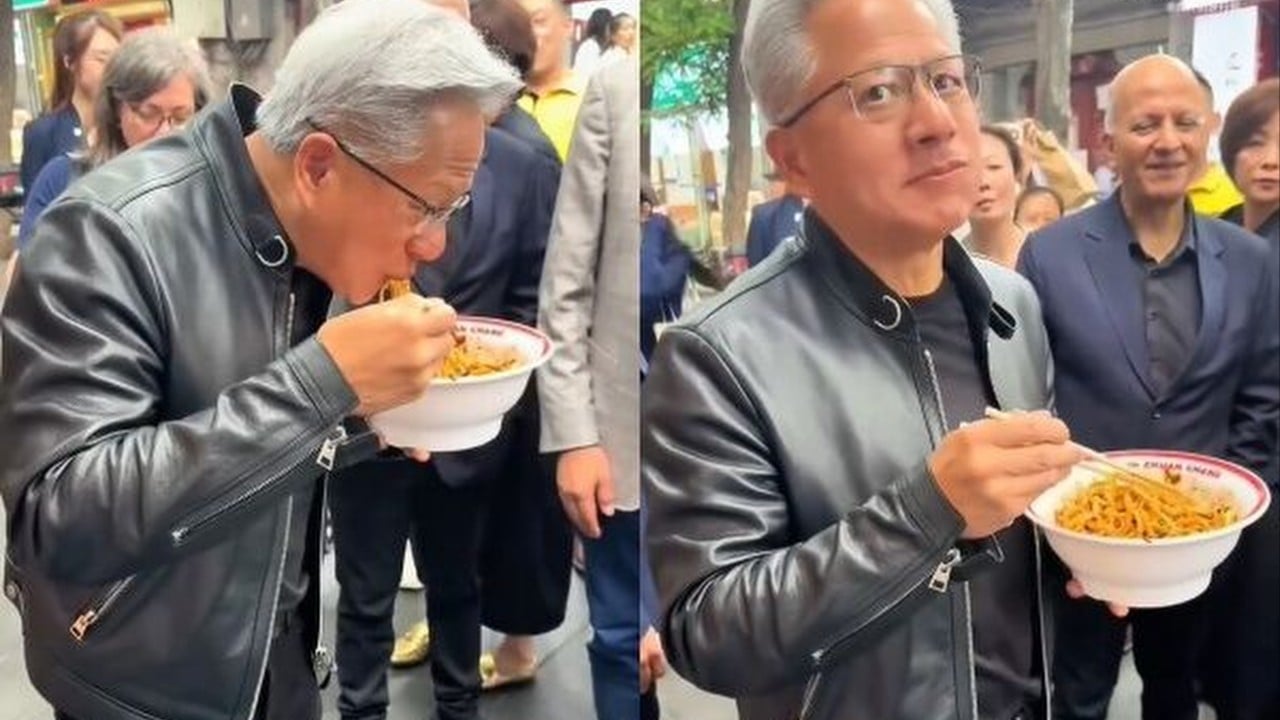
A tech billionaire standing on a humid Beijing sidewalk in a black leather jacket, slurping a 38-yuan bowl of fried sauce noodles, is the ultimate masterclass in geopolitical theater.
When Nvidia CEO Jensen Huang bypassed the stiff protocols of the official state visit delegation in Beijing to mingle with tourists and eat zhajiangmian at Fangzhuanchang No. 69, the internet did exactly what it was supposed to do. It went viral. Within twenty-four hours, the noodle shop launched a "God of War in leather jacket" set meal. Budget beverage chain Mixue Bingcheng rapidly updated its digital ordering apps to feature a "Boss' Favorite" peach oolong tea. Social media feeds across China racked up over 200 million views, marveling at the down-to-earth billionaire who handles 30-degree Celsius heat and local fermented tofu drinks with equal parts grit and grit-and-bear-it charm.
But reduce this moment to a quirky viral marketing story, and you miss the entire point of the play. This is not just a story about rapid Chinese commercialization or a restaurant capitalizing on a celebrity sighting.
This is calculated, high-stakes economic diplomacy masked as street food charm. At a moment when Washington is tightening the screws on semiconductor export controls and Beijing is pushing its state enterprises to purge Western silicon, Huang is playing a delicate, multi-billion-dollar game of survival. He is reminding the Chinese market—and its regulators—that while Nvidia might be an American corporate giant, its heart, its leadership, and its cultural allegiance remain deeply, unshakeably connected to the region.
The Soft Power of the Bypassed Banquet
Silicon Valley executives usually arrive in Beijing tucked behind the tinted windows of black sedans, moving seamlessly from the airport tarmac to the guarded enclaves of the Diaoyutai State Guesthouse. They talk strategy in sterile boardrooms and toast to mutual cooperation over banquets that cost more than a factory worker’s annual salary.
Huang threw out the traditional playbook. By stepping onto the pavement of the Nanluoguxiang commercial district, he executed a deliberate pivots away from corporate isolation.
- The Sidewalk Strategy: Standing outside because the shop was too packed sends a visual message of humility that resonates deeply with a Chinese public weary of untouchable corporate elites.
- The Cultural Litmus Test: Intentionally sipping douzhi—a pungent, fermented mung bean beverage that even most non-local Chinese citizens avoid—and grimacing openly creates a moment of authentic vulnerability.
- The Everyday Consumer Touch: Buying a drink from Mixue, a notoriously low-cost brand known for catering to the working class, signals an intentional alignment with the masses rather than the oligarchs.
This populist branding is critical because Nvidia is facing an unprecedented existential threat in the world’s second-largest economy. U.S. export restrictions have systematically starved Nvidia of its ability to sell its top-tier artificial intelligence chips, like the H100 and B200, to Chinese tech giants. Cut off from his primary product line, Huang has had to engineer weaker, compliance-friendly alternatives specifically for the Chinese market.
To sell these downgraded chips, Nvidia cannot rely on technological superiority alone. It needs immense goodwill. It needs the Chinese tech ecosystem to want to buy from Nvidia, even when local competitors like Huawei are whispering that domestic silicon is the patriotic choice. Huang’s street-level charm offensive is designed to build a reserve of public and corporate affection that hardware specs can no longer guarantee.
The Commercial Reflex of the Chinese Market
The speed with which local businesses monetized Huang's lunch reveals the hyper-reactive nature of China's modern consumer landscape. This isn't a market that waits for corporate approval; it moves at the speed of a trending hashtag.
| Brand | Immediate Action Taken | Price Point | Consumer Response |
|---|---|---|---|
| Fangzhuanchang No. 69 | Launched the "God of War" combo (Noodles + Yogurt) | 45 Yuan ($6.50) | Over 100,000 group-buying vouchers sold in days |
| Mixue Bingcheng | Created "Boss' Favorite" menu category on digital mini-programs | 7 Yuan ($1.00) | Viral social media traction matching graphics cards with tea |
This rapid monetization serves Nvidia just as much as it serves the noodle shops. Every time a local consumer orders a "leather jacket" set meal, Nvidia's brand equity is reinforced not as an aggressive American tech hegemon, but as a familiar, celebrated icon of modern tech success. It turns a foreign semiconductor company into a localized meme.
Domestic AI firms in China are under intense political pressure to decouple from American architecture. Huawei’s Ascend chips are gaining traction, bolstered by state directives to achieve technological self-reliance. For Nvidia, staying relevant means maintaining a cultural footprint so deep that erasing the company from the domestic tech landscape feels unnatural to the public and counterproductive to local business interests.
Why the Tech Elite Must Play the Populist
The timing of this sidewalk excursion is anything but accidental. Traveling as part of a high-profile U.S. business delegation puts a target on any executive's back. It invites intense scrutiny from Washington hawks who view any cooperation with China as a security risk, and from Beijing regulators who view American tech firms as potential vectors for foreign interference.
By stepping out of the official delegation bubble, Huang decoupled his corporate identity from Washington's political agenda. He effectively reminded observers that governments argue, but markets endure.
It is a strategy born of absolute necessity. If Nvidia loses China, it loses a massive chunk of its long-term growth runway. If China completely bans or successfully replaces Nvidia hardware, it accelerates the fragmentation of the global tech stack. The noodle bowl, the cheap tea, and the sweat-soaked leather jacket in 29-degree heat are the tools of a master strategist stripping away political pretense to protect a supply chain.
When the hype dies down and the noodle shop queues return to normal, the reality of the chip wars will remain. But by choosing the sidewalk over the boardroom, Huang ensured that when Chinese tech founders look to build their next AI models, they won't just see a cold, sanctioned American corporation. They will see the guy who stood in the heat, drank the sour milk, and ate the same noodles they do.