The European Union cannot find a single diplomat to negotiate with Vladimir Putin because Brussels has mistaken institutional consensus for actual geopolitical power. Ukrainian President Volodymyr Zelenskyy forced this reality into the open by publicly demanding that Europe name a specific representative for future peace talks. The request looks simple on paper but it has triggered a quiet panic across the continent. Brussels remains trapped in a structural deadlock, unable to decide who should speak for the bloc, while back-channel diplomacy is already being dominated by Washington and Moscow.
By treating the search for an envoy as a bureaucratic HR problem rather than a fundamental crisis of sovereignty, European leaders are guaranteeing their own exclusion from the final settlement of the war.
The Gerhard Schroder Trap and the Ghost of Minsk
The immediate catalyst for the current deadlock arrived when Vladimir Putin publicly suggested that former German Chancellor Gerhard Schröder would be his preferred European interlocutor. It was a calculated provocation. Schröder is the ultimate symbol of Europe’s past energy dependence on Moscow, having spent years lobbying for Russian state-owned energy giants. EU Foreign Policy Chief Kaja Kallas swiftly rejected the idea, pointing out that letting the Kremlin select Europe's negotiator would mean allowing Putin to sit on both sides of the table.
Dismissing Schröder was the easy part. Finding an alternative has proven impossible.
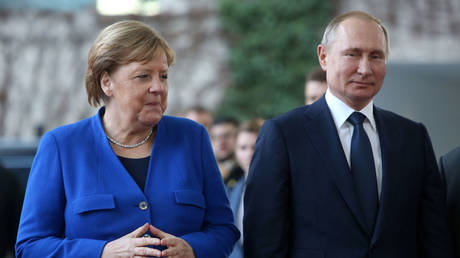
The crisis deepened when former German Chancellor Angela Merkel entered the fray, urging current European leaders to negotiate directly with the Kremlin while explicitly ruling herself out as an envoy. Merkel’s intervention carried a heavy historical irony. She was the architect of the 2015 Minsk II accords, a diplomatic framework that froze the conflict in eastern Ukraine but ultimately failed to prevent the 2022 invasion.
Merkel’s refusal to step into the arena exposes a deeper structural truth. She argued that only politicians currently wielding state power can credibly look Putin in the eye. A retired elder statesman or a mid-level bureaucratic envoy carrying a mandate from 27 different capitals has no currency in the Kremlin. Putin respects hard power, sovereign decision-making, and military leverage. He does not respect a committee.
The Friction Between Capital Cities and Brussels Bureaucracy
The search for a negotiator is paralyzed by a constitutional design flaw within the European Union itself. Foreign policy requires speed, flexibility, and the ability to make sudden concessions. The EU is built on the exact opposite principles.
[The European Diplomatic Deadlock]
       │
       ├──► The Brussels Problem: Institutional envoys lack sovereign military backing.
       │
       ├──► The Capital Problem: Powerful leaders (Paris/Berlin) lack a total bloc mandate.
       │
       └──► The Kremlin Reality: Putin prioritizes bilateral deals with Washington.
If Europe appoints a centralized institutional figure, such as European Council President António Costa or Kaja Kallas, that person lacks the direct authority to trade territory, alter sanctions regimes, or deploy national military assets. Those powers belong exclusively to sovereign capitals like Paris, Berlin, Warsaw, and Rome.
Conversely, if a powerful national leader attempts to take the lead, the move instantly fractures the bloc. A French-led initiative triggers suspicion in Warsaw and the Baltic states, where leaders fear Western Europe will sell out long-term security for a quick return to cheap energy. A German-led initiative is weighed down by the baggage of Nord Stream and past diplomatic failures.
This internal friction has reduced European diplomacy to a spectator sport. While European ministers debate representation in Brussels, the real diplomatic architecture is being constructed elsewhere. Deputy Russian Foreign Minister Mikhail Galuzin confirmed that Moscow remains in constant contact with the United States regarding the war. The White House, not the European Quarter, holds the keys to the financial and military leverage that matters to both combatants.
What is Actually At Stake for the Continent
Europe’s inability to field a single negotiator is not just an embarrassment. It is a direct threat to its long-term stability. The final settlement of the war will not merely draw a new border on a map. It will reshape the entire economic and security architecture of the continent for the next thirty years.
A seat at the negotiating table is required to manage several critical realities.
- The 90 Billion Euro Question: Europe has committed billions in financial aid and loans to Ukraine. If Washington brokers a peace deal without European input, the financial burden of reconstruction will fall squarely on European taxpayers without Brussels having a say in the geopolitical terms.
- The Sanctions Architecture: The EU is currently drawing up its 20th sanctions package against Russia. Undoing or maintaining these restrictions is Europe's primary economic leverage, yet the bloc risks having its economic policy dictated by a bilateral deal struck between the US and Russia.
- The Troops on the Ground: European planners have floated the idea of a ceasefire guarded by a coalition of European troops inside Ukraine. Deploying soldiers without a unified political command structure is an extraordinary military risk.
The Direct Route to Strategic Irrelevance
The core illusion holding Europe back is the belief that it can remain a major geopolitical player by acting solely as a bank and an armory. For four years, Europe has provided critical financial and military support to Kyiv. But support is not the same as strategy.
By failing to establish a single, powerful voice backed by the collective military and economic weight of its member states, Europe has allowed itself to be sidelined. Zelenskyy’s public prompt to António Costa was a polite warning that Ukraine cannot wait forever for Europe to organize its own committee.
If European leaders continue to hide behind institutional procedures and regional rivalries, the future of European security will be decided by a phone call between Washington and Moscow. Europe will not be the architect of the peace. It will simply be the party that pays for the invoice.