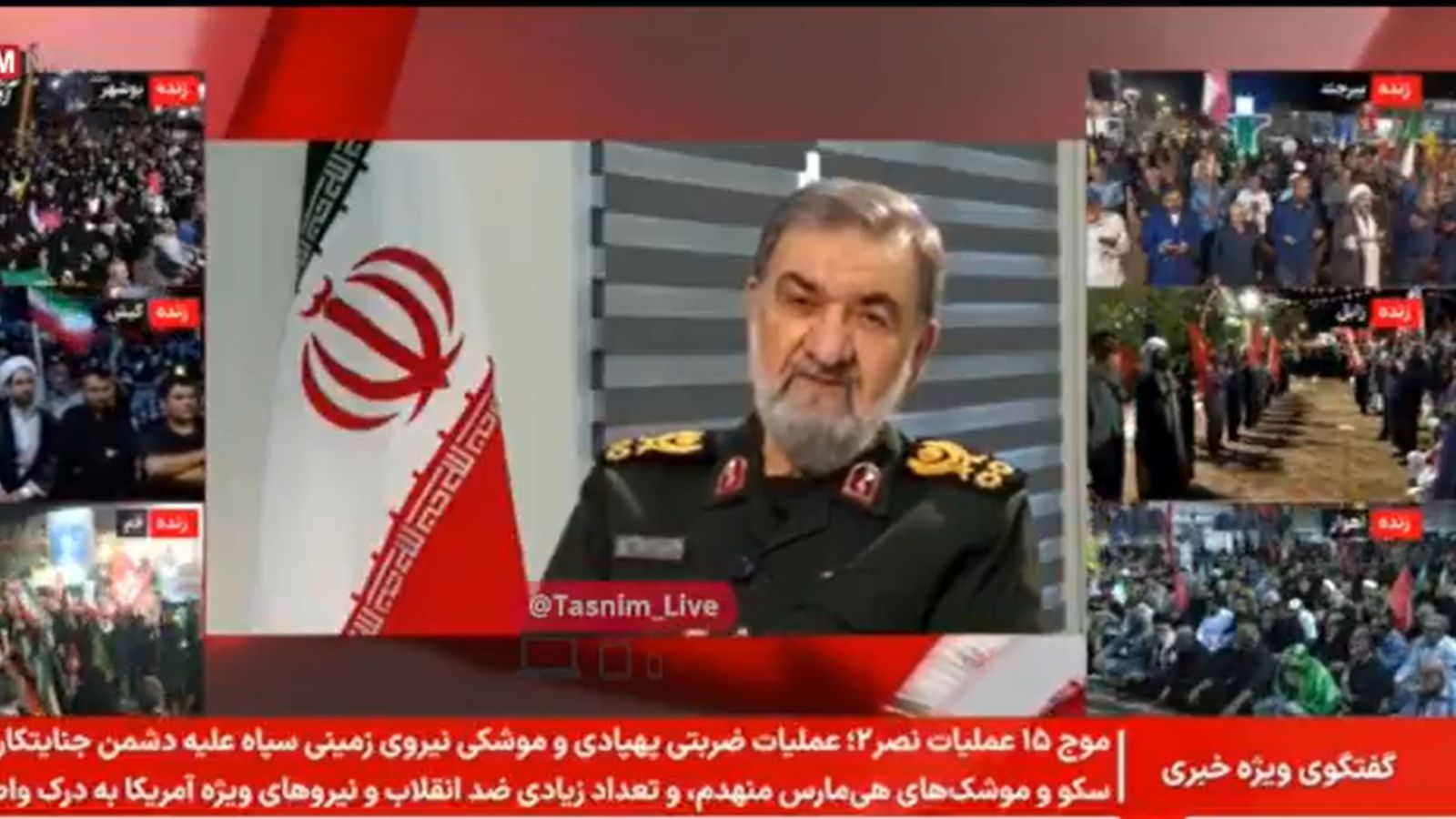
The military confrontation between the United States and Iran has breached a dangerous new threshold after a seventh consecutive night of heavy American airstrikes. With Washington expanding targets from proxy groups to internal Iranian infrastructure and enforcing a naval blockade, Tehran is ditching its traditional asymmetric restraint. Major General Mohsen Rezaei warned that Iran will abandon symmetric retaliation in favor of unlimited offensive operations. This escalation threatens to transform a localized maritime dispute over the Strait of Hormuz into an unrestricted regional war.
For decades, the unwritten rules of engagement between Washington and Tehran were clear. Conflict was managed through proxies, conducted in grey zones, and calibrated to avoid triggering a direct, conventional war between states. That doctrine evaporated over the last week. The current American aerial assault, orchestrated under Central Command, is no longer a series of punitive pinpricks. It is a systematic attempt to dismantle the state military infrastructure of southern Iran. Yet, seven days of sustained bombardment have failed to achieve the primary political objective of forcing open the vital shipping lanes of the Persian Gulf. Instead, the campaign has triggered a dangerous mutation in Iranian strategic doctrine that endangers every American partner in the Middle East.
The Shift from Proxy Friction to Total Infrastructure Attrition
The seventh night of American strikes hit deep into sovereign Iranian territory. Bombardment targeted the cities of Sirik, Ahvaz, and Yazd, moving beyond the immediate coastal perimeter. Central Command confirmed that its forces utilized fighter jets, long-range drones, and surface warships to hit surveillance facilities, logistics networks, and underground missile caches. The geographical spread of these operations reveals a major shift in Washington's planning. The White House is no longer just striking the launching pads of specific drones or fast-attack craft. It is attempting to sever the logistical tendons that connect the Iranian interior to the littoral zones of the Persian Gulf.
This is an explicit attempt to force a breakdown in Iran’s domestic transport capacity. On the southern coast, American missiles brought down the Bandar Abbas-Rudan bridge and the Bandar-e Khamir bridge. These are not minor overpasses. They are key transport links supporting Bandar Abbas, the busiest and most critical commercial port facility in the country. By dropping these structures, American planners have isolated the coast from the logistics networks that supply regular military installations and Islamic Revolutionary Guard Corps naval bases. In Chabahar, a maritime surveillance tower used by the Revolutionary Guards to track commercial shipping and direct swarm attacks was flattened.
The cost within Iran is growing rapidly. The health ministry in Tehran reported dozens of fatalities and hundreds of injuries across the southern provinces since the campaign intensified. In the southwestern city of Ahvaz, the ripple effects of nearby strikes forced the emergency evacuation of more than two hundred patients from a pediatric oncology hospital. Meanwhile, precision strikes on utilities have disabled desalination pumps and electrical infrastructure in Jask, cutting off drinking water to thousands of residents across rural coastal villages. This marks a deliberate transition toward destroying dual-use infrastructure, a move designed to make the preservation of the maritime blockade economically unbearable for the political leadership in Tehran.
Tehran Dictates a New Geography of Violence
The assumption that heavy bombardment would house-train the Iranian military command structure has proven to be an illusion. Tehran’s response has been swift, direct, and unconstrained by the national borders that previously defined the conflict. Major General Mohsen Rezaei’s declaration that no political border remains safe is a literal description of current Revolutionary Guard operations. Rather than absorbing the strikes or limiting responses to American naval vessels in international waters, Iran has expanded its targeting matrix to include the infrastructure of neighboring states that host or support American military forces.
Kuwait bore the brunt of this doctrinal shift. Iranian missile and drone barrages struck a critical American naval fuel-support pier at the port of al-Ahmadi, alongside a military signals and communications center. The attacks did not stop at military installations. Swarms of Iranian drones hit a major Kuwaiti power and water distillation plant for two consecutive days, forcing several generation units offline and threatening the domestic utilities of the state. The physical threat to aviation forced Kuwait to temporarily suspend all operations at its international airport.
This is an intentional strategy to create a regional crisis. By holding the civilian infrastructure of Gulf cooperation states hostage, Tehran wants to force America's regional partners to withdraw their logistical support for the blockade. In Bahrain, home to the American Fifth Fleet, air raid sirens have been sounded repeatedly as local air defenses scramble to intercept incoming aerial attacks. The Revolutionary Guards claimed direct hits on an intelligence center and a staging site for American combat aircraft at the Sheikh Isa Air Base. In Jordan, far to the west, an Iranian strike targeted fuel infrastructure at the Al-Azraq Air Base. By converting the defensive American campaign into an existential threat to the stability of the entire region, Iran is testing the political willpower of the coalition supporting Washington's maritime objectives.
The Illusion of a Clean Aerial Blockade
The fundamental problem with the current American strategy is its reliance on air power to solve an inherently physical, geographic challenge. Air campaigns are highly effective at breaking static objects, but they cannot occupy territory or continuously control narrow waterways. The Strait of Hormuz is a unique maritime chokepoint dominated by Iranian islands, jagged coastlines, and hidden mobile missile batteries. A week of heavy bombardment has done nothing to restore the normal flow of commercial transit. Shipping industry experts have balked at the current risks, and global crude prices have experienced violent upward spikes as the fighting shows no sign of abating.
The enforcement of the American blockade has required direct physical intervention by surface fleets. Marine units have had to conduct dangerous boarding operations, such as the seizure of the commercial vessel M/T Wen Yao in the Gulf of Oman, to prevent ships from entering blockaded ports. Yet, for every vessel intercepted, the Revolutionary Guards find opportunities to strike back. They targeted a Thai-flagged commercial vessel that attempted to traverse the strait without explicit Iranian permission. The reality is clear. As long as Iran commands the northern coast of the strait, it retains the capability to disrupt commercial shipping with low-cost sea mines, anti-ship missiles, and small fast-attack craft.
This operational reality has triggered a quiet but intense debate inside Washington military circles. Military analysts are beginning to point out that if the goal is the permanent security of the Strait of Hormuz, an air campaign alone will never suffice. It requires physical dominion over the islands and coastlines that command the waterway. The phrase "ground assault" is no longer just a worst-case scenario discussed in academic think tanks; it is becoming a looming operational requirement if the current administration intends to see its blockade through to a definitive conclusion.
Domestic Friction and the High Cost of Hardline Miscalculation
While the conflict intensifies on the coast, a parallel crisis is developing within the political heart of Iran. In Tehran, hundreds of kilometers away from the impact zones, the political class has long treated confrontations with the West as a rhetorical exercise. Hardline politicians regularly beat the drums of war from secure television studios and parliamentary podiums, safe in the knowledge that previous escalations ended in backroom diplomacy. That luxury is disappearing. The domestic economy is in freefall, with the Iranian rial collapsing to a record low of nearly 1.92 million per US dollar as international confidence vanishes.
The economic damage is no longer abstract. At the isolated southern ports, the economic life of the region has ground to a halt. More than four thousand shipping containers are currently stranded in the yards of Bandar Abbas, and half of the port’s civilian workforce has been laid off as operations dry up under the pressure of the American naval blockade. This disconnect has triggered rare public dissent from pragmatic political figures inside Iran. Local media commentators have openly criticized the hardline factions, calling for those who block negotiations to be sent to the front lines to experience the reality of the war they helped provoke. They accuse the political elite of practicing a safe, comfortable form of patriotism while the working-class populations of the southern provinces pay for those decisions with their lives, their infrastructure, and their water supply.
The United States faces a symmetrical problem of strategic overreach. The decision to expand the air campaign to civilian infrastructure like bridges, transport networks, and power systems was meant to bring Iran to the negotiating table on American terms. Instead, it has driven the Iranian military command into a corner, forcing them to adopt an unrestricted asymmetric doctrine where the targets are no longer just American soldiers, but the very economic foundation of the Middle East. Every bridge dropped in Hormozgan province appears to shorten the distance to a broader regional conflict that Washington is poorly prepared to manage. The illusion that this campaign could be run as a clean, risk-free exercise in air power has shattered against the reality of burning utilities in Kuwait and air sirens screaming over Bahrain. Shipping companies must now plan for a prolonged period where the Persian Gulf is an active war zone, and regional governments must decide how long they can afford to serve as the anvil for America’s hammer.