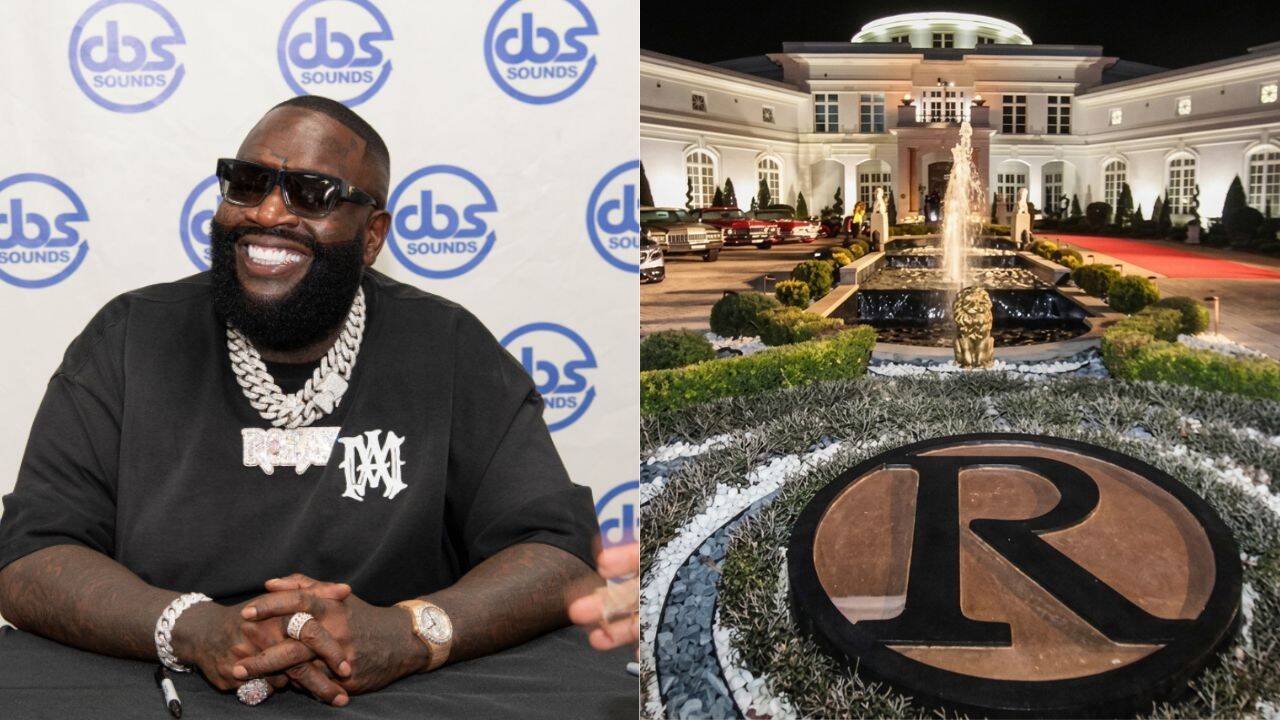
Mega-estate acquisitions operate under a distinct set of economic distortions that diverge entirely from standard residential real estate markets. When a high-net-worth individual acquires a distressed ultra-luxury asset, the transaction is rarely driven by conventional yield metrics or standard amortization schedules. Instead, it represents a calculated play in asset-class arbitrage, brand capital positioning, and sunk-cost recovery. The transaction involving the former Evander Holyfield estate in Fayette County, Georgia—subsequently acquired by musician and entrepreneur Rick Ross for $5.8 million—serves as a primary case study in the economics of distressed mega-assets, asset restructuring, and operational cost management.
To understand the mechanics of this transaction, one must deconstruct the financial profile of the asset prior to purchase. The property, situated on over 200 acres and featuring one of the largest single-family residential structures in the state, was originally constructed during a period of peak capital availability. However, ultra-luxury properties of this scale suffer from extreme asset-specific liquidity constraints. The pool of potential buyers capable of acquiring a 100-room compound is vanishingly small. When the original owner faced severe financial distress, the asset experienced a forced liquidation trajectory, creating a massive divergence between replacement cost and market clearing price.
The Cost Function of Mega-Estate Ownership
The primary misconception surrounding mega-estates is that the acquisition cost represents the principal financial burden. In practice, the purchase price is merely the initial capital expenditure in a continuous capital-allocation loop governed by severe negative cash flow dynamics. The true economic burden of a property of this magnitude resides in its operational cost function.
Total Cost of Ownership = Acquisition Cost + (Annual Maintenance + Property Tax + Capital Improvements) * Time - Monetization Value
The components of this equation dictate why traditional buyers avoid such assets:
- Fixed Capital Drag: Property taxes on multi-million dollar sprawling compounds scale non-linearly with acreage and square footage, frequently running into hundreds of thousands of dollars annually regardless of asset utilization.
- Deferred Maintenance Liabilities: When a property undergoes foreclosure or distress proceedings, maintenance schedules are invariably deferred. Mechanical, HVAC, and plumbing systems designed for commercial-scale footprints require capital injections that often rival the purchase price of standard suburban homes.
- Operating Overhead: Maintaining 200 acres of land, massive aquatic features, and high-density interior spaces requires a permanent institutional-grade staff, transforming a residential asset into a small corporate entity from an operational standpoint.
For the acquisition to make economic sense, the buyer must implement a strategy that either transforms the liabilities into revenue-generating mechanisms or leverages the asset's brand equity to offset the carrying costs.
Brand Capital Integration and Asset Monetization
In the case of the Fayette County estate, the integration of the physical asset into a broader commercial media footprint changes the underlying financial equation. Real estate owned by public figures is rarely a purely private consumption good; it functions as a physical studio, a content production nexus, and a tangible manifestation of brand equity.
When a property features a private lake, extensive agricultural acreage, and commercial-scale entertaining spaces, its utility expands beyond shelter. It operates as a media production asset. The cost savings derived from hosting film shoots, music videos, and corporate retreats on-site versus renting comparable commercial infrastructure provide a direct offset against the carrying costs. Furthermore, the property serves as a physical anchor for promotional campaigns, effectively converting a dead-weight residential liability into a marketing channel with a measurable return on investment.
This strategy relies on capturing the delta between commercial rental rates for premier production locations and the marginal cost of utilizing owned infrastructure. While the property remains a capital sink on a pure balance-sheet basis, its integration into the owner's broader enterprise ecosystem alters its net present value profile.
The Liquidity Trap and Depreciation Dynamics
Ultra-luxury real estate occupies a unique position in the wealth preservation matrix. Unlike equities or fixed-income instruments, these assets possess zero secondary market liquidity in compressed timeframes. A standard residential property can be liquidated within 30 to 90 days by adjusting price to market clearing levels. A 54,000-square-foot compound with highly customized architectural choices has a target demographic numbered in the single digits within any given regional market.
This creates a structural liquidity trap for whoever holds the title:
- Idiosyncratic Design Risk: Custom features built to the exact specifications of the original owner rarely align with the preferences of subsequent buyers, necessitating substantial demolition and renovation capital.
- Carrying Cost Escalation: Because the holding period for a successful resale of a mega-estate can span years, the accumulated carrying costs erode the nominal capital gains achieved through a distressed purchase price.
- Regional Market Ceilings: Fayette County, Georgia, while affluent, does not command the same square-foot valuations as primary coastal luxury markets like Malibu or Palm Beach. Consequently, the upside potential on capital appreciation is bounded by local market absorption rates.
Rational market participants entering this space must abandon the expectation of traditional real estate appreciation. Instead, value extraction must occur through operational utility, brand leverage, and the strategic minimization of ongoing overhead.
Structural Optimization of Distressed Luxury Assets
Optimizing an asset of this scale requires applying industrial management principles to residential management. The transition from a distressed bank-owned property to a functioning enterprise involves three distinct operational phases:
First, energy efficiency and system rationalization must replace legacy configurations. Facilities built in the late 20th century are notoriously inefficient. Retrofitting climate control zones, upgrading to high-efficiency LED arrays, and implementing automated resource management systems reduce the baseline operational burn rate.
Second, labor restructuring is paramount. Transitioning from a fragmented, ad-hoc maintenance model to a consolidated facilities management protocol eliminates redundancy and prevents catastrophic system failures that trigger emergency repair premiums.
Third, programmatic asset utilization ensures that the physical plant remains active. Assets that sit vacant degrade at an accelerated rate due to humidity, lack of seal maintenance, and system stagnation. Establishing a predictable schedule of utilization—whether through internal commercial projects or managed external events—maintains mechanical integrity while defraying operational drag.
The acquisition of large-scale legacy estates remains a high-variance financial play. Success is determined not by the initial discount secured at the auction block, but by the rigor of the operational framework implemented during the holding period. Those who treat such properties as traditional homes face inevitable capital depletion; those who treat them as industrial-scale media assets and brand nodes can successfully navigate the structural liabilities of ultra-luxury real estate ownership.