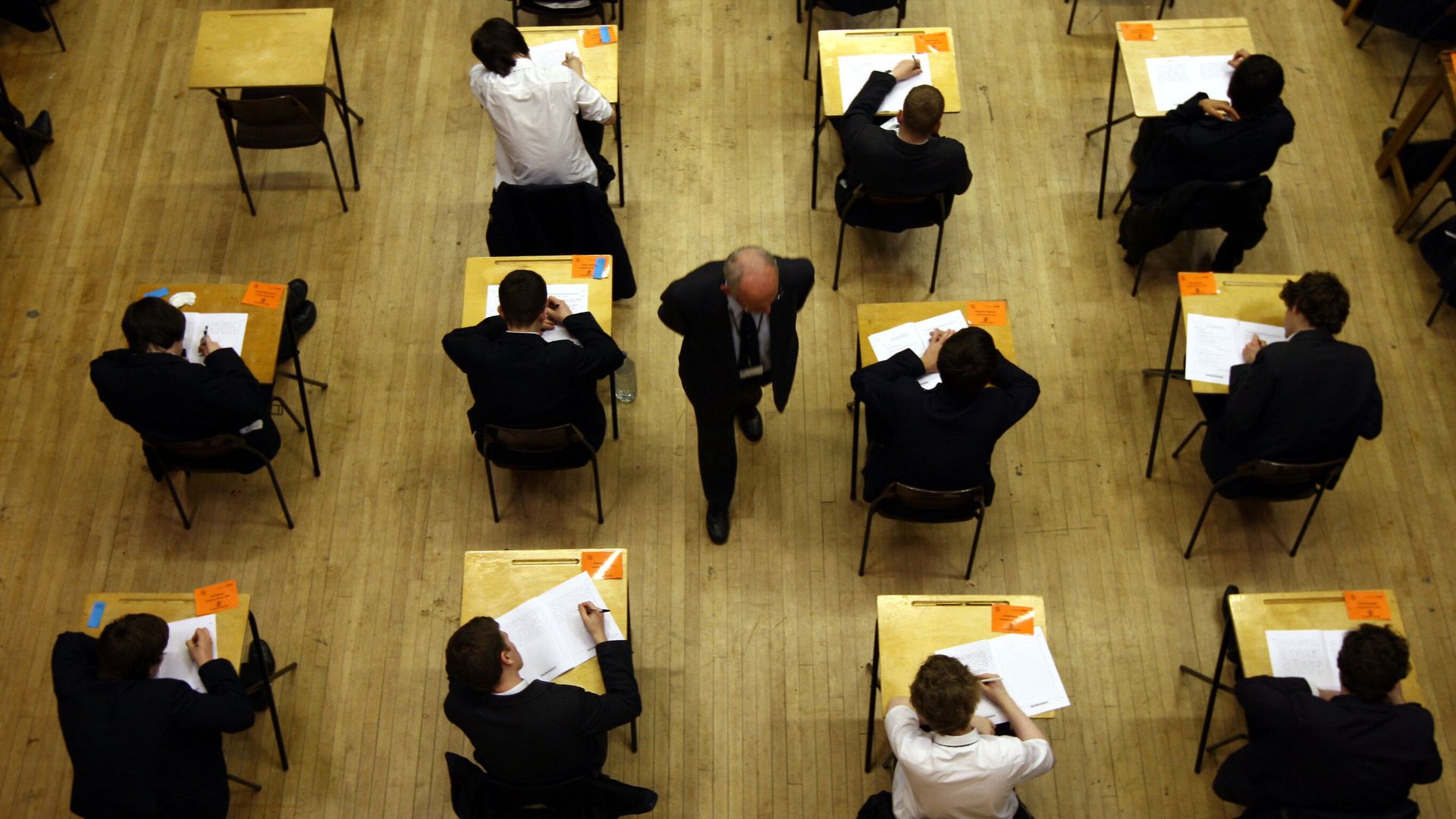
The fluorescent lights of a British school gymnasium hum at a frequency designed to induce mild panic. You know the sound. Rows of identical laminated desks, spaced precisely one point two-five meters apart, stretch across the scuffed parquet floor. A clear plastic pencil case sits beside a transparent water bottle with the label peeled off. At the front of the room, an invigilator checks a wall clock with the solemnity of a launch director.
In a few years, a sixteen-year-old will sit at one of those desks, pick up a black ballpoint pen, and write in Cyrillic.
Not Russian. Ukrainian.
On the surface, the news that the United Kingdom is introducing a Ukrainian GCSE sounds like a dry bureaucratic footnote. A minor update to the Department for Education’s catalog of qualifications. An administrative nod to the tens of thousands of families who arrived on British shores after February 2022. You can almost hear the press release rustling—polite, measured, utterly devoid of pulse.
Look closer, though. Look past the exam boards, the curriculum frameworks, and the accreditation timelines. What is actually happening in that gymnasium has nothing to do with league tables and everything to do with survival.
The Architecture of Erasure
To understand why a standardized test for sixteen-year-olds carries the weight of history, you have to understand what happens when a language is treated as an inconvenience.
I remember the quiet, suffocating embarrassment of watching older relatives switch tongues the moment a stranger stepped onto a London bus. It wasn't shame, exactly. It was a survival reflex—a sudden folding inward, an instinctive shrinking of one’s cultural footprint so as not to take up too much air in a borrowed room. For decades, speakers of smaller or politically contested European languages in Britain lived in a curious limbo. Their mother tongue was the language of the kitchen table, of lullabies, of whispered prayers and furious arguments. English was the language of authority. English was the language that got you into university, signed your lease, and proved you belonged.
When your native language has no official currency in the country you now call home, a slow, invisible erosion begins.
Consider a hypothetical teenager—let’s call her Solomiya—who arrived in Manchester in the spring of 2022 with a rucksack, a half-charged phone, and a winter coat that was too heavy for an English April. At fourteen, she spoke Ukrainian with the effortless, muscular fluency of someone who had argued about poetry in Kyiv cafes and traded jokes on the Kharkiv metro. By sixteen, spending seven hours a day inside an English comprehensive school, her linguistic center of gravity began to shift. She started dreaming in English. She searched for Ukrainian words that used to sit right on the tip of her tongue, only to find English idioms blocking the doorway.
Without formal study, a language doesn't vanish overnight. It fossilizes. It stays trapped at the vocabulary level of the age you were when you left. You remain forever fourteen in your mother tongue—capable of ordering soup or asking for directions, yet suddenly mute when trying to discuss economics, philosophy, or grief.
And in the context of Ukraine, linguistic erosion isn't a passive accident of migration. It is the exact outcome an invading army spent missiles trying to achieve.
For centuries, from the Valuev Circular of 1863 to the Russification policies of the Soviet era, the suppression of the Ukrainian language was a deliberate instrument of imperial control. Ban the books. Close the schools. Rebrand the tongue as a peasant dialect. Convince the children that their own history is a footnote to someone else’s empire. When Russian forces occupied territories in eastern and southern Ukraine over the past few years, one of their very first acts—before repairing water mains, before restoring electricity—was to burn Ukrainian textbooks and replace the school curriculum.
They knew something that bureaucrats often forget. Territory can be contested with artillery, but identity lives in syntax.
What an Exam Paper Actually Buys You
When the UK government confirmed plans to develop and offer a Ukrainian GCSE—working alongside exam boards like AQA and engaging with the Ukrainian community and embassy—the headlines focused on logistics. Officials noted that over 200,000 Ukrainians had arrived in Britain under the Homes for Ukraine and Ukraine Family schemes, tens of thousands of them school-aged children.
Numbers like that are easy to skim. They flatten human lives into demographic charts.
Let’s make it concrete. In the British education system, a GCSE is not merely a certificate you tuck into a folder and forget. It is structural validation. It tells a teenager that the knowledge carried inside their head—the grammar they mastered, the literature they wept over, the idioms their grandmother taught them—counts toward their future. Literally. It translates into UCAS points for university applications. It fills a crucial slot on a sixth-form timetable. It tells an admissions tutor in Edinburgh or Bristol that this student possesses rigorous, academic bilingualism.
Think of the psychological shift that creates inside a teenage mind.
Before this decision, a displaced Ukrainian student sitting in a classroom in Birmingham or Brighton faced an unspoken hierarchy. French, Spanish, German, Mandarin, Arabic, Russian—all of these were recognized pathways to academic prestige. A Russian GCSE has been available in Britain for decades, taken by thousands of students. Ukrainian, meanwhile, existed in the margins, preserved only through exhausting Saturday morning community schools run by volunteer teachers in rented church halls.
Imagine the quiet absurdity of that reality. A young refugee fleeing Russian bombardment could walk into a British exam hall and earn a state-recognized qualification in Russian, yet had no official avenue to be accredited in their own native language.
That asymmetry hurt. Not loudly, not with protests in Whitehall, but with a dull, persistent ache that every immigrant child recognizes: the feeling that your identity is tolerated as folklore, yet dismissed as scholarship.
By bringing Ukrainian into the formal GCSE framework, Britain dismantled that wall. Suddenly, Saturday school isn't just an act of nostalgic preservation. It is preparation for a national qualification.
The Ripple Beyond the Diaspora
If you think this qualification is only for Ukrainian refugees, you are missing half the story.
Walk into any modern British secondary school and look at the modern foreign languages department. For years, teachers have fought an uphill battle to convince British teenagers that learning another language matters. Numbers for French and German have slumped steadily over the past two decades. The island mentality—the comfortable, lazy assumption that everyone else will eventually speak English—has hollowed out language classrooms from Cornwall to Cumbria.
Yet something unexpected happened after 2022. British families opened their spare bedrooms. Towns in rural Devon and suburban Surrey suddenly found themselves hosting families from Lviv, Odesa, and Mariupol. Neighbors learned how to pronounce dyakuyu. Community centers hosted borscht fundraisers. Teenagers shared earbuds on the school bus, trading grime tracks for Ukrainian indie rock.
Empathy, it turns out, is a far better language teacher than any textbook.
When a language enters the national curriculum, it ceases to belong exclusively to the people born into it. It becomes public property—an intellectual door open to anyone curious enough to turn the handle. A British-born student with zero Ukrainian heritage can now choose to study the language of Taras Shevchenko and Lesya Ukrainka alongside Spanish or history. They can wrestle with six grammatical cases, learn to read a different alphabet, and gain direct, unmediated access to the largest country wholly within Europe.
Consider what that means twenty years from now.
Reconstruction in Ukraine will be one of the largest geopolitical, economic, and engineering undertakings of the twenty-first century. Britain has positioned itself as one of Kyiv’s closest strategic allies. Who is going to draft those trade agreements, manage those infrastructure projects, report from those bureaus, and run those diplomatic missions? Not people relying on automated translation apps. It will be the generation sitting in British classrooms today—both the Ukrainian-born students who refused to let their mother tongue wither, and the British-born classmates who decided to meet them halfway.
The Messy Reality of Building a Qualification from Scratch
Of course, celebrating a headline is much easier than building a curriculum. If we are being completely honest, the road from government announcement to the first stack of marked exam papers is fraught with friction.
Creating a new GCSE in Britain is a notoriously painstaking process, governed by Ofqual—the exams regulator—with strict rules around comparability, assessment objectives, and grading standards. You cannot simply translate a French GCSE paper into Ukrainian and call it a day.
Language exams have to test four distinct skills: listening, speaking, reading, and writing. They require standardized vocabulary lists, calibrated audio recordings, trained examiners, and clear mark schemes that distinguish between a Grade 4 pass and a Grade 9 distinction. Who writes those papers? Who moderates the oral exams when a student in rural Wales needs to be assessed?
The truth is, Britain faces a chronic shortage of qualified modern language teachers even in established subjects. Finding educators who possess both native-level fluency in Ukrainian and British Qualified Teacher Status (QTS) is no small feat. Many of the brilliant Ukrainian teachers currently living in the UK hold advanced degrees from universities in Kyiv or Lviv, yet remain stuck in bureaucratic limbo while trying to get their teaching credentials recognized by British authorities.
There is also the delicate question of heritage speakers versus non-native learners. This is the perennial headache of every community-language GCSE in Britain, whether it’s Polish, Punjabi, Turkish, or Modern Hebrew. When a native speaker takes a GCSE designed for second-language learners, grade boundaries skew dramatically upward. A non-native student who has studied Ukrainian for two years might struggle to conjugate irregular verbs under time pressure, while a teenager raised in Dnipro breezes through the comprehension passage without breaking a sweat. Exam boards have to design assessments rigorous enough to challenge heritage speakers intellectually—pushing them beyond kitchen-table fluency into formal register, essay structure, and cultural analysis—without making the qualification impossible for a dedicated British beginner.
It is complicated. It will take time, funding, and stubborn administrative willpower to ensure this doesn't become a boutique qualification offered in only a handful of London boroughs while students in the north are left scrambling to sit as private candidates.
Why Small Administrative Acts Outlive Loud Speeches
Politicians love grand gestures. They love podiums, flags, defense pledges, and solemn handshakes outside Downing Street. Those moments dominate the evening news and vanish from memory six months later.
Curriculum reform works in the exact opposite way. It is slow, unglamorous, and largely invisible to anyone outside a school staffroom. Yet its effects compound across generations.
Think back to the post-war decades in Britain, when waves of families arrived from the Caribbean, South Asia, and Eastern Europe. The languages they brought with them were rarely met with institutional curiosity. Children were often told—explicitly or implicitly—to leave their mother tongue at the school gates so it wouldn't "interfere" with their English. Millions of second-generation Britons grew up able to understand their grandparents' jokes, yet unable to read a single sentence in their ancestral script. That loss isn't measurable on an economic chart, until you sit beside a forty-year-old mourning a parent whose letters they can no longer decipher.
Offering a Ukrainian GCSE interrupts that cycle before it can take root.
It sends an unmistakable message to a generation of uprooted young people: You do not have to amputate part of yourself to succeed here. Your language is not a relic of a life you lost; it is a living, intellectual asset in the life you are building.
Picture that school gymnasium again.
The rain is drumming against the high wire-mesh windows—classic British May weather, gray and relentless. Down row four, desk seven, a seventeen-year-old leans forward over an exam booklet. Outside, buses hiss past on wet asphalt, and a double-decker splashes through a puddle on the high street. Inside, the room is entirely silent save for the scratch of nibs on paper.
The student reads a prompt printed in crisp, official type, approved by an English exam board, stamped with a royal crest. Then, steadily, unhurriedly, they begin to write in the sweeping, unmistakable curves of the Ukrainian alphabet—claiming space on the page, and in the country, in the exact words their mother taught them.