Silence arrives first.
Before the blue lights paint the wet asphalt in frantic strobes, before the yellow tape pulls taut across the street corners, and long before the words "critical incident" appear on a morning news ticker, there is a heavy, suffocating quiet that settles over a neighborhood when a gunshot rings out.
To understand what really happens when a car is damaged by gunfire and two people are taken into custody, you have to step away from the police press release. Standard news reports treat these moments like sterile equations. One damaged vehicle plus two arrests equals a resolved threat. Case closed. Move on to the weather.
That clinical framing misses the entire point.
Let us consider a hypothetical evening on an ordinary residential street—the kind of tree-lined avenue where people walk their dogs at dusk and leave porch lights burning for late-shifting nurses. Imagine a man named Arthur, sixty-two years old, standing at his kitchen sink rinsing a coffee mug. Outside his window, a silver sedan idles near the curb. Inside that car sits Elena, a twenty-eight-year-old paralegal checking her phone before walking up to her front door.
Then comes the crack.
It does not sound like the thunderous explosions you hear in action movies. In real life, a gunshot in a quiet neighborhood sounds sharp, flat, and painfully close—like a heavy wooden pallet snapping in half right behind your ear.
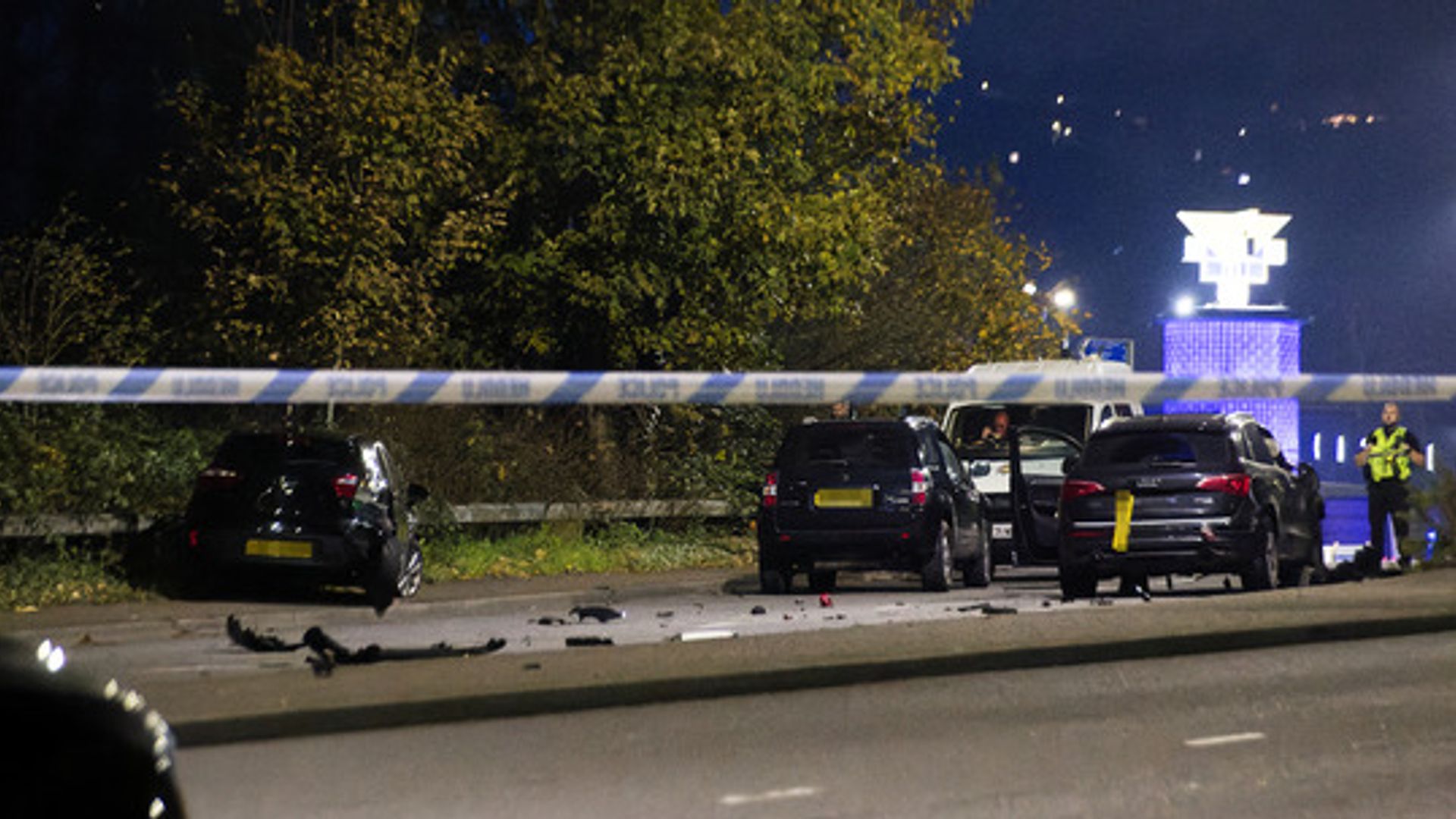
Within seconds, the glass of Elena’s rear passenger window spiderwebs into a thousand jagged crystals. A dark, punched-out hole appears in the metal of the rear quarter panel. Two figures sprint toward a waiting vehicle down the block, tires screech against damp pavement, and they are gone.
By the time the first patrol cars arrive, the immediate physical danger has vanished. Officers secure the perimeter. Forensics teams place small yellow numbered markers beside spent brass casings. Within hours, investigators track down a suspect vehicle, make two arrests, and declare a critical incident—a formal designation law enforcement uses to signal high-level coordination, major investigative resources, and heightened public safety protocols.
On paper, the system worked. Nobody died. The suspects are behind bars.
Yet if you knock on Arthur’s door three weeks later, or ask Elena why she now sits in her driveway for ten minutes with her engine running before she can force herself to unbuckle her seatbelt, you discover that the real story only begins after the crime scene tape comes down.
The Anatomy of a Critical Incident
People often confuse the term "critical incident" with a body count. When readers see those two words in a headline, their minds immediately jump to worst-case scenarios. In policing, however, a critical incident is defined not just by fatal outcomes, but by potential volatility, the severity of the threat to public order, and the level of scrutiny required to manage the aftermath.
Think of a critical incident declaration like a hospital declaring a code trauma before the ambulance even backs into the bay. It is an institutional gear-shift. Ordinary patrol routines are suspended. Detectives, ballistic experts, intelligence analysts, and senior commanders are pulled into a single unified command structure. Every piece of evidence—from CCTV footage on a corner grocery store to the microscopic striations on a recovered bullet—is treated with the urgency of a homicide investigation.
Why? Because a bullet fired at a car is a coin flip with human life.
Ballistics experts will tell you that the difference between property damage and a fatal shooting is often measured in millimeters and milliseconds. A slight gust of wind, a driver leaning forward to adjust the radio, a tire hitting a pothole at the exact fraction of a second a trigger is pulled—these are the razor-thin margins that separate a repair bill from a funeral.
When police arrest two suspects following an incident like this, the public breathes a collective sigh of relief. We want to believe that handcuffs act like an eraser, wiping away the trauma of the event. Having lived through the aftermath of neighborhood violence myself—watching my own street transform overnight from a place where children left bicycles on the front lawn into a corridor of drawn curtains and double-locked deadbolts—I can tell you that the eraser never quite works.
The Invisible Shockwave
There is a specific smell that lingers in a neighborhood after a shooting. It is a mix of burnt cordite, exhaust fumes from idling emergency vehicles, and the metallic tang of collective adrenaline. Even after the rain washes the street clean, the memory of that night stays lodged in the architecture of daily life.
Consider what happens next in our hypothetical scenario with Arthur and Elena.
For Elena, the damaged car becomes a physical monument to a moment she wants desperately to forget. Insurance adjusters use polite, bloodless phrases like "comprehensive claim" and "body work estimate." They talk about replacing the quarter panel and vacuuming safety glass out of the upholstery. They cannot vacuum out the phantom sound of the impact that wakes her up at three in the morning whenever a neighbor slams a car door.
Arthur, who wasn't even the target, experiences a quieter, more insidious shift. Psychologists who study community trauma refer to this as secondary exposure, though the people living through it simply call it losing your peace of mind. Before that night, Arthur never thought about sightlines from his living room window. Now, he notices which streetlights are burned out. He hesitates before taking the trash cans to the curb after dark.
Criminological research consistently supports what residents feel in their bones. Studies on urban and suburban gun violence demonstrate that a single shooting incident measurably depresses neighborhood foot traffic, reduces local business patronage, and spikes anxiety levels among residents within a half-mile radius for months afterward. The bullet hits one piece of metal, yet the shockwave shatters the invisible social contract that allows strangers to live peacefully side by side.
Why Two Arrests Are Only the Beginning
When news breaks that two suspects have been arrested in connection with a shooting, readers naturally assume the legal process moves swiftly toward justice. Television dramas have trained us to expect a neat resolution within forty-two minutes plus commercials.
Reality is far messier, slower, and fraught with uncertainty.
An arrest is merely the opening threshold of a labyrinthine legal journey. Under the law, taking two individuals into custody requires probable cause—a reasonable belief, grounded in facts, that they committed the crime. Convicting them in a courtroom requires proof beyond a reasonable doubt, a standard that demands airtight forensic and testimonial evidence.
In cases where a car is struck by gunfire, prosecutors face complex evidentiary puzzles:
- Establishing Intent: Did the shooter intend to kill the occupant, intimidate a rival, or fire recklessly without a specific target? The legal distinction between attempted murder, aggravated assault, and unlawful discharge of a firearm carries wildly different sentencing guidelines.
- Accomplice Liability: When two people are arrested, one may have pulled the trigger while the other drove the getaway car or supplied the weapon. Untangling who knew what, and when they knew it, can take months of digital forensics, cell tower mapping, and witness interviews.
- Forensic Linking: Investigators must match the bullet fragments lodged in the vehicle's frame to a specific firearm, and then link that firearm to the suspects' hands through gunshot residue or DNA evidence.
I have sat in courtrooms watching families wait eighteen months just for pre-trial motions to conclude. During that long, agonizing stretch, rumors swirl through the community. Neighbors wonder if retaliation is coming. Victims feel trapped in emotional limbo, unable to fully heal because the legal chapter remains stubbornly open.
The Architecture of Resilience
So how does a street heal when the headlines fade?
It does not happen through press conferences, and it rarely happens through policing alone. While law enforcement plays an essential role in removing immediate threats and securing accountability, long-term safety is built in the quiet, unglamorous spaces between neighbors.
Historians and sociologists who study community recovery after acute violence point to a recurring pattern: neighborhoods that bounce back fastest are those with strong "collective efficacy"—a fancy term for neighbors who actually know each other's names and look out for one another.
To visualize this, think of a neighborhood like a woven fishing net. A single gunshot tears a jagged hole right through the center. If the surrounding knots are weak and frayed, the tear spreads, and the whole net unravels into fear and isolation. If the knots are tight—if people check on their elderly neighbors, share porch light schedules, attend local precinct meetings, and refuse to surrender their sidewalks to fear—the net holds, and the hole can be mended.
In our hypothetical street, healing begins the first evening Arthur walks across the street with a warm loaf of bread, knocks on Elena’s door, and asks how she is holding up. It continues when three other neighbors decide to form a group chat to keep eyes on the block, when the city finally repairs the flickering streetlamp at the corner, and when children slowly begin riding their scooters down the sidewalk again.
We read short news blurbs about damaged cars and arrests every single week. Our eyes skim past the dates, the street names, and the official statements because our brains are overwhelmed by the sheer volume of bad news competing for our attention. It is easy to treat these reports as background noise—just another blip in the daily feed.
Until it happens outside your window.
The next time you see a headline announcing a critical incident and a pair of arrests, pause for ten seconds before scrolling past. Look beyond the broken glass and the police tape. Think about the person sitting in that parked car, the neighbor standing at the kitchen sink, and the long, quiet work of stitching a frightened street back together.
Out on that ordinary avenue, dusk is falling once again. One by one, along both sides of the street, the porch lights click on.