The hum of a refrigerator is the soundtrack of modern civilization. You never hear it until it stops.
I learned that lesson on a Tuesday night in February, sitting in a freezing living room with three dead smartphones and half a carton of melting ice cream. A localized grid failure—nothing cinematic, just a transformer fire coupled with an ice storm—had severed my neighborhood from the twentieth and twenty-first centuries in less than four seconds. Within two hours, the cell towers went dark because their backup batteries ran dry. Within four, the municipal water pressure dropped to a hesitant, rusty drip. By dawn, the corner grocery store had locked its glass doors because the electronic cash registers wouldn't boot and the sliding entrances couldn't open without a current.
We like to believe we live in an age of pure frictionlessness. Tap a glass screen, and food arrives at the porch. Flip a plastic toggle, and darkness retreats. Turn a chrome handle, and clean water pours endlessly into a ceramic basin. Yet that velvet smoothness hides a terrifying brittleness. Our modern infrastructure is a high-wire act performed without a net, optimized for efficiency rather than endurance.
Now, quietly, without sirens or panic, the people in charge of keeping entire nations running are starting to whisper a truth they spent decades trying to help us forget.
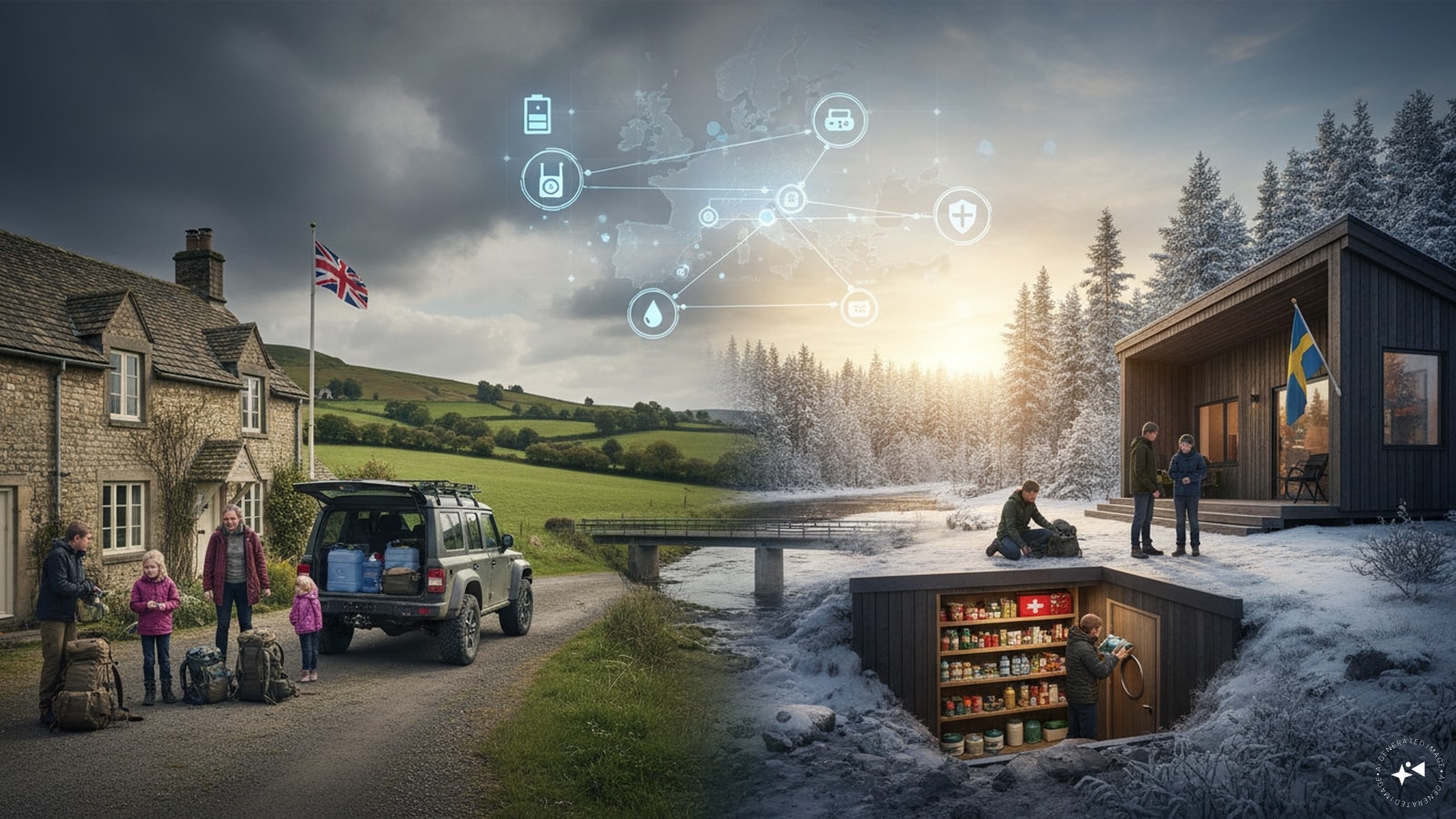
Across Europe, from the damp coastal towns of Britain to the snow-dusted forests of Sweden, governments are mailing pamphlets, launching websites, and knocking on the psychological doors of millions of households. Their message is deceptively simple, almost domestic in its modesty. Buy some bottled water. Keep a stash of tinned beans. Buy a radio that runs on batteries, not Wi-Fi. Learn how to survive on your own for seventy-two hours.
To understand why this is happening right now, we have to look past the headlines and step inside the kitchens of ordinary people living through a strange, unsettled era.
The Pamphlet in the Mailbox
Consider a hypothetical evening in Gothenburg, Sweden. Let’s call our protagonist Astrid—a forty-two-year-old graphic designer who spends her days debating typography and her evenings walking her terrier along the harbor. Astrid is not a survivalist. She does not own camouflage trousers, nor does she spend weekends burying ammunition crates in the woods. She is a thoroughly modern European citizen who trusts the municipal snowplows to clear her street by six in the morning and expects the pharmacy to have her daughter’s asthma inhaler in stock.
Then, an envelope arrives.
Inside is a bright, starkly illustrated booklet titled In Case of Crisis or War. The Swedish Civil Contingencies Agency—known locally as MSB—has updated and distributed millions of copies of this guide to every household in the country. Similar movements are rippling outward. In Britain, the government launched its Prepare website, urging citizens to assemble an emergency kit complete with wind-up torches, spare batteries, and three days of non-perishable food. Finland has maintained its legendary culture of kokonaisturvallisuus—comprehensive security—for generations, instructing families to keep a home reserve capable of sustaining them independently for seventy-two hours. Germany, France, and the Baltic states have all dusted off civil defense playbooks that sat gathering cobwebs since the autumn of 1989.
Why the sudden urgency?
For thirty years after the Cold War ended, Western democracies operated under a comforting illusion called the "peace dividend." Governments dismantled public air-raid shelters, sold off strategic grain reserves, and privatized utilities to squeeze out every penny of short-term savings. Citizens, in turn, outsourced their survival entirely to the supply chain. Why keep five gallons of water under the stairs when the supermarket down the road is open twenty-four hours a day?
History, however, refused to stay retired.
When Russia invaded Ukraine in 2022, European defense planners watched in real time as artillery and drones targeted not just military barracks, but electrical substations, water treatment plants, and fiber-optic cables. At the exact same moment, climate extremes began hammering the continent with unprecedented ferocity—flash floods tearing through German valleys, heatwaves buckling British railway tracks, and wildfires forcing evacuations across the Mediterranean. Add to that the invisible warfare of the digital age, where a single well-placed cyberattack can paralyze a hospital network or shut down a fuel pipeline, and the math changes overnight.
The state cannot be in every living room at once.
The Seventy-Two-Hour Gap
Think of national emergency response like an ambulance driving through rush-hour traffic. No matter how skilled the paramedics are, no matter how loud the siren wails, it takes time to clear the intersection. In a major crisis—whether a severe winter storm, a cyberattack on the power grid, or a geopolitical shock—first responders, military engineers, and utility crews are immediately overwhelmed by the most critical targets. They have to keep intensive care units powered, clear fallen trees from arterial highways, and restore high-voltage transmission lines.
They cannot come to your apartment to bring you drinking water on day one. They probably cannot reach you on day two either.
This window—roughly three full days—is what emergency planners call the resilience gap. If ten million households panic simultaneously because they have zero food, zero water, and zero information, the resulting chaos paralyzes the very authorities trying to fix the crisis. Roads clog with desperate drivers searching for open gas stations. Emergency phone lines collapse under millions of non-lethal calls from people simply asking what is going on.
Conversely, if those same ten million households can close their curtains, light a candle, eat cold lentils from a tin, and listen to a battery-powered radio for seventy-two hours, something miraculous happens. The street stays quiet. The roads stay clear. The ambulances get through.
Preparation, it turns out, is not selfish hoarding. It is an act of civic solidarity.
Let’s test this idea through another hypothetical lens. Picture Marcus, a thirty-five-year-old software engineer living in a fourth-floor flat in Manchester, England. When the British government first rolled out its preparedness guidance, Marcus laughed it off over pints with friends. The tabloid press mocked the advice as "nanny state panic," conjuring images of bunkers and tinfoil hats. Marcus had cloud backups for his code, automated deliveries for his coffee beans, and Apple Pay on his watch. What could possibly go wrong?
Now imagine a severe North Sea storm knocks out regional transmission lines in mid-January, coinciding with a sub-zero cold snap.
Hour one feels like an adventure. Marcus lights a scented candle and reads a book by the glow of his phone screen.
Hour six feels uncomfortable. The flat’s radiator has gone stone cold. His phone battery drops to fourteen percent, and the cellular data bar disappears entirely because the local mast’s backup generator has failed. He has no idea if the blackout covers his block or the entire north of England.
Hour twenty-four feels frightening. His tap runs dry because electric pumps are required to push water up to the fourth floor. He realizes his pantry contains half a bag of dry pasta—which he cannot boil without electricity—some condiments, and a bottle of olive oil. He has no cash in his wallet, and the corner shop down the street is only accepting coins and notes because the card terminals are dead.
Marcus isn't facing an apocalypse. He is facing a completely ordinary infrastructure failure. Yet because he relied entirely on invisible, fragile systems, three days without electricity turns into a genuine personal crisis.
The Psychology of Denial
If the logic of keeping a modest emergency stash is so blindingly obvious, why do most of us resist it so fiercely?
I have spent years studying how ordinary people respond to risk, and I still catch myself falling into the exact same traps. Even after my own freezing Tuesday night without power, it took me four months to actually buy a proper hand-crank radio and store twenty liters of water in the back of my closet. Why did I procrastinate? Because buying a jerrycan forces you to admit, on a quiet, sunny Saturday afternoon, that the world is not guaranteed to stay safe.
Psychologists call this normalcy bias—the brain’s deeply wired tendency to assume that because things have always functioned smoothly, they will continue to function smoothly tomorrow. Our minds are magnificent engines for pattern recognition, which makes us terrible at anticipating rare disruptions. To prepare for an emergency feels like inviting bad luck into the house. It feels morbid, paranoid, slightly embarrassing—like wearing a life jacket on a luxury cruise ship while everyone else is sipping champagne by the pool.
Governments know this. That is why the tone of modern civil defense campaigns has shifted dramatically from the Cold War era.
In the 1950s and 1980s, public safety brochures were terrifying documents filled with diagrams of nuclear blast radii and instructions on how to whitewash your windows against thermal radiation. They paralyzed people with dread. Today’s booklets from Stockholm, London, and Helsinki read more like practical housekeeping guides. They talk about pet food, baby formula, wet wipes, and board games to keep children calm when the television won't turn on. They treat crisis not as the end of the world, but as a temporary, manageable disruption—like camping in your own living room.
There is a profound wisdom in this framing. Panic thrives in a vacuum of agency. When something goes wrong and you have nothing—no light, no water, no plan—helplessness curdles instantly into terror. When you reach into a cupboard and pull out a heavy flashlight, a stack of extra batteries, and a five-liter jug of clean water, the emotional temperature in the room drops immediately. You are no longer a victim waiting to be rescued. You are a capable adult handling an inconvenience.
The Anatomy of Quiet Readiness
So what does real, grounded preparedness actually look like when you strip away the internet’s obsession with tactical backpacks and freeze-dried survival buckets?
It looks remarkably boring. In fact, if your emergency kit looks like an action movie prop, you probably did it wrong. True resilience is built out of ordinary household items rotated quietly through your daily life.
Water comes first. Human beings can survive weeks without food, yet three days without water will put an adult in the hospital. Governments generally recommend storing at least three liters of water per person, per day, for three days. For a family of four, that is thirty-six liters—roughly two large plastic crates tucked beneath a bed or at the bottom of a wardrobe. You don't need tactical canteens; standard supermarket multipacks of still mineral water work brilliantly, provided you drink and replace them every six to twelve months so the plastic doesn't degrade.
Food comes second, and heat is the enemy. The golden rule of emergency food is simple: assume you cannot cook it. Tinned chickpeas, tuna, sardines, peanut butter, crackers, dried fruit, and UHT milk require zero electricity, zero gas, and zero clean water to prepare. Choose things you actually like eating on a normal Tuesday. If you hate canned mackerel today, you will resent it deeply during a blackout.
Information is oxygen. When the internet vanishes, rumor fills the void within minutes. Social media—if you can even reach a cell tower—becomes a hall of mirrors amplifying panic and misinformation. A simple battery-powered or wind-up FM/AM radio connects you directly to emergency broadcast frequencies, which national broadcasters in Britain, Sweden, and across Europe maintain on hardened backup power specifically for blackouts.
Warmth and light keep the mind steady. Darkness amplifies anxiety. A few LED lanterns—far safer than open-flame candles, which cause a tragic spike in house fires during every major power outage—transform a pitch-black apartment back into a home. Add thermal blankets, thick wool socks, a basic first-aid kit, a week’s supply of essential prescription medications, and a small envelope of physical cash in small denominations.
Notice what is missing from this list. There are no weapons. There are no gas masks. There is no bunker mentality. Everything on that list serves one single purpose: buying you seventy-two hours of calm dignity while the engineers out in the rain and the dark put the world back together.
A Different Kind of Strength
Last autumn, I visited an elderly friend in rural Sweden whose family has lived on the same stretch of rocky coastline for four generations. In his mudroom, neatly stacked beside the rubber boots and winter coats, sat four heavy blue jerrycans of water, a crate of canned soups, a box of thick beeswax candles, and a weathered transistor radio.
I asked him if he was worried about the news—the naval cables being cut in the Baltic Sea, the cyberattacks on municipal servers, the warnings coming out of Stockholm.
He shrugged, pouring coffee from a thermal carafe. "Worried? No," he said. "If you live near the sea, you don't get angry at the wind. You just make sure the roof is nailed down before November."
That is the shift we are witnessing across Europe right now. For a generation, we mistook convenience for permanence. We built glass towers and wireless networks and forgot that beneath all of it still lies a physical world of copper wires, water pipes, weather fronts, and human fallibility.
The governments urging citizens to pack a small kit aren't trying to frighten us back into the twentieth century. They are asking us to grow up. They are inviting us to trade a tiny sliver of our modern helplessness for a quiet, unshakeable competence.
Go walk into your kitchen tonight. Open the pantry door, look at the shelves, and ask yourself a simple, honest question: if the hum of the refrigerator stopped right now, how long until you started to worry?


