At four in the morning, before the roosters in East Java wake the neighborhood and long before the first commuter scooters choke the arteries of Jakarta, Budi turns the key in his aging diesel generator.
Budi is a hypothetical composite, a stand-in for thousands of small-scale ice factory owners scattered across the Indonesian archipelago, yet the sweat on his brow and the ledger trembling in his hands are painfully real. In his line of work, the hum of the motor is the sound of survival. Without ice, the morning catch from the local fishing boats rots under the equatorial sun by noon. Without diesel, the compressors die. For the past two years, Budi has watched the price of that fuel creep upward, eating away at the thin margins that keep his three children in school and his four employees fed.
He does not read quarterly energy whitepapers. He does not care about geopolitical hedging strategies or the intricacies of sovereign debt ratings. Yet Budi is living on the jagged edge of a question currently keeping policymakers in Jakarta awake at night.
Will diversifying fuel imports actually be enough to fix Indonesia’s deepening energy shortfall?
On paper, the strategy sounds reassuringly sensible. When your house is running out of water and your single well is drying up, you do not rely on one neighbor’s bucket; you strike deals with five different villages. For years, Indonesia—once a proud OPEC exporter that helped fuel the twentieth century—has been quietly sliding into the uncomfortable reality of a net oil importer. Domestic crude production has tumbled from a peak of roughly 1.6 million barrels per day in the mid-1990s to hovering stubbornly below 600,000 barrels today. Aging fields, decades of underinvestment in exploration, and geological fatigue have turned an energy giant into a vulnerable buyer.
So, Jakarta is shopping around. The government and state-owned energy giant Pertamina have been aggressively widening their procurement net—signing memorandums with suppliers in the Middle East, exploring crude and liquefied petroleum gas shipments from the United States, and weighing discounted barrels from non-traditional partners. Diversification is the buzzword of the hour in ministry boardrooms.
It is a neat, logical answer. And it is dangerously incomplete.
The Illusion of the Wider Net
To understand why changing where the tankers come from fails to solve the core crisis, you have to picture Indonesia’s energy system not as a pipeline, but as a leaky bucket carried up a steep mountain.
Think of the mountain as economic growth. Indonesia is Southeast Asia’s largest economy, a sprawling nation of over 280 million people whose appetite for electricity, transport fuel, and industrial power grows hungrier every single year. Millions are entering the middle class, buying their first motorbikes, installing air conditioners against the relentless tropical heat, and powering factories that refine nickel for the world’s electric vehicle batteries. Demand is sprinting uphill.
Now look at the bucket. Even if Jakarta successfully diversifies its fuel imports—sourcing crude from West Africa, LPG from Texas, and refined products from Singapore and the Gulf—every drop poured into that bucket is still subject to the violent whims of global commodity markets and the unforgiving math of currency exchange.
When the US dollar flexes its muscle against the Indonesian rupiah, the cost of imported fuel spikes overnight, regardless of whether the tanker sailed from Houston or Ras Tanura. Diversification protects you if a single shipping lane is blockaded or one supplier suffers a refinery fire. It offers shelter against isolated supply shocks. It does not, however, shield a nation from a systemic structural deficit. If global crude prices surge because of conflict in the Middle East or production cuts by major cartels, every supplier on Indonesia’s newly diversified contact list raises their prices in unison.
You haven't escaped the storm. You have simply bought umbrellas from four different vendors while standing in the same hurricane.
The Invisible Weight on the State
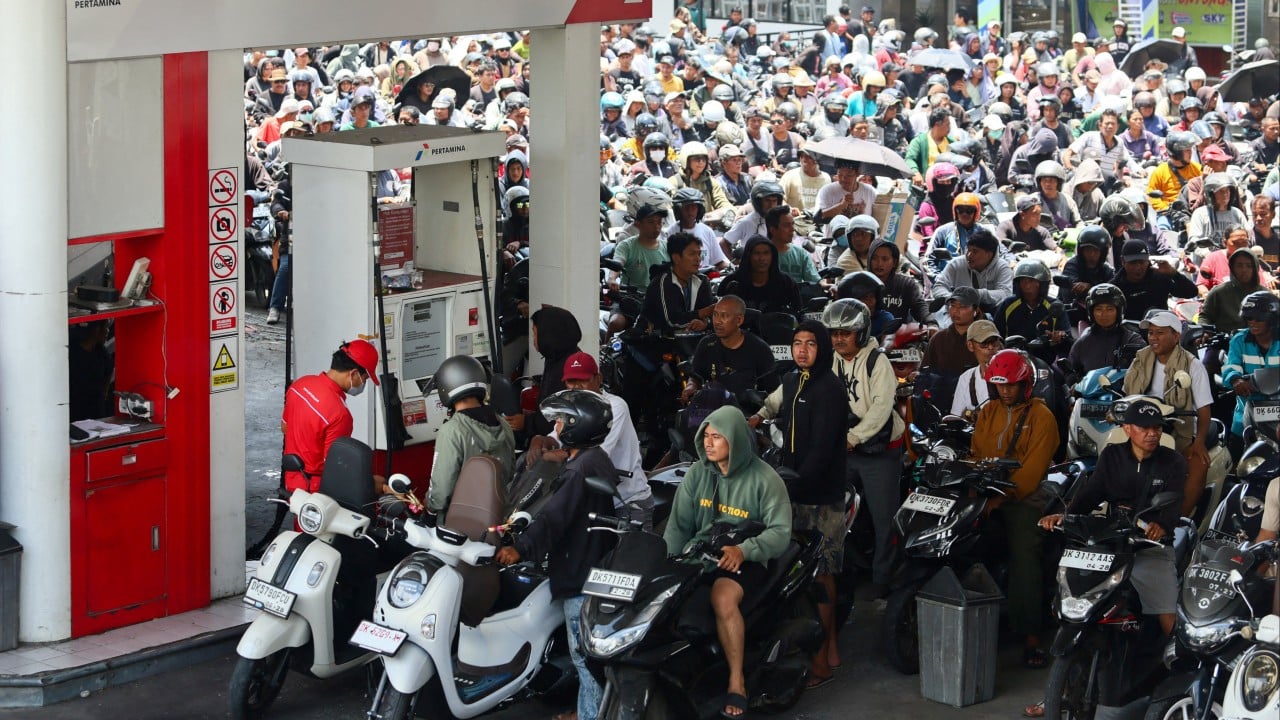
I remember standing at a congested fuel station in Makassar a few years ago during a period of rumored price adjustments. The line of motorbikes stretched half a kilometer down the road, engines idling in the thick, humid air, riders scrolling anxiously through their phones. There was no panic, just a heavy, resigned tension. Everyone in that queue understood an unspoken truth of Indonesian life: the price at the pump is the heartbeat of the household budget.
When subsidized fuel—Pertalite or Biosolar—rises by even a fraction, the ripple effect is immediate and merciless. The cost of transporting chili peppers from the highlands to the city markets jumps. Bus fares tick upward. The price of a bowl of bakso on the street corner quietly increases.
Because fuel prices are deeply political, the Indonesian government absorbs the shock through massive energy subsidies, shelling out tens of billions of dollars in years when global oil runs hot. This is the invisible tax of import dependence. Every trillion rupiah spent subsidizing imported gasoline and LPG is a trillion rupiah stolen from rural health clinics, flood defenses for sinking coastal towns, and classrooms in eastern Indonesia.
Diversifying import sources does almost nothing to relieve this fiscal bleeding. In fact, sourcing fuel from farther afield—such as bringing liquefied petroleum gas across the Pacific from the United States rather than relying solely on closer Middle Eastern hubs—often introduces higher freight and logistics costs. You gain geopolitical breathing room, yes, but you pay a premium for the privilege.
The Bottleneck Nobody Wants to Talk About
There is another, quieter flaw in the import-diversification thesis, one written in rusted steel and delayed blueprints rather than diplomatic treaties.
Indonesia does not just have a crude oil problem; it has a refining problem.
For decades, the country’s refinery infrastructure has struggled to keep pace with modern demand. Several of Pertamina’s major refineries date back to the mid-twentieth century, retrofitted and patched over time but fundamentally constrained in capacity and complexity. Because domestic refineries cannot process enough crude to meet national appetite—nor handle all grades of heavier, sourer crudes efficiently—Indonesia is forced into an expensive double bind: exporting certain types of crude oil it cannot easily refine at home while importing vast quantities of already-refined gasoline, diesel, and petrochemical feedstocks.
Imagine a timber-rich village that has to sell raw logs to a neighboring town at a discount, only to buy back finished wooden planks at retail prices because its own sawmill is too small and outdated.
Upgrading and building new refineries—projects like the long-awaited Balikpapan expansion or the ambitious Tuban grassroots refinery—takes tens of billions of dollars and years of grueling engineering. Until those steel towers actually come online and run at full capacity, diversifying where Indonesia buys its raw crude is like buying exotic ingredients for a kitchen whose stove is broken. You still end up ordering takeout.
The LPG Trap in Every Kitchen
Walk into almost any home from Medan to Merauke, and you will see a small, bright green three-kilogram gas canister tucked beneath the stove. Known affectionately as the melon, this little cylinder is one of the greatest public policy triumphs in modern Indonesian history. Starting in 2007, a massive government program successfully weaned tens of millions of families off dirty, dangerous kerosene and onto cleaner-burning liquefied petroleum gas.
It saved lives, cleared smoke from millions of kitchens, and freed women from hours of hunting for firewood.
It also quietly tethered the daily meals of an entire nation to foreign gas terminals.
Today, roughly seventy to eighty percent of Indonesia’s LPG is imported. While the country sits atop vast reserves of natural gas, much of it is methane-rich gas suited for LNG exports or power plants rather than the propane and butane required for household LPG cylinders. Every time a mother in Surabaya lights her stove to fry tempeh before dawn, she is burning gas that likely traveled thousands of nautical miles across open ocean.
Diversifying LPG suppliers—looking toward North America alongside traditional Gulf partners—is a prudent tactical move to ensure ships keep arriving on time. Yet it leaves the underlying vulnerability completely intact. As long as domestic cooking relies on imported canisters, the state remains trapped in an open-ended subsidy commitment that grows heavier with every newborn child and every new household formed.
What Real Energy Security Looks Like
If diversifying imports is merely a painkiller rather than a cure, what does actual healing require?
It requires shifting the center of gravity from buying better to needing less of what we cannot produce.
Consider the quiet revolution already taking shape in pieces across the archipelago, often overshadowed by flashy diplomatic announcements. First, there is the aggressive push into biofuels. By mandating higher blends of palm-oil-based biodiesel—moving from B30 to B35 and eyeing B40—Indonesia has tapped into a resource it controls in abundance. Critics rightly point to the ecological tightrope of palm oil expansion and the need for strict sustainability guardrails, yet from a purely energetic standpoint, every liter of domestic biofuel displaces a liter of imported diesel that would otherwise drain foreign currency reserves.
Second, and far more transformative over the long arc, is the electrification of mobility and cooking. Indonesia possesses the world’s largest reserves of nickel, a cornerstone mineral for modern batteries. Pair that industrial leverage with abundant, largely untapped geothermal energy simmering beneath the volcanic Ring of Fire, massive solar potential, and hydroelectric rivers in Kalimantan and Papua.
If a commuter in Bandung trades a gasoline scooter for an electric motorbike charged by geothermal power, that is a permanent amputation of import demand. If urban households transition from imported LPG canisters to induction stoves powered by domestic grids, the melon subsidy begins to shrink organically.
Yet here, too, honesty demands admitting how messy the road ahead truly is. Indonesia’s power grids—particularly in Java and Bali—still rely heavily on coal, while eastern islands suffer from patchy transmission infrastructure. Rolling out millions of induction stoves or EV charging networks is not a switch you flip in a ministry office; it is a generational slog of copper wire, transformer upgrades, consumer financing, and trust-building. People do not abandon a reliable gas canister for an electric stove if the neighborhood transformer trips every time it rains.
Back to the Hum of the Generator
Which brings us back to four in the morning in East Java, and the steady, stubborn vibration beneath Budi’s boots.
Budi does not need politicians to promise him that tankers are now sailing from three continents instead of one. Diversifying fuel imports is a smart insurance policy for a nation navigating a fractured, unpredictable world. When geopolitical tremors rattle the Strait of Hormuz or supply chains snarl, having multiple doors to knock on prevents immediate blackouts and empty pumps. Policymakers would be reckless not to pursue it.
Mistaking an insurance policy for a business model, however, is how nations sleepwalk into crisis.
True energy security for Indonesia will not be signed in a hotel ballroom in Doha or Houston. It will be built slowly, stubbornly, at home—in modernized refineries that finally run at full tilt, in volcanic steam harnessed beneath mountain slopes, in tangled copper grids upgraded village by village, and in the slow weaning of an economy off fuels it must beg the world to sell it.
Until that deeper work catches up with the nation’s ambition, every dawn across the archipelago will begin the same way: with millions of engines turning over, and a quiet, unspoken prayer that the ships out on the horizon arrive before the tanks run dry.


