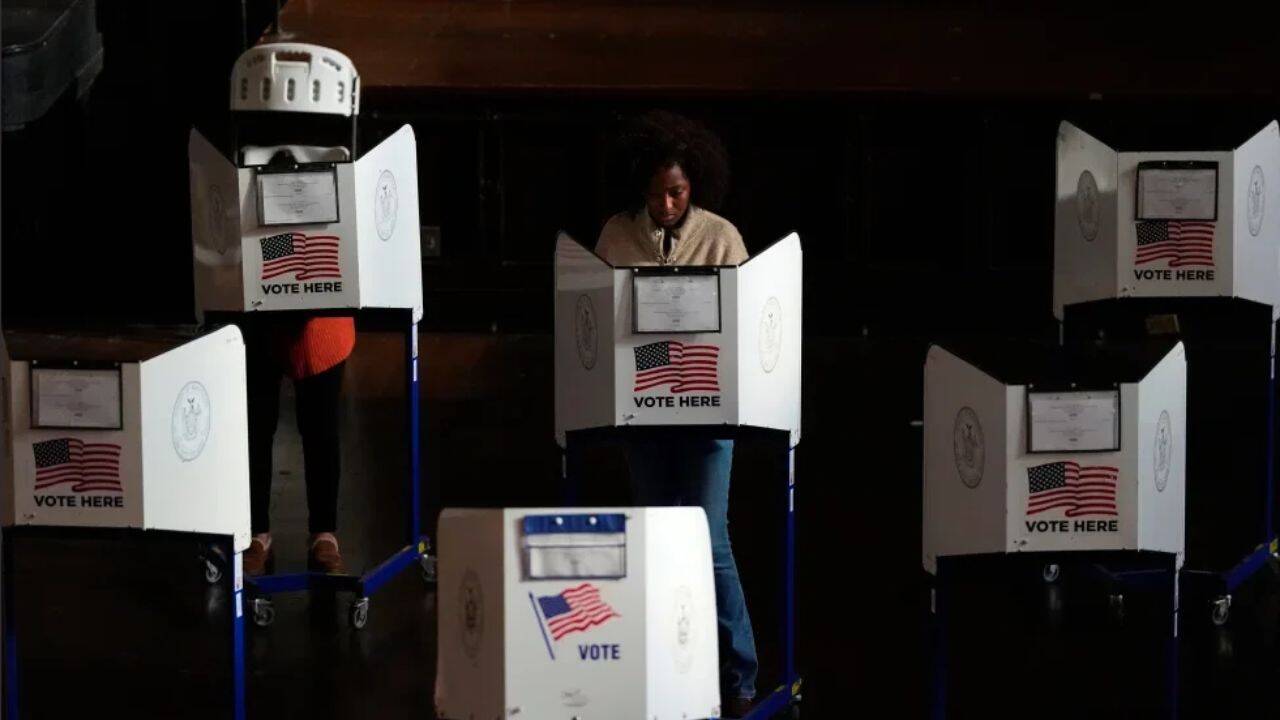
The fluorescent lights in a county gymnasium buzz at a frequency that eventually settles right behind your eyes. It smells like floor wax, damp wool coats, and the faint, metallic tang of stale coffee kept warm on a burner since five in the morning.
This is the engine room of American democracy. It is not marble pillars or gilded chambers. It is folding tables, extension cords taped down with neon yellow gaffer tape, and three dozen retired schoolteachers, postal workers, and suburban dads trying to read handwriting that looks like seismograph charts.
For decades, the hardest part of this job was surviving on four hours of sleep and figuring out why the thermal printer jammed at 6:58 PM.
Now, the hardest part is deciding whether to check the rearview mirror on the drive home.
Consider a hypothetical poll worker—let us call her Evelyn—sitting at Table 4 in a swing-state precinct. Evelyn is sixty-eight. She has worked every primary, general, and special election since the first Bush administration because her father told her that republics do not run on autopilot. Across from her stands a man in a tactical vest, filming her face with an iPhone held six inches from her nose, demanding to know why the electronic poll book took four seconds instead of two to verify his neighbor's address.
Evelyn’s hands shake slightly as she hands him a provisional ballot. She smiles, keeps her voice level, and recites the script she memorized during Saturday morning training.
Behind that calm exterior, she is calculating the distance between her folding chair and the gymnasium's fire exit.
When Bureaucracy Becomes a Battlefield
We used to treat election administration like municipal plumbing. Nobody thought about the pipes until the basement flooded, and nobody knew the name of the county clerk unless they needed a marriage license or a dog tag.
That invisibility was a feature, not a bug. Democracy relies on millions of unglamorous, hyper-local transactions executed by ordinary citizens who hold zero partisan authority while on the clock. Think of election workers as the referees of a championship game where both teams are convinced the rules are rigged—except these referees get paid twelve dollars an hour, wear laminated lanyards, and have no whistle to stop the clock when the crowd storms the court.
Over the past several election cycles, the temperature inside those gymnasiums has spiked from tepid to boiling. According to surveys conducted by the Brennan Center for Justice, roughly one in three election officials report experiencing harassment, abuse, or threats because of their job. More than half express deep concern about the safety of their colleagues.
Numbers on a page feel sterile. Threats on a voicemail do not.
When the Department of Justice launched its Election Threats Task Force in 2021, investigators did not find a handful of grumpy voters blowing off steam. They uncovered a relentless stream of graphic death threats directed at civil servants, their spouses, and their children. Election directors in states like Arizona, Georgia, Michigan, and Pennsylvania have had their home addresses published online—a practice known as doxxing—turning quiet cul-de-sacs into surveillance zones.
Fear works slowly, like rust on a hinge. It does not require a physical attack to break the mechanism; it only requires making the cost of participation feel unbearably personal.
The Architecture of Vulnerability
To understand why these threats hit so hard, you have to understand how radically decentralized—and underfunded—the American voting system actually is.
Unlike countries with a single national election ministry, the United States runs more than ten thousand separate local election jurisdictions. A massive metropolitan county in California might have a multi-million-dollar security budget, biometric access controls, and a dedicated sheriff’s detail. Three hundred miles away, a rural county clerk in Nevada or Wisconsin might operate out of a converted storage room in the basement of a 1920s courthouse, managing fifty thousand ballots with a staff of two and a panic button installed only after someone threatened to burn down the building.
So, who actually protects the people counting America's votes?
The honest, uncomfortable answer is a patchwork quilt stitched together out of local police departments, federal task forces, emergency grants, and sheer improvisation.
On paper, protection comes from several layers:
- Local Law Enforcement: County sheriffs and municipal police are the first line of physical defense, patrolling polling places and escorts for ballot transport vehicles.
- State Legislatures: A growing number of states have passed laws making it a specific felony to threaten or intimidate election workers, alongside address-confidentiality programs that scrub officials' home locations from public property records.
- Federal Oversight: The FBI, the Department of Justice, and the Cybersecurity and Infrastructure Security Agency (CISA) provide threat intelligence, active-shooter training, and prosecution muscle when threats cross state lines.
In practice, that safety net has gaping holes.
In many rural counties, the local sheriff is an elected partisan official whose political loyalties may clash directly with the nonpartisan clerk running the election. When an election director asks for deputies to stand outside a ballot-processing center, the response can range from immediate, professional solidarity to a shrug and a reminder that the department is already short-staffed.
Even when law enforcement is fully committed, there is a delicate constitutional tightrope to walk. Armed officers stationed too close to a ballot box can look less like protection and more like voter intimidation, particularly in communities with painful histories of disenfranchisement. Security has to be present enough to deter violence, yet invisible enough to let democracy breathe.
The Great Exodus of Institutional Memory
I still remember the first time I watched a county clerk break down during a public budget hearing. She wasn't crying because of a specific threat; she was crying because three of her most experienced precinct captains—women who knew every street boundary, nursing home protocol, and signature-verification rule by heart—had walked into her office that morning and handed back their keys.
They hadn't been attacked. They were just tired of being treated like criminals by neighbors they had known for twenty years.
This is the invisible crisis unfolding beneath the headlines. When veteran election officials quit, they do not just leave an empty desk. They take decades of institutional memory out the door with them.
Running an election is an intricate logistical ballet. It involves chain-of-custody logs, logic and accuracy testing on optical scanners, bilingual ballot proofing, ADA compliance checks, and reconciling every single spoiled ballot down to the last sheet of paper. You cannot download that expertise overnight.
Across the country, turnover among chief local election officials has surged to historic highs. In several western and midwestern states, upwards of forty percent of county election directors administering recent cycles were brand new to the job.
Imagine replacing forty percent of the air traffic controllers at O'Hare International Airport right before Thanksgiving weekend, and then standing outside the tower with megaphones accusing them of crashing the planes on purpose.
That is the operational reality facing American elections. Rookie administrators are more likely to make innocent clerical errors—a misprinted mailing label, a delayed precinct tally, a jammed tabulator—and in today's hyper-suspicious climate, every honest human mistake is immediately weaponized as proof of a grand conspiracy.
What Happens Inside the Counting Room
If you have never spent an evening inside a central ballot-tabulation facility, it is easy to imagine smoke-filled back rooms and mysterious algorithms. The reality is profoundly dull—and rigorously transparent.
Picture a warehouse-sized room ringed by thick glass walls or yellow stanchions. Inside, workers operate in strict bipartisan pairs. One Democrat, one Republican. Always two sets of eyes on every envelope, every signature, every unfolded sheet of paper. If a ballot has a coffee stain or a stray pen mark that prevents the scanner from reading it, the bipartisan team recreates the voter's exact intent onto a clean duplicate ballot while both sign a logbook attesting to the transfer.
Every box of ballots is sealed with numbered, tamper-evident zip ties that are recorded on clipboards at every step of the journey from the precinct to the central vault.
During recent midterm cycles, many counties took the extraordinary step of installing bullet-resistant glass around these tabulation rooms, reinforcing exterior doors with steel plates, and installing 24-hour livestream cameras pointed at the ballot vaults. Some facilities now require workers to pass through magnetometers just to reach their desks, while snipers watch from adjacent rooftops during peak counting nights.
Think about the psychological weight of that transformation.
The physical architecture of transparency—the glass walls meant to let the public witness the integrity of the count—has had to be upgraded to ballistic-grade polycarbonate to stop high-velocity rounds. We are literally armoring the windows of democracy so people can look through them safely.
The Quiet Courage of Showing Up
Despite the vitriol, the surveillance, and the sleepless nights, something remarkable keeps happening every time the polls open.
People still show up.
They show up in small towns in Iowa, in sprawling suburbs outside Atlanta, and in rain-soaked precincts in Seattle. They haul rolling suitcases full of snacks, reading glasses, and hand sanitizer into elementary school cafeterias at dawn. They tape the yellow caution lines to the linoleum floor. They plug in the machines.
Why? Because once you have worked an election, you realize that the ritual itself is fragile. It exists only because ordinary humans agree to perform it together in good faith.
Let us return to Evelyn, our hypothetical poll worker at Table 4.
The man in the tactical vest eventually finishes filming, drops his provisional ballot into the locked slot, and walks out into the cool November air. Evelyn exhales. Her heart rate slows down. Ten minutes later, a young man in paint-splattered work boots walks up to her table. He looks nervous, shifting his weight from foot to foot.
"First time," he mutters, handing over his ID. "Not really sure how this works."
Evelyn’s posture changes instantly. The tension leaves her shoulders. She leans forward, explains how the privacy sleeve works, points him toward the voting booth, and hands him an "I Voted" sticker with a genuine, unforced warmth.
For thirty seconds, the noise outside the gymnasium doors disappears completely.
Holding the Line
We cannot outsource the survival of self-government to armor plating, felony statutes, or federal task forces. Those tools are vital shields, and every jurisdiction owes its workers the fullest measure of physical and legal protection available.
Yet laws only punish harm after it occurs. Badges only guard the perimeter.
The real defense of the American ballot box happens in the quiet civic bargain struck between neighbors—the agreement that we can argue fiercely over policy, candidates, and the direction of the country without turning the people who count the votes into enemies of the state.
At eight o'clock on election night, when the last voter has left the building and the heavy gym doors are bolted from the inside, two workers—one from each party—will walk together to the front of the room, break the plastic seal on the ballot box, and begin the long, meticulous count under the hum of the fluorescent lights.