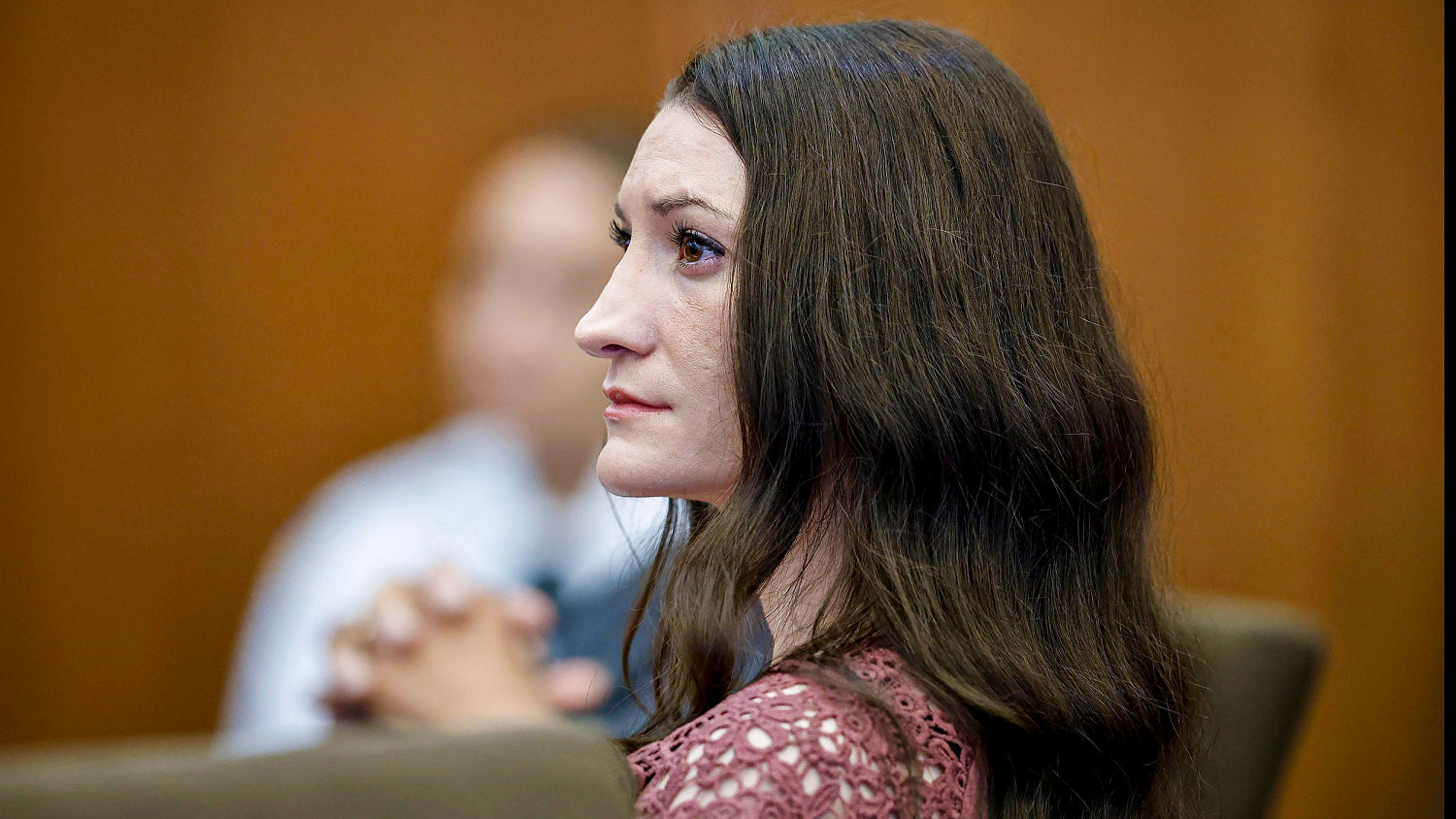
Silence.
That is the thing nobody prepares you for when you sit on the wooden benches of a Massachusetts courtroom during a trial involving the death of children—not the shouting of lawyers or the rustle of legal pads, but a heavy, suffocating quiet that seems to press against your eardrums until you realize everyone in the room is holding their breath at the exact same second.
In March, that silence returns to Plymouth County.
Lindsay Clancy, the former labor and delivery nurse from Duxbury whose name became shorthand for an unthinkable suburban nightmare in January 2023, is scheduled to face a retrial over the strangulation deaths of her three young children: five-year-old Cora, three-year-old Dawson, and eight-month-old Callan. After a mistrial left the legal system suspended in mid-air, prosecutors and defense attorneys are preparing to step back into the arena, armed with psychiatric records, prescription logs, and competing definitions of what it means to lose your mind.
Most news reports reduce this case to a brutal timeline. They list the charges—three counts of murder, three counts of strangulation—and note the calendar date in March when jury selection begins anew. They treat the retrial like a procedural scheduling update.
They miss the entire point.
What happens in that courtroom this spring is not merely a legal accounting of one catastrophic evening on Summer Street. It is a collision between two irreconcilable ways human beings try to survive tragedy: the demand for moral accountability and the terrifying reality of a brain that has completely severed its tether to reality.
The Architecture of an Unthinkable Night
To understand why a second trial is tearing at the nerves of everyone watching, you have to look at the distance between the life Lindsay Clancy built and the twenty-five minutes in which it ended.
Before January 24, 2023, the ledger of her life looked like an advertisement for stability. She worked at Massachusetts General Hospital, guiding other women through the threshold of motherhood. Neighbors in Duxbury described a devoted mother who kept meticulous journals about her children’s milestones, worried over their nutrition, and organized their days with gentle precision.
Then came the spiral.
Consider what happens when a high-functioning mind begins to fracture from the inside out. In the months following the birth of her youngest son, Callan, Clancy sought help repeatedly. She did not hide in the shadows; she entered the medical system with the fluency of a nurse who trusted clinical intervention. Over a span of roughly four months, doctors prescribed a rotating cascade of psychiatric medications—antidepressants, mood stabilizers, benzodiazepines, and sleep aids—adjusting dosages as her anxiety hardened into insomnia, agitation, and terrifying intrusive thoughts.
Think of a circuit breaker box in an old house during a summer storm. When one appliance draws too much current, the switch flips to protect the wiring behind the wall. Now imagine someone standing at that panel, taping the switches open while forcing higher and higher voltage through the lines, hoping the lights will stay on until morning.
By late January 2023, the wiring failed.
On the evening of January 24, Clancy’s husband, Patrick, stepped out to pick up takeout food and children’s medication—an errand lasting less than half an hour. When he returned to the quiet house, he found his wife injured on the ground outside after jumping from a second-story window, and his three children unresponsive in the basement, each strangled with exercise bands.
Cora and Dawson died that night. Callan died days later in a Boston hospital. Clancy survived, paralyzed from the waist down.
Why the First Trial Fractured
When the first trial ended without a verdict, observers outside the courthouse looked for simple villains. Was the prosecution too rigid? Was the defense relying too heavily on sympathy?
The truth is far more unsettling. A hung jury or mistrial in a case like this exposes a fault line running straight through modern criminal law.
In Massachusetts, the standard for criminal responsibility—what the public colloquially calls the insanity defense—hinges on a strict legal threshold. Under the state’s rule, a person is not criminally responsible if, at the time of the conduct, a mental disease or defect left them lacking the substantial capacity either to appreciate the criminality of their conduct or to conform their behavior to the requirements of the law.
Notice the precision of those words. The law does not ask whether the defendant was suffering. It does not ask whether the defendant was overmedicated, exhausted, or desperate. It asks what happened inside that skull in the exact minutes the act occurred.
Prosecutors in Plymouth County built their case around evidence of planning and awareness. They pointed to Clancy’s internet searches in the days leading up to the killings, the timing of her husband’s errand, and the methodical nature of the act itself. To the state, sending Patrick out for food was not the random byproduct of a psychotic break; it was the creation of a window of opportunity. If you can clear the room, the prosecution argued, you know what you are about to do is wrong.
The defense looked at the exact same set of facts and saw the signature of severe postpartum psychosis compounded by acute medication toxicity.
I have sat across from women who have survived postpartum psychosis—women who were caught before the worst happened, sitting in sterile hospital rooms weeks later, trying to describe the voice that commanded them. They do not describe anger. They do not describe hatred. They describe an absolute, mathematical certainty that their children are in mortal danger and that death is the only shelter left. To a healthy mind, that logic is monstrous. To a brain hijacked by psychosis, it feels like mercy.
When twelve ordinary citizens are locked in a deliberation room and asked to decide which version of reality is true, the weight is crushing. Agreeing with the prosecution means declaring that a woman who spent her career bringing babies safely into the world suddenly became a cold-blooded murderer. Agreeing with the defense means accepting that a loving parent can become lethal without moral blame—a terrifying thought for anyone who has ever felt overwhelmed at two in the morning with a crying infant.
What Changes When a Case Goes to Retrial
A retrial is never a carbon copy of the first proceeding. Even when the evidence box contains the same exhibits, the atmosphere inside the courtroom shifts fundamentally.
First, the element of shock is gone. In the initial trial, jurors are hearing the forensic details and emergency calls for the first time; the visceral horror of the crime can overwhelm clinical testimony before an expert witness ever reaches the stand. By the second trial, both legal teams know exactly where the narrative stalled.
Prosecutors sharpen their timeline. Every digital footprint—every text message, Google query, and pharmacy timestamp—gets stripped of ambiguity and presented as proof of executive function. If a defendant can calculate driving times to a restaurant or organize a bedtime routine, the state will argue, the cognitive machinery required to tell right from wrong was still intact.
Defense attorneys, meanwhile, must translate abstract neurochemistry into something a layperson can feel in their bones. A jury does not connect with a list of thirteen different psychiatric prescriptions read aloud by a toxicologist. They connect when they understand what happens when withdrawal from one drug collides with the side effects of another—when akathisia, an unbearable internal restlessness that feels like fire under the skin, strips away sleep for days on end.
There is also the physical reality of the defendant herself. Clancy enters the courtroom in a wheelchair, permanently paralyzed from her suicide attempt. Her physical condition is not evidence of innocence, and judges routinely instruct jurors not to let pity cloud their judgment. Yet human eyes cannot unsee what is sitting twenty feet away at the defense table.
The Invisible Stakes Beyond Plymouth County
If you live outside Massachusetts, it is tempting to treat the March retrial as a local tragedy—a grim curiosity unfolding on cable news segments between weather reports.
That is a mistake.
Every year, roughly one to two out of every thousand new mothers experience postpartum psychosis. Unlike postpartum depression, which arrives like a slow fog of sadness and detachment, psychosis hits like a flash flood. Hallucinations, paranoia, rapid mood swings, and delusions can escalate within hours. Left untreated, or treated with the wrong pharmacological combination, the condition carries documented risks of both suicide and infanticide.
Yet American medicine and American law remain almost entirely out of sync on how to handle it.
In countries like the United Kingdom, specialized mother-and-baby psychiatric units allow acutely ill mothers to receive intensive inpatient stabilization without being separated from their infants—and their legal systems recognize infanticide as a distinct category rooted in maternal mental illness. In the United States, a mother in crisis often bounces between general emergency rooms, outpatient prescribers who have fifteen minutes per appointment, and insurance gatekeepers who approve days of care when weeks are required.
And if the system fails to catch her before tragedy strikes, the criminal courts step in with binary tools built for bank robbers and gang disputes: guilty of first-degree murder, or not guilty by reason of insanity.
Consider a hypothetical scenario to see how stark that divide really is. Imagine a diabetic patient whose physician repeatedly alters their insulin regimen over four months, triggering severe hypoglycemia that causes the patient to black out behind the wheel and strike a pedestrian. Courts routinely examine whether involuntary intoxication or medical impairment negated criminal intent. Now place that same physiological disruption inside the brain’s mood and perception centers, where there is no blood-sugar strip to prove the crash happened, and watch how quickly skepticism replaces grace.
That is the invisible trial running parallel to the Commonwealth’s case against Lindsay Clancy.
The Man Standing in the Wreckage
Lost in the legal briefs and psychiatric debates is the quietest figure in the entire story: Patrick Clancy.
Days after losing all three of his children, while his wife lay under police guard in a hospital bed, Patrick posted a public statement forgiving her. He asked the world to see the woman he married, not the illness that consumed her.
Think about the emotional geometry required to survive that position. If the jury convicts Lindsay of murder, the state officially defines the mother of his children as a deliberate killer, sentencing her to life in prison without the possibility of parole. If the jury finds her not guilty by reason of insanity, she is committed to a secure psychiatric facility for evaluation and potentially indefinite confinement—still separated from the world, still haunted by the empty bedrooms in Duxbury.
There is no verdict in March that puts a family back together. There is no cross-examination that restores a five-year-old girl’s laugh, a three-year-old boy’s footsteps on the stairs, or an infant’s weight against a shoulder.
Walking Back Into the Room
When court officers unlock the doors in Plymouth County this March, dozens of prospective jurors will file into the gallery, carrying driver’s licenses, summons notices, and the quiet hope that they will not be picked.
They will be asked whether they have read about the case. They will be asked whether they can set aside emotion, follow the judge’s instructions on the law, and weigh expert testimony without bias. Most of them will answer honestly, believing they know where the line between madness and evil lies.
Then the evidence will begin. They will see the photographs of Cora, Dawson, and Callan. They will hear the clinical logs of a nurse who begged for help while her mind unraveled. And when the doors finally close behind them for deliberations, they will discover what the first jury learned—that when you stare long enough into the wreckage of a shattered mind, the shadows stop having edges, and the only sound left in the room is the ticking of the clock on the wall.