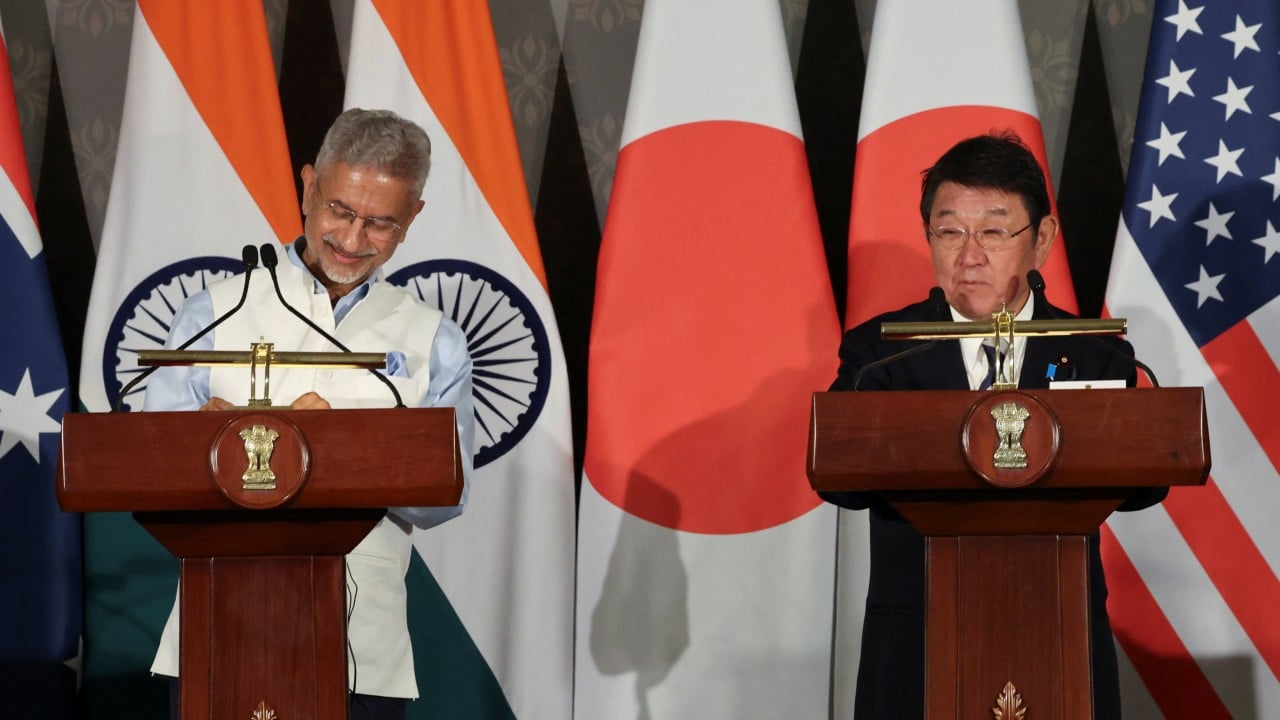
Foreign policy circles are gripped by a collective delusion. For years, the consensus among think-tank analysts and defense intellectuals has been that the Quadrilateral Security Dialogue—the Quad—is the definitive counterweight to China’s rise in the Indo-Pacific. They write endless papers on its evolving purpose, its maritime cooperation, and its potential to secure a free and open ocean.
It is a fantasy.
The Quad—comprising the United States, Japan, India, and Australia—is fundamentally incapable of functioning as a serious security alliance. It is not an Asian NATO, nor will it ever be. While Western commentators obsess over joint naval drills and vague communiqués about a rules-based order, Beijing is executing a hard-nosed, material strategy that the Quad’s loose structure cannot hope to contain.
To understand why the Quad is failing, you have to stop looking at diplomatic press releases and start looking at the structural contradictions and hard economic realities that its members refuse to face.
The Geography Myth and the Indian Illusion
The first major flaw in the lazy consensus is the assumption of shared strategic alignment. The narrative suggests that four major democracies, united by shared values, see the threat identically. They do not.
I have spent over a decade analyzing regional defense strategies and talking to military planners across these capitals. The gap between Washington's ambitions and Delhi's realities is massive.
The United States views the Indo-Pacific through a maritime lens, focused heavily on the Western Pacific, Taiwan, and the South China Sea. India, by contrast, faces an existential, continental threat on its northern border with China. When Indian and Chinese troops clash in the Himalayas, a US Navy destroyer in the Malacca Strait is a distraction, not a solution.
Let us dismantle the premise of a common question often asked in Western policy debates: How can the Quad deter a conflict over Taiwan?
The brutal, honest answer is: It cannot.
India has zero intention of putting its boots on the ground or its ships in the water to defend Taiwan. New Delhi’s foreign policy is rooted in strategic autonomy. India uses the Quad as a diplomatic shield and a tool to secure advanced American technology, not as a mutual defense pact. If Washington expects India to join a hot war in the Pacific, it is fundamentally miscalculating.
Consider the raw mechanics of Indian trade and energy. India relies heavily on Russian military hardware and maintains complex ties with the Global South. It will not subordinate its national sovereignty to a grand strategy designed in Washington. By pretending India is a core military partner in a Pacific contingency, Western planners are building a strategy on quicksand.
Economic Entanglement Always Trumps Rhetoric
The second fatal flaw is the assumption that security can be completely separated from economics.
The Quad wants to counter China's influence, yet every single member of the Quad is economically addicted to China. You cannot effectively deter an adversary when your supply chains, manufacturing bases, and consumer markets are inextricably linked to them.
| Quad Member | Major Economic Reality |
|---|---|
| Australia | Despite political friction, iron ore and resource exports to China remain vital for economic survival. |
| Japan | Deeply integrated manufacturing supply chains rely heavily on Chinese factories and markets. |
| India | Despite banning Chinese apps and scrutinizing investments, imports of crucial active pharmaceutical ingredients (APIs) and electronics from China continue to rise. |
| United States | Decoupling is a political talking point; the reality is a messy, slow-moving diversification that will take decades, not years. |
Look at Australia. Canberra talked a big game about standing up to economic coercion, yet the moment Beijing eased trade restrictions on wine, barley, and coal, Australian businesses rushed right back. Look at Japan. Tokyo’s corporate giants have spent decades building integrated production networks in mainland China. They cannot simply pack up and leave without triggering a domestic economic crisis.
China understands this leverage perfectly. While the Quad talks about "de-risking" and establishing alternative supply chains for critical minerals and semiconductors, China is actively securing the raw materials and processing infrastructure required to dominate the green transition and next-generation telecommunications. The Quad’s initiatives in these sectors are small, underfunded, and hopelessly late.
The Technology Gap: Soft Commitments vs. Hard Monopolies
The competitor articles love to highlight the Quad’s Critical and Emerging Technology Working Group as a sign of progress. They point to agreements on open-source telecommunications (Open RAN) and joint semiconductor initiatives as evidence that the group is securing the digital future.
This is bureaucratic theater.
While the Quad forms committees to discuss technology standards, China is executing a centralized, state-funded industrial strategy. Beijing does not wait for consensus among disparate democracies. It heavily subsidizes its tech giants, builds global infrastructure through the Digital Silk Road, and embeds its standards in international bodies across Africa, Central Asia, and Southeast Asia.
The Quad’s approach relies on the hope that private tech companies in four different nations will spontaneously align to counter state-backed monoliths. It does not work that way. American tech companies are driven by quarterly shareholder value, not State Department directives. Indian tech firms are focused on scaling domestic infrastructure and software services. Japanese and Australian firms operate under their own commercial pressures.
Without a massive, centralized pool of capital and a mandate that forces these industries to cooperate, the Quad’s tech initiatives are just expensive talking shops. They produce white papers while China produces hardware.
The ASEAN Exclusion and Strategic Drift
Another flawed question dominating the discourse is: How can the Quad reassure Southeast Asian nations of Western commitment?
The reality is that Southeast Asian nations do not want to be saved by the Quad. Association of Southeast Asian Nations (ASEAN) capitals view the Quad with deep suspicion. They see it as an outside grouping that threatens "ASEAN centrality" and risks turning their backyard into a battleground for superpower competition.
By pushing the Quad as the primary regional architecture, the West is alienating the very countries it needs to win over. Countries like Indonesia, Malaysia, and the Philippines do not want to choose between their primary security guarantor (the US) and their primary economic partner (China). When the Quad forces the issue, it creates strategic anxiety, not reassurance.
Furthermore, the Quad suffers from severe structural drift. Because it cannot agree on a hard military mission due to India's constraints, it has expanded its mandate to include everything under the sun: vaccine distribution, climate change mitigation, humanitarian assistance, and maritime domain awareness.
When an organization is responsible for everything, it is responsible for nothing. A security grouping that spends its summits discussing solar panels and disaster relief kits is an organization that has lost its way. It is a sign of strategic paralysis, a symptom of an inability to agree on the core issue: how to handle China’s military expansionism.
The Cost of the Counter-Intuitive Truth
Admitting the truth about the Quad has a major downside. It forces Western policymakers to confront a terrifying reality: there is no cheap, multilateral shortcut to balancing China in Asia.
The illusion of the Quad allows Washington to pretend it has a powerful coalition handling the region, preventing the US from making the hard, costly choices required for real deterrence.
If the United States wants to counter Chinese power, it must stop relying on loose diplomatic forums. It needs to double down on bilateral, hard-edged military alliances where goals are aligned and commitments are legally binding. The AUKUS agreement—which provides Australia with conventionally armed, nuclear-powered submarines—is an example of actual strategic weight. It involves hard capabilities, technology transfers, and deep industrial integration. It is focused, aggressive, and functional.
The Quad is none of those things. It is a talk shop dressed up in the language of geopolitics, a comfortable diplomatic ritual that allows leaders to take photos, issue vague statements of solidarity, and fly home pretending they have checked the Asia box.
Stop analyzing its purpose. Stop looking for its evolution. The Quad is doing exactly what it was designed to do: hide the deep strategic divisions between its members behind a wall of diplomatic noise. Beijing sees right through it. It is time the West did too.