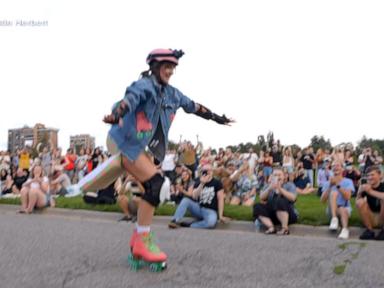
The internet treats public humiliation like a wholesome rite of passage. A video goes viral showing a woman strapping on roller skates for the very first time in the middle of a packed park or a crowded boardwalk, wobbling like a newborn colt while bystanders cheer or wince. Comment sections erupt into applause for her bravery. Digital media outlets hail the spectacle as an inspiring masterclass in stepping outside the comfort zone.
It is nothing of the sort. It is exhibitionist amateurism disguised as courage. You might also find this connected story useful: The Structural Mechanics of Dominance Why The Norris Extension Cornered Piastri.
This staged vulnerability trades genuine progress for immediate social validation. The lazy consensus says that throwing yourself directly into the deep end of a chaotic public environment proves grit. The reality is that it proves an addiction to external approval that actively sabotages the mechanics of learning.
True skill acquisition is an unglamorous, solitary, and often humiliating private pursuit. It requires closed feedback loops, low stakes, and the freedom to fail without an audience filming your cognitive load. When you turn your day-zero incompetence into a spectator sport, you shift your brain's primary objective from mastering the motor skill to managing the optics of your embarrassment. You are not learning how to skate. You are learning how to perform the character of a resilient beginner for strangers who will scroll past your face within three seconds. As highlighted in latest coverage by Yahoo Sports, the results are significant.
Let us dismantle the mechanics of this modern spectacle.
The Myth of Trial by Fire
Pedagogical research in motor learning tells a different story about how the human brain acquires complex physical tasks. When a beginner straps on quad skates, their nervous system faces an immediate sensory overload. The cerebellum must process novel vestibular inputs, adjust proprioception, and coordinate hundreds of micro-muscles in the ankles, hips, and core just to maintain an upright stance against gravity.
In a controlled environment, an adult learner spends the first twenty minutes simply understanding weight distribution while holding onto a stable kitchen counter or a wall. This is deliberate practice. It isolates variables.
Drop that same learner into the middle of a bustling esplanade surrounded by cyclists, rogue dogs, and fifty pairs of judgmental or overly encouraging eyes, and the physiological response changes entirely. Cortisol spikes. The sympathetic nervous system triggers a mild fight-or-flight reaction. Muscles tense up. Stiff muscles resist the fluid ankle flexion required to absorb momentum.
You do not accelerate learning by introducing social anxiety. You impair motor learning by flooding the bloodstream with stress hormones that force the body back into rigid, defensive movement patterns. The crowd is not helping her skate; the crowd is guaranteeing she will grip the pavement with her toes and fall harder.
Imagine a scenario where a classical pianist decides to debut their very first piano lesson on a makeshift stage in Times Square. Passersby stop, clap, and film as the student violently hammers out random, jarring chromatic scales while trying to read sheet music upside down. We would instantly diagnose that pianist with a severe case of misplaced priorities. Yet when someone does the exact same thing on four polyurethane wheels, we call it empowerment.
The Attention Economy of Incompetence
We need to look past the warm fuzzies of the viral clip and examine the economic engine driving it. Platforms reward the spectacle of the struggle because struggle generates emotional friction.
When a novice films their first day on skates, they are participating in a transaction. They offer their raw vulnerability; the algorithm offers attention, validation, and a hit of dopamine. But dopamine is a fickle currency. It conditions the brain to chase the applause of the beginning phase rather than the quiet, lonely satisfaction of the intermediate plateau.
I have watched ambitious professionals blow thousands of dollars on high-end gear, designer protective pads, and customized skates, only to quit two weeks later. Why? Because they built their entire motivation structure around the initial novelty wave. Once the novelty wore off and nobody cared that they could finally glide ten feet without flailing, the fuel ran out. They were never invested in the craft of skating. They were invested in the narrative of becoming a skater for an audience.
Real competence has no audience for its most critical hours.
Consider how elite athletes train. A UFC fighter does not learn a new submission technique in front of twenty thousand screaming fans under blinding arena lights. They drill it in a quiet, humid gym with three training partners and a coach who doesn't care about their feelings. A concert violinist spends ten thousand hours in a soundproof room practicing the same four-measure passage until their fingers bleed silently.
Publicizing day zero creates a psychological trap known as premature identity adoption. By declaring yourself a "skater" to the world before you can even execute a basic plow stop, you lock your ego into a persona. Now, every subsequent fall threatens that fragile identity. Instead of treating a fall as neutral data about your center of gravity, your ego treats it as a public indictment. That is a fast track to resentment and abandonment.
Rewriting the Beginner's Playbook
If you actually want to learn how to roller skate, surf, code, or speak Mandarin, you must do the opposite of what the modern internet demands. You must go underground.
1. Optimize for Low Visibility
Find the empty parking lot at 6 AM. Find the tennis court with a locked gate. Find the basement hallway with a smooth concrete floor. Remove all witnesses. When nobody is watching, your nervous system can finally drop its defenses. You can look ridiculous, fall on your hip, laugh, and get back up without a single mirror reflecting your perceived foolishness back at you.
2. Isolate the Mechanics
Do not attempt to roll forward until you have mastered standing still. Spend your first session marching in place on the grass or a thick carpet to feel how your weight shifts over the trucks and wheels. Break the complex motion into atomic units:
- The stance (knees bent, chest over toes)
- The recovery (bringing heels together)
- The bailout (how to fall safely on fleshy parts without breaking wrists)
3. Starve the Algorithm
Resist the urge to document the struggle for social media currency. If you must record yourself, do it strictly as biomechanical data—a silent video reviewed privately to check your posture against tutorial footage. Delete the footage the moment you analyze it. Guard your motivation jealously. Do not outsource your sense of achievement to people who consume your failures as afternoon entertainment.
The road to mastery is paved with private repetitions, silent frustrations, and uncelebrated small wins. Stop performing your incompetence for strangers. Put the phone down, lace up in the shadows, and let your progress speak for itself long before you ever step into the light.