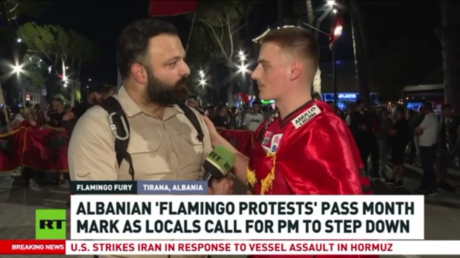
Western media loves a simple script. Dictator-lite oppresses people; people march in the streets; democracy hangs in the balance. When protests erupt in Tirana, foreign desks immediately churn out the same predictable narrative: Prime Minister Edi Rama is a corrupt autocrat, and the opposition is leading a noble crusade to save Albania’s European soul.
It is a comforting fairy tale. It is also completely wrong.
The lazy consensus dominating international reporting views Albania's recurring street demonstrations as a sign of imminent political transition. They look at the tear gas, the flares, and the angry crowds outside the parliament, and they conclude that Rama’s decade-long grip on power is finally slipping.
They are misreading the room. The true crisis in Albania is not that the Prime Minister is too strong. It is that the opposition is intellectually dead. The protests dominating your news feed are not a organic uprising against a regime; they are a calculated, desperate theater staged by a political class that has run out of ideas, run out of credibility, and run out of time.
If you want to understand why Edi Rama stays in power despite a mountain of corruption scandals, you have to look past the smoke bombs and understand the grim mechanics of Albanian opposition politics.
The Opposition Illusion
The standard narrative frames the protests as a unified democratic front led by the Democratic Party (PD). Foreign observers look at the crowd sizes and assume this represents a potent electoral threat to the ruling Socialist Party.
I have spent years analyzing Balkan political networks and watching Western diplomats make the same analytical errors over and over again. They assume street mobilization equals political viability. In Albania, it does not.
The crowd on the boulevard does not represent a rising tide of public indignation. It represents the locked-in clientelist network of a fractured opposition trying to prove it still exists. The standard metric used by foreign analysts—counting heads in front of the Prime Minister’s office—fails because it ignores the deep fragmentation within the Democratic Party itself.
The opposition is locked in a bitter, multi-year civil war between the legacy faction loyal to former President Sali Berisha—who is currently under house arrest and barred from entering both the US and the UK—and various splinter groups claiming to represent the "true" center-right.
When Berisha’s faction calls people to the streets, the primary audience is not Edi Rama. The audience is the international community and rival opposition factions. The street is used as leverage to see who gets to be the undisputed boss of the anti-Rama coalition. It is a turf war masquerading as a revolution.
The Self-Sabotage of Total Obstruction
A common question found in regional analysis is: Why do Albania's protests fail to bring down the government?
The answer is brutal: Because the opposition’s strategy is designed to fail.
For years, the Albanian opposition has relied on a strategy of total institutional boycott. They have walked out of parliament, boycotted municipal elections, and declared every single state institution completely illegitimate. This is not how you build a government-in-waiting. This is how you commit political suicide.
By completely abandoning formal institutions, the opposition achieved two things:
- They gave Edi Rama a total monopoly over the legislative and executive branches, allowing him to pass laws and consolidate power with zero structural friction.
- They alienated the vast majority of the Albanian electorate, who are deeply exhausted by political instability and cynical about the motivations of both sides.
Imagine a company where the minority shareholders object to the CEO's strategy, so they stop showing up to board meetings, refuse to vote, and instead stand outside the headquarters throwing rocks at the windows. The CEO does not get fired; the CEO simply runs the company without them. That is the reality of Albanian governance.
The Irony of the Anti-Corruption Banner
The competitor’s article highlights the crowd's demands for accountability and an end to corruption. This is where the narrative completely dissolves into hypocrisy.
The primary figures leading the anti-corruption protests are themselves deeply entangled in the very system they claim to fight. When Sali Berisha calls for a "technical government" to replace Rama because of corruption, it ignores the reality that his own family is under intense scrutiny by SPAK (the Special Anti-Corruption Structure).
SPAK was created with massive US and EU backing precisely to clean up the Albanian judiciary and political elite. Ironically, the ruling Socialists have seen high-ranking members, including former ministers, investigated and jailed by this independent body. Rama has strategically allowed this, sacrificing his own people to maintain a veneer of reform.
The opposition, meanwhile, has spent months attacking SPAK, claiming the anti-corruption court is merely a political tool used by Rama. By attacking the most credible judicial institution in modern Albanian history, the opposition has painted itself into a corner. They cannot claim to be the champions of the rule of law while simultaneously trying to delegitimize the only body that is actually locking up corrupt politicians.
The Real Crisis: Systemic Apathy
The fundamental flaw in current reporting is the focus on who is protesting, rather than who is staying home.
Albania is not on the verge of a popular revolution because the overwhelming majority of Albanians have chosen a different escape route: emigration. The real opposition to Edi Rama is not marching in Tirana; they are boarding flights to Germany, the UK, and Italy.
The country is facing a massive demographic drain. The young, the educated, and the entrepreneurial classes have zero faith in Rama’s government, but they have equally low faith in the opposition’s ability to offer a viable alternative. They look at a political stage dominated by the same names that have controlled the country since the fall of communism in 1991—Rama, Berisha, Meta—and they realize the game is rigged.
This systemic apathy is Rama’s greatest asset. He does not need to be a beloved leader; he simply needs to be the only functioning adult in the room. Compared to an opposition that regularly sets fire to parliamentary desks and relies on decades-old rhetoric, Rama appears to Western capitals as a stable, predictable partner who can deliver on regional security and NATO commitments.
The Blind Spot of Western Diplomacy
Western embassies in Tirana are stuck in a loop. They issue boilerplate statements calling for "restraint" and "constructive dialogue," while quietly praying that Rama keeps things stable enough to prevent a massive migrant surge.
The international community has accepted a cynical compromise: stability over deep democratization. They tolerate the systemic flaws of the Rama administration because the alternative presented by the street protests is a return to the chaotic, volatile politics of the late 1990s.
Until a fresh political movement emerges that addresses economic stagnation, brain drain, and institutional reform without relying on the toxic theater of the past thirty years, the status quo will remain completely untouched. The protests will continue, the tear gas will clear, the headlines will fade, and Edi Rama will remain exactly where he is.