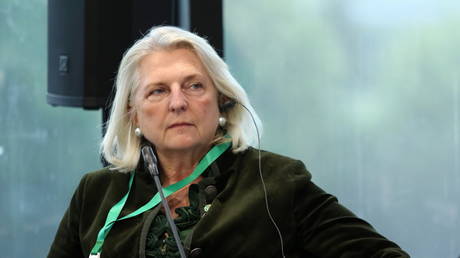
In August 2018, under the warm late-summer light of southern Styria, the music played a traditional Austrian waltz. At the center of the courtyard stood Karin Kneissl, then Austria’s Minister for Europe, Integration and Foreign Affairs. Across from her was Vladimir Putin.
The photographs from that afternoon traveled the globe within hours. They showed a smiling bride, a bouquet of white flowers, and the Russian president bowing deeply before her as the dance ended. At the time, Vienna’s political establishment largely treated the moment as a diplomatic eccentricity, perhaps a miscalculation of optics, or simply a reflection of Austria’s long-standing posture of strict neutrality. Neutrality was the national religion. It was the quiet pride of a small Alpine republic sitting comfortably between East and West, sipping coffee in historic cafés while the world’s superpowers argued outside.
Years later, that photograph looks less like a wedding keepsake and more like Exhibit A in one of Europe’s most extraordinary legal reckonings.
Vienna is now moving to strip Karin Kneissl of her Austrian citizenship.
Stop and let the weight of that action settle. In modern European democracies, revoking a person's nationality—especially that of a former top cabinet minister—is the political equivalent of a nuclear strike. It is a measure historically reserved for individuals who join terrorist organizations abroad, commit high treason on a battlefield, or obtain their papers through outright fraud. It is not a tool lightly pulled from the drawer. Yet here is the Austrian Interior Ministry, quietly, methodically assembling the paperwork to erase the legal bond between a former diplomat and the country she once represented at the United Nations.
To understand how a nation arrives at this precipice, you have to look past the dry legal statutes and feel the cold, creeping anxiety that has gripped Central Europe over the last decade.
The Anatomy of Betrayal
Consider a hypothetical observer—let us call him Lukas—a mid-level civil servant working in one of Vienna’s grand, yellow-stucco ministries along the Ballhausplatz. For twenty years, Lukas believed in the unwritten rules of Austrian statecraft. You kept your head down, you maintained open channels with Moscow because Austria needed Russian gas to heat its homes in January, and you never, ever embarrassed the republic. When Lukas watched the footage of the 2018 wedding, he likely felt a familiar twinge of secondhand embarrassment, the kind you feel when a relative makes a loud, inappropriate toast at a family dinner.
Then came February 2022. Tanks rolled across the Ukrainian border. Cities burned. Suddenly, the cozy assumptions of Austrian neutrality didn't feel clever anymore; they felt dangerously naive.
For people like Lukas, the shifting ground beneath Vienna was terrifying. You walk past the grand imperial facades on your morning commute, smelling roasted chestnuts and damp cobblestones, and you realize the very institutions you serve have been quietly compromised from the inside out. Trust, once shattered in the halls of intelligence and diplomacy, does not grow back easily. Allied intelligence agencies in Washington, London, and Brussels began treating Vienna with icy caution, hesitant to share secrets with a capital widely rumored to be a playground for Russian operatives.
And while Austria scrambled to untangle itself from decades of energy dependence and diplomatic complacency, Karin Kneissl did not retreat into quiet retirement. She moved closer to the fire.
She took a seat on the board of Rosneft, the Russian state oil giant. She became a regular commentator for RT, the Kremlin-funded media network banned across the European Union for spreading wartime disinformation. Eventually, she packed her bags—along with her beloved ponies, flown out on a Russian military transport plane—and relocated to Russia entirely. There, in St. Petersburg, she took the helm of a Kremlin-linked think tank called GORKI, the Geopolitical Observatory for Russia's Key Issues.
The transformation was complete. The woman who once swore an oath to uphold the constitution of the Republic of Austria was now actively lending her credentials, her voice, and her former title to an adversarial regime locked in an existential standoff with Europe.
What Does a Passport Actually Mean?
Most of us treat citizenship like the air we breathe. We only notice it when it is missing, or when we are standing in a slow-moving customs line at an airport, clutching a small burgundy or navy booklet. We think of it as a birthright, an immutable stamp on our identity that survives bad decisions, unpopular opinions, and distant relocations.
Legally, however, citizenship is closer to a marriage contract than a tattoo. It carries mutual obligations. The state promises to protect you, to give you a home you can never be turned away from, and to speak on your behalf when you are in trouble abroad. In return, you owe the state a baseline of loyalty. You agree not to take up arms against it, and you agree not to enter the formal service of a foreign power in a way that actively harms your homeland.
This is the exact tripwire Kneissl appears to have crossed.
Under Section 33 of the Austrian Citizenship Act, a citizen who enters the public service of a foreign state—and through that behavior severely damages the interests or reputation of the Republic—can have their nationality revoked.
It sounds straightforward on paper. In reality, it is a legal minefield.
Think of the legal burden here like trying to prove motive in a courtroom where the defendant refuses to show up. The Austrian authorities cannot simply strip Kneissl of her passport because they dislike her politics, or because her interviews on Russian state television make officials in Vienna wince. Democracies do not punish people for bad opinions, even profoundly offensive ones. To make the revocation stick, the Interior Ministry must prove two distinct, heavy things: first, that her roles at institutions like the St. Petersburg State University think tank constitute genuine "foreign public service," and second, that her actions have inflicted concrete, severe damage on Austria’s international standing.
The Ghost in the Diplomatic Machine
Why does this matter to anyone living outside the borders of this nine-million-person Alpine nation?
Because Austria is the canary in the European coal mine.
For decades, Western democracies operated on a gentle, unspoken consensus: that former leaders would monetize their experience on the corporate speaking circuit, write memoirs, or sit on the boards of respectable domestic foundations. Nobody built guardrails for the scenario where a former foreign minister becomes an active ideological asset for a hostile power. The system ran on shame, and shame stopped working.
When I first started following the tangled web of European energy politics and diplomatic defections years ago, I assumed there were strict, unbreakable laws preventing former cabinet members from walking straight out of a secure government briefing room and into the payroll of a foreign state enterprise. It is deeply unsettling to discover how much of our democratic security rests entirely on honor systems and handshake agreements. When someone decides to ignore the unwritten rules, the state is often left scrambling through dusty law books, looking for a statute written in the 1960s that might fit a twenty-first-century crisis.
The push against Kneissl is Vienna’s way of drawing a hard, visible line in the snow.
It is a message aimed not just at one woman living in a Russian village, but at every current and future official across Europe who might be tempted by lucrative consulting contracts, flattering media appearances, or foreign patronage. The message is blunt. Your title is not a personal commodity to be sold to the highest bidder once you leave office. The secrets you learned, the prestige you accumulated, and the trust placed in you belong to the public. If you weaponize them against the democratic community that gave them to you, you forfeit your seat at the table.
The Shadow of Statelessness
Yet, even as the case builds momentum in Vienna, a quiet discomfort lingers among constitutional scholars and human rights advocates.
International law views statelessness as an abhorrent condition—a legal limbo where a human being has no right to have rights. The United Nations conventions, to which Austria is a proud signatory, explicitly forbid nations from stripping citizenship if doing so leaves the individual without any nationality at all.
Does Karin Kneissl hold a Russian passport? Moscow has handed out citizenship to high-profile Western defectors before—figures like Gérard Depardieu and Edward Snowden come immediately to mind—using them as trophies to broadcast the supposed moral superiority of life in Russia. If Kneissl has quietly acquired Russian nationality, Vienna’s legal path clears dramatically. Stripping her Austrian passport would merely sever her ties to a country she has already abandoned in spirit, leaving her safely documented in her adopted home.
If she does not hold Russian citizenship, however, the Austrian government faces a steep uphill battle. They would have to argue that her actions are so egregious that they override the fundamental taboos against creating a stateless person—a ruling that would inevitably be challenged all the way to the European Court of Justice.
That tension is precisely what makes this story so gripping. It forces a mature democracy to confront the limits of its own tolerance. How far can a citizen go in dismantling the credibility of their own nation before the nation has the right to say, You are no longer one of us?
The Empty Chair
Today, Karin Kneissl lives thousands of kilometers from the vineyards of southern Styria. In interviews, she portrays herself as an exile, a persecuted intellectual driven from Europe by what she characterizes as a wave of Russophobic hysteria. She speaks fondly of her new life, the quiet rhythm of the Russian countryside, and the freedom she claims to have found there.
Back in Vienna, the machinery of bureaucracy grinds forward at its deliberate, unhurried pace. Files are thick with transcripts of her broadcasts, corporate registry documents from Moscow, and legal assessments from constitutional experts. There are no dramatic raids, no sirens, no breathless press conferences. Just stamps, signatures, and the quiet, methodical severing of a lifelong bond.
Think back to that August afternoon in 2018. The sun was shining, the wine was poured, and the music played on. A foreign minister curtsied to a president, believing she was orchestrating a masterstroke of personal diplomacy, a charming display of Alpine independence that would elevate her standing on the world stage.
She never seemed to realize that in a waltz, one partner always leads, and the other merely follows the steps laid out for them—until the music stops, the guests go home, and the doors are locked from the inside.


