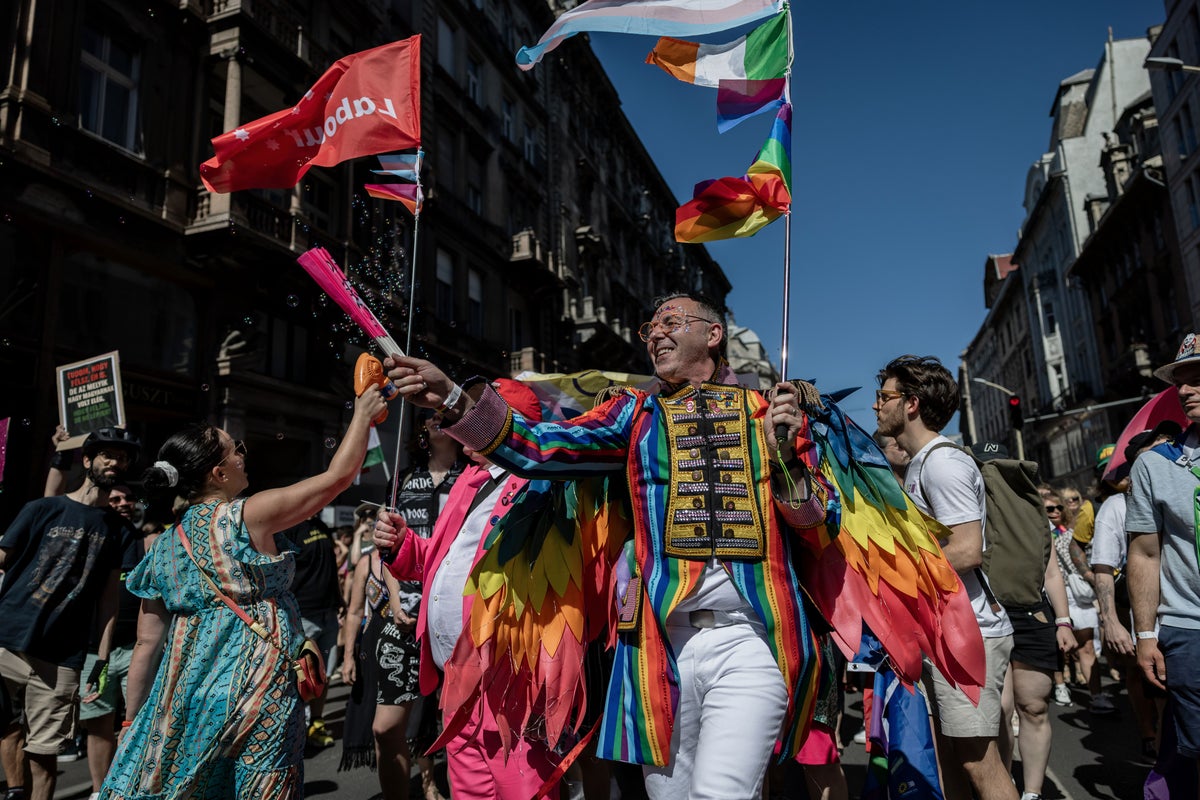
A child sits in a bookstore in Budapest, his fingers tracing the glossy spine of a graphic novel. He is twelve. He is curious. He is at that fragile age where every story he consumes acts as a brick in the foundation of who he will eventually become. In any other European capital, this moment is mundane. In Hungary, for the last few years, it has been a legal minefield.
The book is wrapped in opaque plastic. He cannot see the cover. He cannot flip through the pages to see if the art speaks to him. It is sealed like biohazardous material or a pack of cigarettes. This isn't because the book contains violence or vitriol. It is sealed because, somewhere in its three hundred pages, two characters of the same gender might hold hands or share a dream of a future together.
This is the reality of the 2021 Hungarian "child protection" law. It was framed by the government as a shield for the innocent. In practice, it functioned as a shroud. It didn't just target books; it targeted the visibility of an entire segment of humanity, decreeing that any depiction of LGBTQ+ lives was inherently "harmful" to anyone under eighteen.
But the highest court in Europe just tore the plastic off.
The European Court of Justice (ECJ) recently issued a ruling that resonates far beyond the marble halls of Luxembourg. They didn't just find a technicality. They found a fundamental violation of the spirit of the European Union. They ruled that Hungary’s restrictions on LGBTQ+ content breached the law, striking a blow against a policy that sought to legislate identity out of the public eye.
The Invisible Stakes of a Sealed Book
When we talk about court rulings and EU treaties, the conversation often evaporates into the stratosphere of legalese. We talk about "infringement procedures" and "article 2 of the Treaty on European Union." These terms are cold. They don't capture the heat of a librarian’s anxiety as she wonders if a certain young adult novel will result in a heavy fine for her shop.
Imagine a hypothetical teacher named Eleni. She has taught literature for twenty years. Under the 2021 law, Eleni lived in a state of constant, low-grade fear. If a student asked her why two men were executed in a historical poem, or if a modern play touched on themes of gender identity, she had to navigate a labyrinth of silence. The law didn't just ban "promotion"; it effectively banned existence.
This is the "chilling effect." It is a psychological frost that settles over a society. You don't need to arrest every teacher if you make the law vague enough that they arrest their own tongues.
The Hungarian government argued that this was about "sovereignty" and the right of parents to educate their children. It’s a powerful emotional hook. Every parent wants to protect their child. But the court saw through the framing. The ECJ pointed out that while member states have a right to organize their education systems, they do not have a right to violate the core values of the Union they voluntarily joined. You cannot claim "protection" as a justification for discrimination.
The Ledger of Values
The conflict between Brussels and Budapest has often felt like a slow-motion car crash. On one side, you have the Orban administration, which has pinned its political identity to "illiberal democracy" and traditional family values. On the other, you have the EU’s executive arm, which views these laws as a direct assault on the fundamental rights of EU citizens.
The court's decision was surgical. It focused on the fact that the law restricted the free movement of services and goods—the very lifeblood of the European market. If a book can be sold freely in Paris but must be wrapped in plastic and hidden in a "special section" in Budapest, the single market is broken.
But the economic argument is merely the skeleton. The heart of the ruling is about human dignity.
Consider the "People Also Ask" questions that usually populate a search engine on this topic. Is it legal to be gay in Hungary? Yes. Can you hold hands in Budapest? Generally, yes. But the law created a tier system of citizenship. It sent a message to every teenager in the country: You are a secret. You are something that must be managed, hidden, and shielded from your peers.
The ECJ ruling effectively says that a government cannot use "morality" as a wildcard to trump human rights. The court found that the law failed the test of proportionality. It wasn't a shield; it was a gag.
The Weight of the Gavel
The ruling comes at a time when the continent is deeply divided over how to handle the intersection of culture and law. Hungary isn't the only place where these tensions exist, but it became the primary laboratory for testing how far a member state could go before the EU’s legal machinery pushed back.
The stakes were never just about books or television commercials showing rainbow flags. The stakes were about the definition of a European. Is a European someone who fits a singular, state-mandated mold of "tradition," or is a European someone who is protected by a universal set of rights regardless of who they love?
For the boy in the bookstore, the ruling might not change things overnight. Laws on paper take time to become air in the lungs. The Hungarian government has historically been slow to pivot, often framing these legal defeats as "attacks" from foreign elites to bolster domestic support.
Yet, the legal precedent is now an immovable object. It provides a shield for the booksellers, the teachers, and the parents who believe that children are better served by honesty than by forced ignorance.
The Fragility of the Open Shelf
We often take the availability of information for granted. We assume that the stories we need will always be there, waiting on the shelf. We forget that the shelf is held up by a series of invisible agreements. One of those agreements is that the state does not get to decide which humans are "appropriate" to mention in a story.
The court's decision serves as a reminder that "child protection" is a phrase that can be easily weaponized. True protection involves giving a young person the tools to understand the world as it actually is, not as a political party wishes it to be.
The plastic wrap is starting to tear.
As the legal dust settles, the image that remains isn't a courtroom or a judge in a robe. It is that twelve-year-old in Budapest. He doesn't care about Treaty Articles or infringement procedures. He just wants to know if there is a story out there that looks like his life. He wants to know if he is a mistake or a person.
The highest court in the land just told him he is a person.
The book is still on the shelf. The lights are still on. The door is still open. And for the first time in years, the air in the room feels a little less like a held breath.
The silence has been ruled illegal.