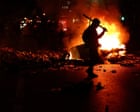
Deploying tens of thousands of officers does not guarantee territorial control when a crowd exceeds a critical density threshold and decentralizes across multiple urban nodes. When France's interior minister acknowledged that law enforcement lost control during violent October 2026 unrest—despite roughly 60,000 officers mobilized nationwide and over 2,300 arrests across the weekend—standard headline coverage treated the admission as a simple story of political embarrassment and offered resignations. That framing misses the operational mechanics behind state crowd control. Controlling civil disorder is not a linear function of headcount; it is a spatial allocation, intelligence, and legitimacy problem operating under tight time constraints.
This analysis deconstructs the conventional "loss of control" narrative into measurable system variables, separates verified October 2026 facts from analytical hypotheses, and lays out a tactical framework for diagnosing and correcting crowd-control failures in dense urban environments.
Deconstructing the Standard Riot Narrative
Standard news reporting on major French protests typically reduces complex operational breakdowns to four surface-level tropes: a dramatic ministerial quote, a tally of arrests and damaged storefronts, partisan accusations between left and right, and a vow to deploy even more personnel next time.
That approach leaves three causal links unexplained:
- Static guard vs. mobile disruption: Protecting fixed symbols, landmarks, or administrative buildings ties up units in static postures, leaving commercial corridors and transit junctions vulnerable to fast-moving smaller groups.
- Arrest volume vs. deterrence: Detaining over 2,300 individuals in a single weekend demonstrates reactive enforcement capacity, yet high arrest counts can coincide with widespread looting across dozens or hundreds of businesses when offenders disperse faster than units can clear streets.
- Force projection vs. escalatory feedback: Heavy use of kinetic or chemical crowd-control munitions can clear an immediate intersection while generating severe injuries and political backlash that widen participation in subsequent rounds of mobilization.
Known Facts Versus Analytical Hypotheses
Rigorous strategy requires separating documented events from explanatory models. In October 2026, nationwide demonstrations tied to cost-of-living pressures and weeks of high school (lycée) unrest escalated into severe clashes, looting, and institutional closures. Reported figures include roughly 60,000 security personnel deployed on October 17, more than 2,330 detentions over the weekend (with roughly 70% adults), hundreds of injured demonstrators and educators, roughly 1,000 injured officers on October 17, targeted retail looting, and high-profile disruptions such as the Louvre unable to open as scheduled. Interior Minister Laurent Nuñez stated that police lost control in some areas and offered his resignation, which President Emmanuel Macron declined while calling for transparency regarding planning and intelligence shortcomings.
Exact causal weights are not established by headline counts alone. What follows are structured hypotheses based on public-order operations and collective behavior theory:
- Intelligence-to-deployment lag: When unrest shifts from scheduled marches to unannounced secondary gatherings or commercial looting, command posts face a latency gap between early social or street signals and tactical unit repositioning.
- Span-of-control compression: As incident sites multiply across a city or country, platoon and company commanders must manage concurrent perimeters, medical evacuations, and detainee processing, degrading situational awareness.
- Threshold dynamics in crowd behavior: Classic collective action models (such as Thomas Schelling's threshold models) show that individuals who would not initiate violence or looting often join once visible norm violation crosses a local tipping point and perceived risk of immediate apprehension drops.
The Four Pillars of Urban Public-Order Control
To evaluate why a security apparatus holds or loses ground, analysts should assess four interlocking pillars rather than relying on total deployment numbers.
1. Predictive Intelligence and Spatial Mapping
Effective crowd management depends on anticipating where friction will emerge before barricades go up. High-school walkouts, union calls, and cost-of-living grievances create identifiable fault lines, yet opportunistic looters and violent agitators frequently exploit seams between permitted routes, closed schools, and dense retail districts. When intelligence tracks march permits better than secondary flashpoints, reserves end up chasing yesterday's map.
2. Force Mobility and Reserve Elasticity
A fixed headcount is only as useful as its reserve ratio and mobility. If 80% of available units are locked guarding static perimeters, only 20% remain as a mobile reaction force. Once secondary disturbances erupt in multiple neighborhoods simultaneously, unallocated reserves are quickly exhausted.
3. Escalation Ladder Calibration
Public-order doctrine relies on graduated responses so tactical choices match threat levels. If de-escalation channels are absent or blunt munitions cause severe injuries—such as documented cases of lost limbs or eyes during the broader unrest—protest movements harden, drawing sympathy from moderate participants and local officials. Conversely, overly passive perimeters allow localized vandalism to cascade into sustained property destruction.
4. Command Clarity and Political Alignment
Operational control deteriorates when tactical commanders receive mixed signals or when public disputes erupt between national ministries, mayors, and opposition leaders over blame and legitimacy. Macron's decision to reject Nuñez's resignation while demanding transparency on planning and intelligence failures illustrates the tension between preserving chain-of-command continuity and answering for execution gaps.
The Cost Function of Unchecked Escalation
Every uncontained riot imposes compounding costs across four categories that compound over successive protest cycles:
- Direct physical and material loss: Injured officers, injured students and citizens, damaged public transit, shuttered cultural or educational sites, and ransacked retail storefronts represent immediate economic and human damage.
- Operational fatigue: Repeated weekend mobilizations and multi-week school disruptions degrade officer stamina, increase overtime strain, and narrow the margin for disciplined decision-making.
- Judicial and administrative backlog: Mass arrests—numbering in the thousands over a single weekend—create downstream bottlenecks in processing, legal representation, and court dockets, while fast-tracked prosecutions can spark fresh friction over due process.
- Political polarization: Prolonged disorder erodes trust in both state competence and protest leadership, creating openings for hardline political factions while fueling grievances over economic strain and heavy-handed policing.
Tactical Diagnostic and Operational Sequence
When an administration or security command faces recurring protest escalation, ad-hoc announcements of larger deployments rarely solve the underlying bottleneck. A disciplined operational audit follows a clear sequence:
- Reconstruct the timeline by minute and grid cell: Map where violence, barricades, and looting first appeared relative to police unit locations and march routes, isolating where response time exceeded offender movement time.
- Audit reserve ratios and static commitments: Calculate what share of deployed officers held static guard posts versus mobile quick-reaction units, and identify low-value perimeters that can be hardened physically rather than with personnel.
- Separate peaceful assembly from targeted criminality: Pair clear protection for lawful demonstrators with dedicated, fast-moving containment teams focused specifically on arson, critical-infrastructure blockades, and commercial looting.
- Tighten rules of engagement and medical/legal tracking: Standardize use-of-force oversight to reduce severe avoidable injuries while streamlining arrest-to-booking workflows so officers return to patrol quickly.
- Address underlying grievance triggers alongside enforcement: Security measures can buy time and protect property, but durable de-escalation requires political or economic off-ramps for underlying cost-of-living and institutional pressures.
Limitations and Trade-Offs
No operational framework eliminates risk in high-density urban environments. Intelligence systems cannot predict every spontaneous flashpoint or opportunistic criminal actor in real time. Increasing mobility by reducing static guards carries the risk that a high-profile site or vulnerable neighborhood is briefly exposed. Strict crackdown policies and aggressive prosecutions may suppress street numbers in the short term while deepening long-term alienation among youth and working households. Furthermore, external analysts must work with incomplete real-time data during active crises, where official tallies and partisan claims often diverge.
Strategic Recommendation
Executive leaders and security planners should stop treating raw officer headcount as the primary metric of public-order readiness and immediately institute a two-tier containment and intelligence-led reserve model ahead of major protest weekends. Specifically, command should cap static perimeter assignments at a strict ceiling, hold a larger share of forces in decentralized mobile reaction units positioned near transit hubs and commercial corridors, and pair rapid-response containment of looting and infrastructure sabotage with transparent post-incident operational reviews that separate tactical lessons from partisan blame.
French interior minister admits police 'lost control' of protests
This video directly covers the French interior minister's admission that police lost control during the nationwide unrest and provides visual context for the political and street-level fallout analyzed above.


