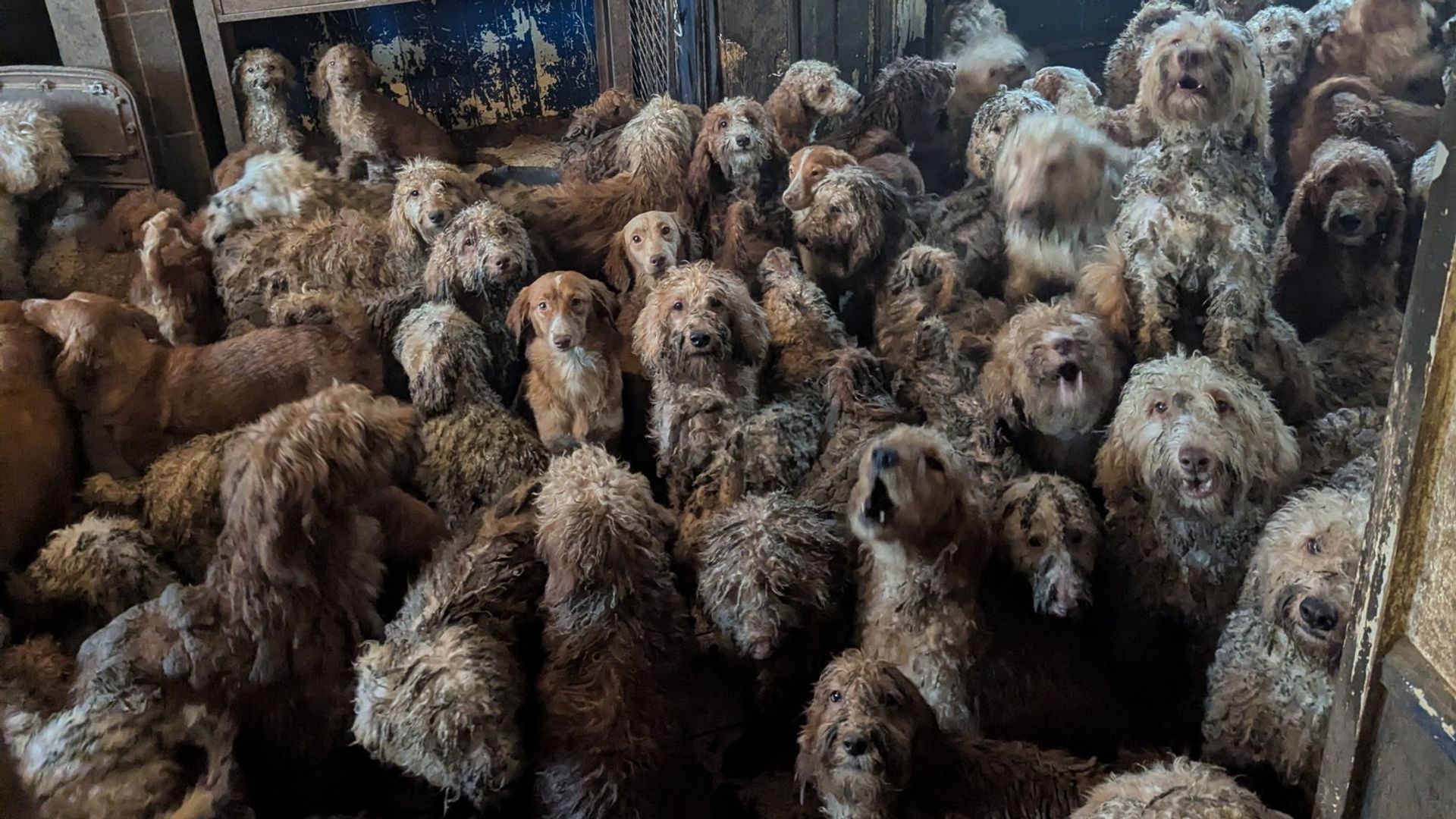
The glow of a smartphone screen at 2:00 AM can be a dangerous thing. It’s the hour when outrage travels fastest, hopping across timelines before the brain has a chance to fully wake up. In the case of a single, jarring photograph that recently tore through the internet, that outrage felt like a physical weight. The image showed dozens of dogs—beagles, mostly—packed into a small, cluttered living room. They were perched on sofas, huddling on the floor, and peering out from every corner with those wide, liquid eyes that seem to demand an immediate rescue.
Social media did what it does best. It caught fire. Within hours, the comments sections were a battlefield of accusations. People demanded to know how the RSPCA could allow such a scene to exist. They questioned the charity’s competence, their funding, and their soul. Then, the counter-narrative arrived. Skeptics pointed to the uncanny smoothness of a dog’s fur in the background or a strange distortion in the carpet. They claimed the whole thing was a lie—a product of Artificial Intelligence designed to bait clicks or smear the organization.
Reality, as it turns out, is far more haunting than a digital hallucination.
The Weight of the Living
When an inspector walks into a home that smells of ammonia and desperation, the world shrinks. There is no zoom lens or "undo" button. There is only the sound of claws on linoleum and the overwhelming task of counting heartbeats. The RSPCA confirmed that the image, while looking too horrific to be true, was a genuine photograph taken during a real-life intervention.
Imagine the silence after the door opens. It isn’t actually silent; it’s a vibrating hum of panting and shifting bodies. This wasn't a computer-generated fever dream. It was a hoard. It was a situation where a human being likely started with two pets and, through a slow, crushing slide into mental or financial collapse, ended up with a house that breathed.
We live in an era where we are so used to being deceived by deepfakes and manipulated pixels that our first instinct is to scream "fake" at anything that disturbs our peace too deeply. It is a defense mechanism. If the image is fake, we don’t have to feel the ache in our chests. If it’s just AI, those dogs aren't actually suffering. But dismissing the image as a digital ghost does a profound disservice to the inspectors who had to physically carry those animals out, one by one, into the light.
The Friction of Truth
The skepticism directed at the RSPCA is a symptom of a larger, more jagged problem. We have lost our grip on the scale of animal neglect. In a standard year, the organization receives a call for help every 30 seconds. That is not a statistic meant to be read and forgotten; it is a clock ticking in the background of every workday.
Think of a single dog. Consider the cost of its food, the timing of its walks, and the specific way its ears need cleaning. Now, multiply that by forty. The logistics alone are a nightmare, but the emotional cost is what really breaks the people on the front lines. When the public looks at a photo and argues about whether a shadow looks "too sharp" to be real, they are ignoring the very real mud on the boots of the person who took the picture.
The irony is sharp. While the internet debated the authenticity of the lighting, the dogs in that room were being processed into a system that is already bursting at the seams. A kennel is not a home, but for those beagles, a plastic crate and a clean bowl of water represented a sudden, jarring upgrade from the chaos of the living room.
The Mirage of the Easy Fix
There is a common misconception that animal hoarding is a villainous act. We want a monster to hate. We want to believe that someone sat in that room and chose to let the situation spiral out of control because they were cruel. The truth is often much quieter and more tragic. It is usually the result of "animal collecting," a recognized psychological phenomenon where the individual believes they are the only ones who can save these creatures, even as they provide them with nothing but a crowded path to illness.
The RSPCA’s response to the "fake" accusations wasn't just a PR move; it was a plea for a return to reality. They explained that the image was captured during an ongoing investigation, which is why certain details were obscured or why the composition looked chaotic. Real life doesn't have the polished symmetry of a staged photoshoot. Real life is messy. It has bad lighting. It has dogs that don't sit still for the camera because they are terrified.
But the digital world demands perfection. If a photo doesn't look like a National Geographic cover, we suspect a filter. If it looks too bad, we suspect a prompt entered into a generator. This skepticism creates a dangerous vacuum where real suffering can be dismissed as "content."
The Invisible Infrastructure
Behind every rescued animal is a chain of human hands. There is the neighbor who finally made the call after months of hesitation. There is the call taker who listened to the trembling voice on the other end of the line. There is the inspector who drove to the address, knowing they might see something that would stay with them for a decade.
Then, there are the vets.
Imagine the intake process for a room full of dogs. You aren't just checking for fleas. You are checking for the invisible scars of living in a pack in a confined space. You are looking for dental disease, heartworms, and the specific, hollow stare of a dog that hasn't seen the sun in weeks. The cost of this care is astronomical. When people accuse a charity of faking images to drum up donations, they are essentially accusing them of inventing a crisis that is already standing on their doorstep.
The organization doesn't need to invent horror. They are drowning in it.
The pushback against the photo also revealed a strange, modern entitlement. We feel we are owed the "raw" files, the metadata, and the GPS coordinates of every tragedy. We treat the suffering of others—human or animal—as a puzzle to be solved by "internet detectives." But an investigation isn't a game. It is a legal process. Revealing too much can tank a court case, meaning the person responsible for the neglect might never face consequences. The "blurriness" or "weirdness" people saw wasn't AI; it was the necessary shielding of a crime scene.
The Ghost in the Machine
We are entering a period where the "liar’s dividend" is paying out in full. This is the idea that because we know AI can create fake images, people can now dismiss any inconvenient truth as a fabrication. It is a gift to the negligent. If a video of an animal being mistreated surfaces, the abuser can simply say, "That’s a deepfake."
The RSPCA found themselves in the crosshairs of this new reality. They weren't just defending their integrity; they were defending the very concept of evidence. If we stop believing our eyes when they show us something uncomfortable, we lose the ability to intervene. We become spectators in a world where nothing is real and, therefore, nothing is our responsibility.
Consider the dogs again. They don't know about pixels. They don't know about Twitter threads or the ethics of image generation. They only know the feeling of the floor and the sound of the door. To them, the intervention was the moment the world stopped being a crowded, suffocating box and started being a place where they could breathe.
The Cost of Looking Away
The frenzy over the photograph eventually died down, replaced by the next cycle of outrage. But the dogs remained. They didn't disappear when the browser tab was closed. They had to be fed. They had to be socialized. They had to be taught that a human hand could offer a pat instead of just a crowded push.
This is the labor that isn't captured in a viral photo. It is the slow, grueling work of rehabilitation. It is the foster parent who sits on the floor for three hours just to get a beagle to walk toward them. It is the donor whose five pounds pays for a single round of vaccinations.
We have a choice in how we consume the tragedies of the world. We can be the skeptics who pick apart the shadows to avoid the pain of the truth, or we can be the people who accept that the world is often darker than we want to admit.
The image was real. The dogs were real. The suffering was real.
As the digital landscape becomes increasingly cluttered with hallucinations and lies, the only way to remain tethered to the truth is to look at the work being done on the ground. It isn't found in a comment section. It’s found in the quiet, steady rhythm of a rescue center at dawn, where the only thing that matters is the next meal, the next walk, and the long, hard road toward a home that doesn't have forty other dogs in it.
The camera may capture a moment, but it’s the hands that follow that define the story. To doubt the image is easy. To help the living is the only thing that actually changes the frame.
The next time a photo makes you recoil, don't look for the pixels. Look for the pulse.



