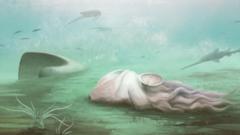
The taxonomic reclassification of Syllipsimopodi bideni—originally heralded as the oldest known relative of octopuses and squids—exposes a critical failure in morphological-based dating and the fragility of "missing link" narratives in evolutionary biology. When a discovery is retroactively stripped of its status, the issue is rarely a lack of data; it is an error in the structural framework used to interpret soft-tissue fossils. Understanding why Syllipsimopodi failed the octopus test requires an objective analysis of coleoid morphology, the physics of gladius preservation, and the specific anatomical markers that define the crown group Octopodiformes.
The Anatomy of a Classification Error
The initial classification of Syllipsimopodi as an ancestral octopus rested on the presence of ten suckered arms and what appeared to be a primitive gladius (an internal shell remnant). However, recent re-examinations of the fossil, which dates to the Mississippian period (approximately 328 million years ago), reveal a fundamental mismatch between its physical structures and the lineage-defining traits of the Vampyropoda (the group containing octopuses and vampire squids). Don't miss our previous coverage on this related article.
The Morphological Triad of Coleoid Evolution
To classify a fossil within the cephalopod tree, researchers must satisfy three distinct anatomical criteria. The failure of Syllipsimopodi to maintain its position stems from inconsistencies across these vectors:
- Appendage Configuration: While modern octopuses possess eight arms, their ancestors passed through a ten-armed stage. The presence of ten arms in Syllipsimopodi was used as evidence of its basal position. This is a logical fallacy of "primitive retention"—sharing a trait with an ancestor does not prove a specific relationship with a modern descendant.
- Gladius Geometry: The gladius is a chitinous internal structure. In true vampyropods, this structure is broad and supports a different muscular arrangement than in decapodiforms (squids and cuttlefish). Re-analysis suggests the fossilized remains in Syllipsimopodi are more consistent with a pro-ostracum from a belemnoid or an early decapodiform ancestor.
- Sucker Attachment Mechanics: Unlike modern octopuses that utilize complex musculature for individual sucker control, the fossil evidence in Syllipsimopodi shows a more rigid, serial arrangement that mirrors early squid-like lineages rather than the specialized nervous system architecture required for the octopus branch.
[Image of cephalopod evolution tree] If you want more about the context of this, Engadget offers an excellent summary.
The Carboniferous Bottleneck
The difficulty in identifying the "first" octopus is exacerbated by a taphonomic bottleneck during the Carboniferous period. Soft-bodied organisms require exceptional conditions for preservation, typically found in Lagerstätten (sedimentary deposits that exhibit extraordinary fossil richness).
The Mississippian Bear Gulch Limestone, where Syllipsimopodi was found, provides a high-resolution snapshot, but the chemical environment often distorts soft tissue through a process called "halmyrolysis" (seawater weathering). This creates a high risk of "pareidolia in paleontology," where random mineral stains are interpreted as complex organs or appendages. The reclassification of this fossil suggests that the anatomical features previously identified as "octopus-like" were likely artifacts of compression or independent convergent evolution.
Convergent Evolution as a Statistical Noise
Evolutionary biology is plagued by homoplasy—the independent evolution of similar features in different lineages. In the case of cephalopods, the transition from an external shell to an internal shell (or no shell) happened multiple times across different branches.
- Internalization Speed: The rate at which the shell moved internally varied across the Phragmoteuthida and Teudopseina orders.
- Hydrodynamic Constraints: Predatory pressures forced multiple unrelated lineages toward a streamlined, torpedo-shaped body, leading to similar-looking fossils that are phylogenetically distant.
Because Syllipsimopodi lived in a high-competition marine environment, the "octopus-like" streamlining was likely a functional requirement for survival rather than a genetic signal of being an octopus ancestor.
The Identification Lag: Why Taxonomy Shifts
The delay between a "discovery" and its "correction" is a function of peer-review cycles and the availability of comparative datasets. The initial description of Syllipsimopodi in 2022 was bold because it pushed the vampire squid/octopus split back by 82 million years.
However, the logic used to sustain that timeline was linear. It assumed that because the specimen was the oldest with "suckers and a shell," it must be the root of the tree. This ignores the "Ghost Lineage" problem: the statistical certainty that lineages exist for millions of years before their first appearance in the fossil record. If Syllipsimopodi is not an octopus, the ghost lineage for Octopodiformes shrinks, but our understanding of early decapodiform diversity expands.
Redefining the Octopodiform Root
To identify a true "earliest octopus," researchers must move beyond arm counts and focus on the Cirrate vs. Incirrate divergence.
- Cirri: Small, finger-like projections along the arms.
- Fin Support: Internal structures that allow for flap-based swimming.
Current data suggests that the true divergence point for octopuses likely occurred much later than the Mississippian, potentially in the Triassic. The reclassification of Syllipsimopodi moves it from the "grandfather of octopuses" to a "distant cousin in the squid-ward lineage." This shift is significant because it recalibrates the molecular clock used by geneticists to estimate mutation rates across all cephalopods.
The Mechanism of Morphological Decay
The primary challenge in analyzing fossils of this age is the degradation of chitin. The gladius of a cephalopod is not bone; it is a nitrogen-containing polysaccharide. Over 300 million years, chitin undergoes carbonization.
The "Identity Problem" arises when the carbonized film of a primitive shell is crushed. A flat, crushed shell of a belemnoid (an extinct group related to squids) can look identical to the broad gladius of a vampire squid. The corrective analysis of Syllipsimopodi focused on the lateral margins of this shell remnant. In true octopod ancestors, these margins are reinforced; in the specimen in question, they appear to be simple extensions consistent with the decapodiform branch.
Logic Framework: Distinguishing Decapodiform from Octopodiform
| Feature | Decapodiform (Squid-line) | Octopodiform (Octopus-line) | Syllipsimopodi Evidence |
|---|---|---|---|
| Arm Pairing | 5 pairs (equal or varied) | 4 pairs (+ 2 filaments in Vampyres) | 5 pairs (10 arms total) |
| Internal Shell | Narrow, pen-like | Broad, shield-like or vestigial | Narrow, elongated |
| Sucker Rings | Chitinous rings present | No rings (muscular only) | Inconclusive/Carbonized |
The alignment of Syllipsimopodi with two out of three Decapodiform traits (arms and shell shape) necessitates its removal from the octopus ancestry.
Tactical Implications for Paleobiological Research
The fallout from this reclassification dictates a shift in how "breakthrough" fossils are handled in the media and the lab. The rush to find the "earliest" of any species creates a confirmation bias where researchers look for modern traits in ancient mud.
Future analysis must prioritize Synapomorphies (shared derived characters) over Symplesiomorphies (shared ancestral characters). Ten arms are a symplesiomorphy; they tell us nothing about whether a creature is an octopus or a squid because both started with ten. The field must look for the loss of the fifth arm pair or the specialization of the third pair into filaments (as seen in Vampyroteuthis) to claim a definitive link to the octopus lineage.
The reclassification of Syllipsimopodi is not a failure of the scientific method but its primary function. By stripping the "octopus" label from this Carboniferous predator, we gain a clearer view of the massive radiation of squid-like ancestors that dominated the Paleozoic seas, even if it leaves the origin of the octopus as a more recent, and still missing, chapter in the deep-time record.
The strategic pivot for researchers now lies in the Permian deposits. If the octopus lineage did not split in the Mississippian, the search must intensify in the 250–270 million-year-old strata, where the environmental conditions for soft-tissue preservation are rarer but the phylogenetic probability of finding a true crown-group ancestor is significantly higher.