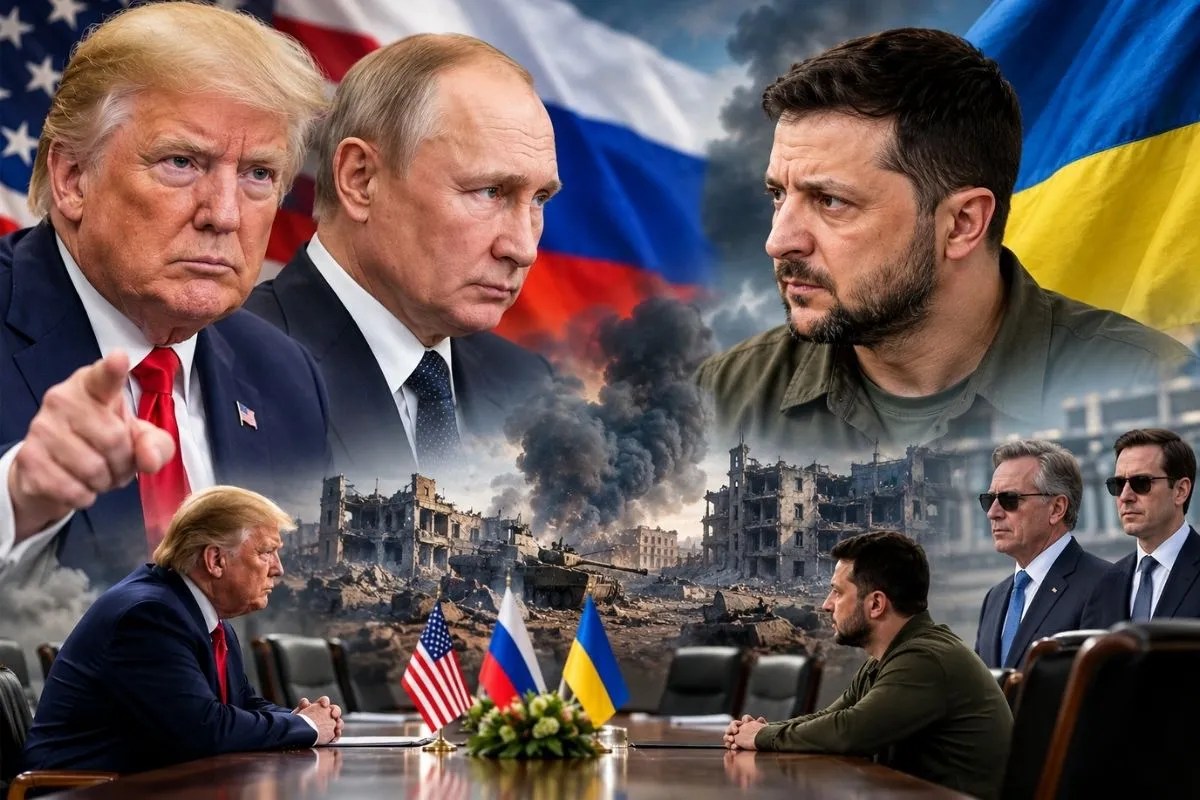
Diplomacy rarely happens on a clean calendar. When Washington pushes for a November negotiating table with Moscow, the headlines instantly turn into a guessing game about maps and ceasefires. Yet if you look closely at what Volodymyr Zelensky actually laid out regarding Ukraine's security options, the conversation isn't really about surrendering territory. It's about survival mechanics.
Most commentary misses the core friction here. You can't sign a piece of paper with the Kremlin unless something heavy stands behind the ink. Without enforceable deterrence, any November truce simply becomes a breather for Russian forces to rearm, regroup, and try again in two years. Zelensky knows this. His government has spent years studying why the 1994 Budapest Memorandum failed and why the Minsk agreements collapsed into frozen trench warfare.
So when Kyiv outlines three distinct paths for post-war security while American officials nudge toward autumn talks, each option carries massive trade-offs. Let's break down what those three pillars actually look like, why Washington's timeline complicates them, and what happens if the math doesn't work.
Why Washington Wants Momentum Before Winter
Timing drives everything in foreign policy. American administrations face domestic political calendars, budget cycles, and competing global crises from the Indo-Pacific to the Middle East. Pushing for November discussions with Russia isn't necessarily about forcing Kyiv into a bad deal tomorrow morning. Often, it's about testing whether Moscow is willing to talk at all before winter freezes the front lines and energy infrastructure comes under renewed missile bombardment.
Here is the problem with that approach. Moscow doesn't view negotiations as a compromise mechanism. Russian leadership historically treats talks as an extension of battlefield pressure—a way to lock in territorial gains while fracturing Western unity. If Washington signals urgency for a November summit, the Kremlin reads that urgency as fatigue.
I've watched European diplomatic circles wrestle with this exact dilemma since 2022. Every time a Western capital mentions a target month for peace talks, Russian state media frames it as proof that support for Kyiv is cracking. Zelensky's team has to counter that narrative publicly while quietly preparing concrete terms so Ukraine isn't painted as the obstacle to peace.
Option One Full NATO Membership and the Article 5 Shield
The first and cleanest security option on Kyiv's table remains full accession to NATO. Nothing else in international security carries the deterrent weight of Article 5, which treats an attack on one alliance member as an attack on all.
Kyiv isn't naive about the political hurdles here. Getting unanimous ratification from every NATO capital—especially when countries like Hungary and Slovakia routinely stall Brussels consensus—takes serious diplomatic muscle. There is also the persistent fear in Washington and Berlin that admitting Ukraine while active hostilities simmer could pull American troops directly into a shooting war with a nuclear-armed state.
To get around the deadlock, Ukrainian strategists have floated variations of the "West Germany model." Under that concept, NATO's security umbrella would cover the territory currently controlled by the Ukrainian government, even while occupied regions remain under diplomatic dispute.
Does that mean Ukraine legally gives up Crimea or the Donbas? No. West Germany never recognized the permanent division of Germany during the Cold War, yet it joined NATO in 1955 and enjoyed decades of protected economic growth. Still, convincing skeptical alliance members to extend Article 5 to a country with an active, thousand-kilometer front line requires political will that hasn't fully materialized in Washington.
Option Two Bilateral Defense Pacts and the "Porcupine" Strategy
If NATO doors stay half-closed in November, Kyiv's second option relies on hardening bilateral security agreements into something far stronger than current promises. Over the past two years, Ukraine has signed dozens of bilateral security pacts with the United States, the United Kingdom, Germany, France, and other G7 partners.
Right now, those deals are basically commitments to keep supplying weapons, intelligence, and training. They are not mutual defense treaties. If Russia attacks again in 2028, those agreements oblige partners to consult within 24 hours and send aid—not to send fighter jets or infantry.
To make Option Two actually work, Kyiv needs those bilateral deals upgraded into binding, multi-year military guarantees backed by congressional or parliamentary law, alongside massive domestic arms production. Think of the Israeli model, often called the "porcupine strategy." You make Ukraine so bristling with air defenses, long-range strike drones, artillery shells, and mechanized brigades that another Russian invasion becomes prohibitively expensive.
This path is realistic, honestly, and it's already half-built. Ukraine's domestic defense industry has scaled up drone and artillery manufacturing at a breakneck pace. The catch? Money and air defense. Keeping a massive standing army equipped to deter a neighbor three times its size requires tens of billions of dollars annually in Western financing. Relying on annual budget votes in Washington or European capitals leaves Kyiv vulnerable to political swings every election cycle.
Option Three European Troop Deployments and Nuclear Deterrence Debates
The third avenue involves direct European strategic backing—ideas that would have sounded unthinkable three years ago. French President Emmanuel Macron cracked open this door when he refused to rule out sending Western troops to Ukraine for non-combat roles like training, demining, or border monitoring.
In a November negotiation scenario, European coalition forces stationed inside western or central Ukraine—away from the immediate line of contact—could act as a tripwire. Moscow would think twice before firing ballistic missiles at Lviv or Odesa if French, British, or Polish military trainers were operating on the ground.
Alongside troop discussions sits an uncomfortable reality that Ukrainian officials occasionally hint at when Western support wobbles. When Ukraine gave up the world's third-largest nuclear arsenal under the 1994 Budapest Memorandum, it received paper assurances from the US, the UK, and Russia. If NATO membership is blocked and bilateral guarantees lack teeth, voices inside Kyiv warn that Ukraine would have no choice but to pursue extreme self-reliance to survive. Nobody in Washington wants nuclear proliferation in Eastern Europe, which is precisely why Kyiv brings up the history of Budapest whenever Western diplomats hesitate on conventional guarantees.
What People Miss About the Kremlin's Red Lines
When pundits debate these three security options, they usually ask whether Vladimir Putin will accept them. That gets the dynamic backward.
If you ask Moscow what security arrangement it accepts for Ukraine, the answer is simple—none. The Kremlin's stated goals since 2021 have demanded Ukrainian neutrality, severe caps on the size of the Ukrainian military, and a ban on foreign weapons and trainers. Accepting neutral status without external security guarantees is political and physical suicide for Kyiv. It would leave Ukraine disarmed while Russia keeps its war economy running at full tilt.
Any viable November framework has to bypass Moscow's veto over Ukraine's alliances. Russia doesn't get a vote on who joins NATO, nor does it get a veto over bilateral defense treaties between sovereign nations. The real negotiation isn't between Kyiv and Moscow over whether Ukraine gets security guarantees; it's between Kyiv and Washington over how ironclad those guarantees will be before Ukraine takes any risks at the bargaining table.
How to Read the Diplomatic Signals Ahead
As November approaches, ignore the noise from anonymous leaks claiming a secret peace map has already been drawn. Watch three concrete indicators instead to see which security option is actually gaining traction.
First, track long-term air defense commitments. If Washington and Berlin announce multi-year Patriot and IRIS-T production slots specifically earmarked for Kyiv beyond 2027, they are building Option Two—the heavily armed porcupine model.
Second, watch how NATO officials talk about the "irreversible path" to membership. If language shifts from vague future invitations to concrete timeline benchmarks or partial Article 5 coverage, Option One is alive.
Third, pay attention to European defense spending and bilateral troop training agreements inside Ukrainian territory. If London, Paris, and Warsaw finalize plans to move training missions from Poland and Germany directly into western Ukraine, Option Three is moving from rhetoric to reality.
Keep your eyes on those hard military commitments rather than diplomatic press conferences. In Eastern Europe, peace doesn't hold because leaders shake hands in November—it holds because the cost of breaking it is too high to pay.