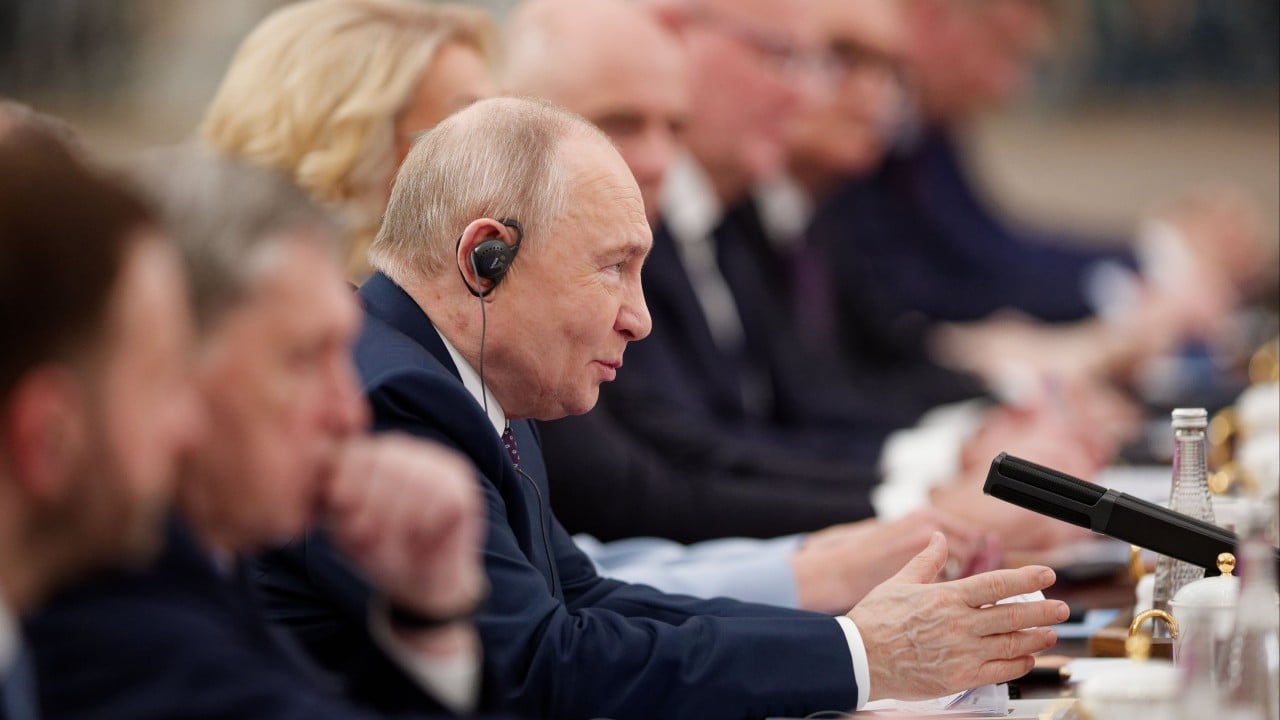
When Xi Jinping and Vladimir Putin sat down in Shenzhen on November 18, 2026, to pledge "stable bilateral ties" just hours before their historic trilateral meeting with Donald Trump, western pundits immediately treated the handshake like breaking news. It wasn't.
If you've watched Eurasian diplomacy closely over the last few years, that pre-summit huddle was pure theater with a very specific tactical goal. Beijing and Moscow didn't meet to decide whether to stay friends. They met to make sure neither of them blinked when they walked into Kylin Villa the next morning to sit across from the American president. For an alternative look, read: this related article.
Most coverage of the APEC sidelines summit in Shenzhen missed the real mechanics of how Xi and Putin actually operate together. They aren't building an ideological brotherhood, and they definitely don't trust each other completely. Instead, they're running a cold, transactional playbook designed to neutralize Washington's favorite diplomatic weapon—divide and conquer.
The Myth of the Reverse Kissinger
For months leading up to the November 2026 Asia-Pacific Economic Cooperation (APEC) Economic Leaders' Meeting, Washington foreign policy circles buzzed with talk of a "reverse Kissinger". The theory went like this. If Trump could offer Moscow a favorable off-ramp in Ukraine or relief from Western isolation, maybe Putin would pull away from Beijing. Or maybe Trump could dangle tariff relief in front of Xi to get China to squeeze Russia's wartime economy. Further coverage regarding this has been published by Al Jazeera.
Putin and Xi killed that fantasy before Trump's plane even cooled on the tarmac in Shenzhen.
During their bilateral sit-down on November 18, Putin explicitly framed their relationship around building a "fairer multipolar world order" and rejecting what he called "ultimatums" and "economic coercion". Xi echoed the exact same script, calling on both countries to "firmly shoulder the responsibilities expected of major powers" and push the "democratisation of international relations".
Here's what those diplomatic buzzwords actually mean in plain English.
- No side deals. Neither Beijing nor Moscow will trade the other away for temporary concessions from Washington.
- United framing. Both leaders enter the room defining the United States—not Russia's invasion of Ukraine or China's trade practices—as the primary source of global instability.
- Asymmetric leverage. By standing shoulder to shoulder, Putin borrows China's massive economic weight, while Xi borrows Russia's willingness to absorb direct military and diplomatic heat from the West.
Honestly, anyone expecting Putin to ditch Xi for a warm handshake from Trump ignores basic geography and survival math. Russia shares a 2,600-mile border with China. Its economy runs on Chinese industrial goods and energy purchases. Trump is in office until January 2029, while Xi and Putin plan on ruling for the foreseeable future. They aren't trading a permanent neighbor for a four-year American political cycle.
Why Shenzhen Happened on Xi's Terms
Look at the staging of the November 19 trilateral summit. It didn't happen in Geneva, Vienna, or Washington. It happened at Kylin Villa in Shenzhen, China.
That venue choice alone handed Xi Jinping a massive visual victory before a single word was spoken. By hosting the first-ever three-way summit between the leaders of the United States, Russia, and China on Chinese soil, Xi positioned himself as the indispensable convener of global power. When the cameras clicked, Xi stood right in the center, flanked by Trump on one side and Putin on the other.
For Putin, the optics were arguably even more valuable. After years of Western sanctions, travel restrictions, and an International Criminal Court (ICC) arrest warrant hanging over his head, Putin walked onto a global stage as an equal partner to the world's two largest economies. Trump even greeted him warmly on camera, joking "Who is that?" before calling Putin "my friend" and describing their history as a "great relationship".
You don't need a PhD in international relations to see why Putin wanted that footage broadcast across Russian state television. It shattered the narrative of Russian diplomatic isolation overnight.
What Actually Happened Inside the Room vs What Was Left Out
If you read the official White House U.S.-Russia-China Heads of State Declaration toward Peace released on November 19, 2026, you'll notice something striking. It's remarkably short, and the biggest crises on the planet are completely missing from the text.
Let's break down what the three leaders actually agreed to put on paper versus what they quietly swept under the rug.
What Made the Joint Declaration
- Nuclear risk reduction: The three leaders reaffirmed the classic Reagan-Gorbachev formula that "a nuclear war cannot be won and must never be fought". They also committed to a trilateral dialogue on reducing nuclear risks and preventing proliferation. For Washington, getting Beijing to sit at a nuclear risk table—even without formal arms control limits—counts as a small step forward after years of Chinese stonewalling.
- Oil and energy flows: With the ongoing conflict in Iran disrupting tanker traffic through the Strait of Hormuz, all three countries pledged to increase the production and supply of refined petroleum products to stabilize global energy markets.
- International court pushback: In a major win for Moscow and Beijing, the joint statement declared that state consent and official immunity are supreme, explicitly warning that the International Criminal Court and similar bodies "must not abuse their jurisdiction".
- United Nations reform: The three founding UN Security Council members vaguely agreed to work toward reforming the organization while preserving the post-1945 international system.
What Got Left on the Cutting Room Floor
Notice what isn't in that four-point declaration. Ukraine isn't mentioned once. Taiwan isn't mentioned. Neither is a concrete ceasefire plan for Iran, despite Trump telling reporters afterward that both he and Xi felt strongly about keeping oil flowing through the Strait of Hormuz.
Analysts at the Council on Foreign Relations quickly pointed out this gap between high-wattage theater and thin policy substance. As CFR fellow Thomas Graham and his colleagues noted in their post-summit assessment, the Shenzhen meeting delivered huge symbolic wins for Beijing and Moscow while leaving the hardest security disputes unresolved.
Trump called the summit a "12 on a scale of zero to 10" in a phone call with NBC News. Meanwhile, Democratic Senator Tim Kaine called the image of Trump standing alongside Xi and Putin deeply concerning, arguing that treating Putin as a friend ignores reality. Both reactions miss the middle ground. The summit wasn't a historic peace breakthrough, and it wasn't an American surrender. It was an opening bid where Xi and Putin arrived with a synchronized game plan and Trump arrived looking for quick, visible wins on trade and energy.
The Unequal Partnership Behind Closed Doors
Here's where most casual observers get tripped up. Just because Xi and Putin project lockstep unity in public doesn't mean they're equals behind closed doors.
In 2026, China holds almost all the cards in the Sino-Russian relationship. Russia's war economy depends heavily on Chinese dual-use components, machine tools, and consumer electronics, alongside Chinese purchases of discounted Russian crude. Beijing knows it. Moscow knows it too, even if Russian officials prefer talking about "equality rather than domination".
That imbalance explains why Xi's pre-trilateral message to Putin was so carefully calibrated. Xi needs Russia strong enough to keep Washington bogged down in Europe and the Middle East, preventing the Pentagon from focusing 100% of its military bandwidth on the Indo-Pacific and Taiwan. At the same time, Xi does not want Russian recklessness—or a catastrophic escalation in Ukraine—to wreck China's fragile economic recovery or trigger secondary sanctions that lock Chinese banks out of Western markets.
Think of it like a high-stakes poker game where two players quietly agree not to raise against each other so they can squeeze the third player at the table. They aren't sharing their bankrolls, and they'll happily take each other's chips once the third player leaves. Right now, though, coordinating their bets keeps the pressure squarely on Washington.
Three Concrete Things to Watch Before January 2027
If you want to know whether the Shenzhen trilateral actually changes anything on the ground—or if it dissolves into another round of tariffs and proxy clashes—ignore the podium speeches and track three hard deadlines over the next six weeks.
- The December 14-15 G20 Summit in Miami. Trump is hosting the G20 at his Doral resort in Florida next month. Xi is expected to attend, and Trump has extended an invitation to Putin. Watch whether Putin actually flies to U.S. soil—which would test every legal and diplomatic boundary around his ICC warrant—or if he sends a lower-level envoy and leaves Xi to handle Trump one-on-one.
- The January 10, 2027 U.S.-China Tariff Deadline. Behind the warm smiles in Shenzhen, the U.S. and China are still operating under a temporary tariff truce following the brutal tit-for-tat trade war of 2025 that pushed duties above 100%. That truce expires on January 10, 2027. If Beijing doesn't follow through on Trump's demands to buy more American agricultural products or curb industrial overcapacity, expect those tariffs to snap right back.
- Follow-up talks on Ukraine and the Strait of Hormuz. The U.S. brokered a fourth round of Russia-Ukraine talks in Abu Dhabi earlier in November without a breakthrough. If Moscow softens its territorial demands—or if Beijing quietly pressures Tehran to stop disrupting shipping in the Persian Gulf—you'll know the private conversations at Kylin Villa had real teeth. If nothing moves by New Year's Day, Shenzhen was just an expensive photo op.
Stop reading diplomatic readouts at face value and start tracking trade deadlines, tanker insurance rates in the Strait of Hormuz, and attendance lists for Miami—because those three indicators will tell you immediately whether Xi and Putin's united front is actually delivering results or just buying time.