China just sent a robotic collector more than three miles down into the Pacific Ocean, and almost every headline missed the real story.
When state media reported that China Minmetals completed its first large-scale seabed mining trial at 5,330 meters in November 2026, commentators immediately framed it as the start of commercial deep-sea strip mining. That's wrong. Commercial extraction is still legally frozen. What actually happened in the Clarion-Clipperton Zone is an engineering and geopolitical stress test that quietly solved two of the biggest bottlenecks holding back ocean-floor mineral recovery. For another look, check out: this related article.
If you care about electric vehicle batteries, critical mineral supply chains, or how Beijing outmaneuvers Washington in international waters, you need to look past the hype and examine what those 200 underwater hours actually proved.
Why the 5,330-Meter Pacific Trial Matters Right Now
Deep-sea mining isn't a new idea. Engineers have kicked around concepts for vacuuming potato-sized rocks—known as polymetallic nodules—off the abyssal plains since the 1970s. Those dark, lumpy concretions sit loosely on the mud at depths between 4,000 and 6,000 meters, packed with nickel, cobalt, manganese, and copper. Similar coverage on this matter has been provided by Wired.
According to the U.S. Congressional Research Service, the Clarion-Clipperton Zone (CCZ)—a 1.7-million-square-mile stretch of Pacific seafloor between Hawaii and Mexico—holds more copper, cobalt, nickel, and manganese than all known land deposits combined.
Until recently, getting those rocks to the surface reliably was an engineering nightmare. Saltwater at 5,330 meters exerts crushing pressure above 500 atmospheres. Temperatures hover near freezing. The seabed itself isn't solid rock; it's soft, unstable sediment that swallows heavy tracked vehicles.
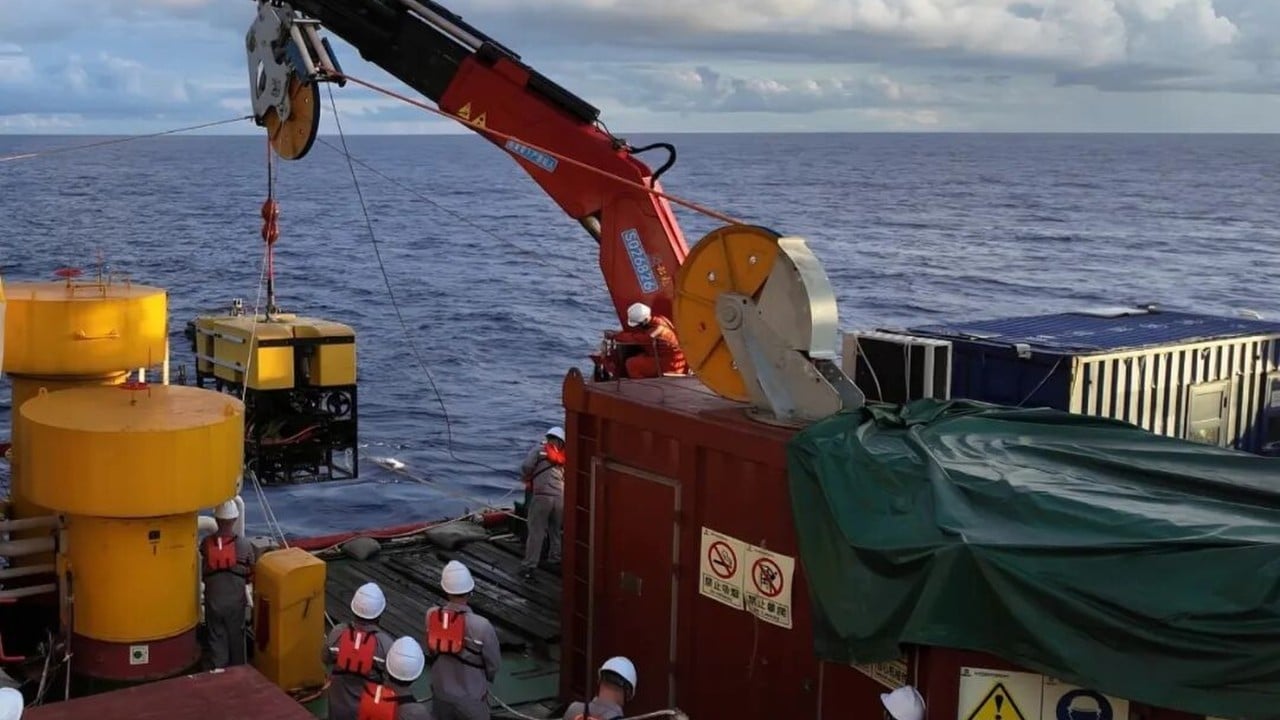
During the November 2026 expedition inside China Minmetals' 72,745-square-kilometer contract area, Chinese engineers didn't just drop a camera to take pretty pictures. They ran sustained industrial hardware trials:
- Six deep-ocean deployments reaching 5,330 meters below the surface.
- Nearly 200 cumulative hours of active underwater operation.
- A continuous 48-hour descent testing endurance without surfacing for maintenance.
Most early ocean-floor prototypes fail within hours from hydraulic leaks, clogged intake nozzles, or snapped tethers. Running continuously for two full days at five kilometers down proves the hardware has moved past laboratory curiosity.
Inside the Hardware That Solved the Weight Problem
Look closely at the engineering specs from the trial and you'll spot why earlier attempts hit a physical wall.
When you lower heavy machinery five kilometers down on a traditional steel cable, the cable itself becomes your biggest enemy. Five miles of thick armored steel weighs so much that it threatens to snap under its own mass before you even attach a mining robot to the bottom.
Chinese engineers bypassed that trap by pairing two domestic systems:
The Haiwei GD11000 Fiber-Reinforced Winch
Led by Professor Li Wenhua at Dalian Maritime University, the Haiwei GD11000 deep-sea winch uses a 13-kilometer tether built with synthetic fiber reinforcement instead of pure steel. Stripping out steel slashes dead weight at extreme depths while maintaining tensile strength. Originally designed for oceanographic science, the winch handled heavy industrial load cycles across all six descents.
The Kunpeng Robotic Collector
Attached to that line was the Kunpeng—a tracked seabed collector built by China Minmetals and named after a giant mythical creature from Chinese folklore. Navigation at 5,330 meters is blind work because GPS signals die within inches of the ocean surface. Researchers at Harbin Engineering University equipped Kunpeng with an acoustic navigation suite that held one-meter positioning accuracy across pitch-black, soft abyssal mud.
That precision matters more than people realize. If a collector drifts off-path, it either misses high-density nodule patches or gets bogged down in trenches. One-meter accuracy turns blind harvesting into a mapped, repeatable grid operation.
Three Misconceptions About Seabed Ore Mining
Whenever deep-sea mining hits the news, public debate splits into two caricatures—either "unlimited clean energy metals forever" or "instant ocean apocalypse." Both miss reality.
Misconception 1 China Is Already Commercially Mining the Pacific
It isn't. No country has launched commercial-scale extraction in international waters. China Minmetals operates under a 15-year exploration contract granted in 2017 by the International Seabed Authority (ISA), the UN-affiliated regulator based in Jamaica. Exploration licenses allow environmental surveys and equipment testing. Full commercial production remains paused while ISA member states negotiate binding exploitation rules, environmental liability standards, and royalty formulas.
Misconception 2 Collecting Rocks Means Ready-to-Use Battery Metals
Picking nodules off the seafloor is only step one. Polymetallic nodules have a totally different chemical structure from terrestrial sulfide or laterite ores. You can't just dump them into a standard smelter. Companies still have to prove they can pump ore reliably up a five-kilometer riser pipe to a surface vessel, ship millions of tons to shore, and refine them profitably without massive energy costs. That said, China already controls the vast majority of global mineral refining capacity—giving Beijing a built-in processing advantage once commercial volume starts moving.
Misconception 3 Western Nations Have a Head Start on Rules
Actually, Beijing holds the structural high ground inside the regulatory system. China holds five of the 31 exploration contracts issued by the ISA—more than any other nation—covering polymetallic nodules, hydrothermal sulfides, and cobalt-rich crusts. It is also the ISA's largest financial contributor and operates the world's largest blue-water research fleet, with more than 40 oceanographic vessels. Meanwhile, because the United States never ratified the UN Convention on the Law of the Sea, Washington sits outside the ISA altogether and has explored unilateral domestic licensing paths—a move that lets Beijing present itself to Pacific nations as the superpower following multilateral rules.
What Happens to the Deep Seafloor When Machines Roll Through
You can't talk honestly about this trial without confronting the ecological bill.
Polymetallic nodules don't grow back on human timescales. They accrete minerals from seawater at roughly a few millimeters per million years. The animals living on and around them—sponges, brittle stars,xenophyophores, and microbes—evolved in one of the most stable, low-energy environments on Earth.
When a heavy collector crawls across that mud, three things happen:
- Direct habitat removal. Stripping the nodules removes the only hard surface available for sessile deep-sea organisms to anchor onto.
- Benthic sediment plumes. Collector tracks kick up fine silt that smothers filter-feeding organisms well beyond the immediate mining path.
- Mid-water discharge clouds. Once nodules are pumped to a surface ship and separated from seawater and mud, the wastewater gets piped back down into the water column, potentially disrupting mid-water food webs and commercial fisheries.
Recent field simulations and microbiological studies in the Pacific—including research published in Total Environment Microbiology in late 2026—show that mechanical disturbance rapidly throws seafloor microbial communities off balance. China Minmetals stated its team worked to minimize seafloor disturbance during the Kunpeng trial, and collecting environmental baseline data is mandatory under ISA rules. Still, an equipment test isn't proof of long-term ecological safety. Until independent marine biologists monitor recovery across multi-year timescales, environmental risk remains the single biggest wildcard.
How Analysts and Industry Watchers Should Track What Happens Next
If you're following critical minerals, clean energy supply chains, or maritime geopolitics, ignore press releases bragging about "trillions of dollars in ocean wealth." Watch these concrete milestones instead:
- Monitor ISA Exploitation Code Deadlines. Track the International Seabed Authority's upcoming 32nd session in 2027. Whether member states finalize binding environmental thresholds and financial royalty rules will determine if companies can submit commercial exploitation applications in 2027 or 2028.
- Watch Vertical Riser Pipe Tests. Gathering nodules on the bottom is solved. The next true technical hurdle is continuous vertical hydraulic transport—pumping slurry 5,300 meters straight up to a mining ship without pipe blockages. Whoever proves continuous ship-to-seabed pumping holds the real commercial lead.
- Follow Pacific Island Coalitions. Watch how nations like Nauru, Tonga, Kiribati, and the Cook Islands—all of which sponsor ISA exploration contracts—navigate pressure from environmental moratorium advocates versus sovereign revenue needs.
- Audit Terrestrial vs. Marine Refining Capacity. Compare capital expenditure announcements from China Minmetals and China National Offshore Oil Corporation (which added marine mineral resources to its 15th Five-Year Plan in 2026) against Western competitors like The Metals Company.
The race for Pacific seabed minerals isn't a theoretical debate anymore. The machines work at five kilometers down, and the rules to govern them are running out of time.
China Finds Gold and Silver Riches Deep Beneath Pacific
This broadcast examines China's deep-sea mineral discoveries in the Pacific and the growing international debate over exploiting seafloor resources.