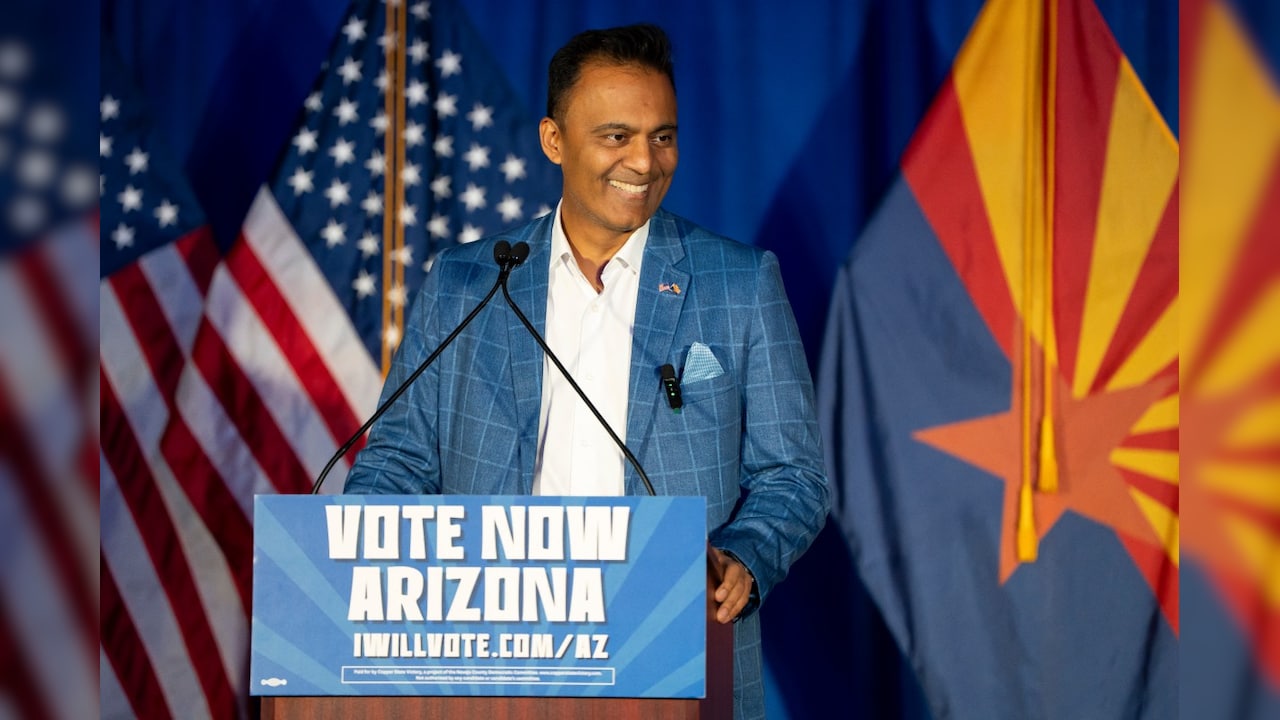
Most political headlines reduce candidates to a single demographic checkbox, and the coverage around Amish Shah is no different. When people search for who Amish Shah is or whether he made history as the first Indian-American to represent Arizona in Congress, they usually run into a wall of premature victory laps and sloppy copy-pasting.
Let's clear the air right away. In November 2024, Amish Shah did not win a seat in the U.S. House of Representatives. He came painfully close—losing Arizona's 1st Congressional District to Republican incumbent David Schweikert by fewer than 4,000 votes in one of the tightest, most expensive races in the country—before launching a second bid for the same seat in the 2026 cycle. For a closer look into similar topics, we suggest: this related article.
That distinction matters. Treating a historic primary win as a general election victory isn't just bad journalism; it misses the actual story of how an emergency room doctor from Chicago became one of the most formidable Democratic contenders in the American Southwest.
The Medical Career Behind the Politician
Before he ever knocked on a door in Phoenix or Scottsdale, Shah spent decades in high-pressure emergency rooms and sports medicine clinics. That background isn't just campaign bio fluff. It fundamentally shapes how he talks, how he campaigns, and why suburban moderates actually listen to him. For additional information on this topic, extensive analysis is available at NBC News.
Born in Chicago to Indian immigrant parents, Shah grew up watching his family build a life from scratch in the Midwest. He didn't take the typical lawyer-to-lobbyist pipeline into politics. Instead, he went all-in on medicine and public health:
- He earned his bachelor's degree in economics from Northwestern University, followed by his medical degree from Northwestern's Feinberg School of Medicine.
- He completed a Master of Public Health at the University of California, Berkeley, focusing on the broader systemic issues that push people into emergency rooms in the first place.
- He trained in emergency medicine in New York City, working in trauma centers where split-second triage decisions dictate survival.
- He later completed a sports medicine fellowship and worked as a team physician for the New York Jets and on the sidelines at the U.S. Open tennis championships.
When Shah moved to Arizona and took a job practicing emergency medicine at Mayo Clinic and Dignity Health facilities, he saw a different side of the state's rapid growth. Phoenix was booming, retirees were flooding into Maricopa County, and the local healthcare infrastructure was straining under the weight of seasonal surges and extreme summer heat.
You learn a lot about a community at 3 a.m. in an emergency department. You see the uninsured construction worker who waited too long to get a laceration checked, and you see the retired teacher rationing heart medication because her Medicare Part D copay jumped. Shah has repeatedly pointed to those overnight shifts as the catalyst that pushed him out of the hospital and into the Arizona State Capitol.
Breaking Into the Arizona State Legislature
If you want to understand why national Democrats poured millions of dollars into Shah's congressional campaigns, look at how he won his first race in 2018.
At the time, Legislative District 24—covering parts of central Phoenix and south Scottsdale—was held by entrenched incumbents. Shah had never held public office. Political consultants told him he didn't have the name recognition or the party machinery to survive a crowded Democratic primary.
He ignored them and walked. Literally.
Shah became legendary in Maricopa County politics for wearing out multiple pairs of running shoes, personally knocking on well over 15,000 doors during his 2018 campaign. He didn't rely on generic mailers or focus-grouped slogans. He stood on porches in 105-degree heat, introduced himself as a local ER doctor, and asked voters what was broken in Phoenix.
It worked. He upset the establishment favorite in the primary, won the general election easily, and made history as the first Indian-American elected to the Arizona State Legislature.
How He Operated at the Capitol
Once inside the statehouse, Shah didn't act like a partisan bomb-thrower. In a deeply divided legislature where Republicans controlled both chambers and the governor's mansion (until Katie Hobbs took office in 2023), progressive Democrats often struggled to get their bills even heard in committee.
Shah took a transactional, data-heavy approach that frustrated purists on his own side while winning over skeptical Republicans. Over three terms in the Arizona House of Representatives, he got more than two dozen bills signed into law—an unusually high batting average for a member of the minority party.
His legislative focus stayed tightly tethered to his day job:
- Healthcare transparency and access: He pushed measures targeting surprise medical billing and worked to expand telehealth access before the COVID-19 pandemic made virtual visits a household necessity.
- Public safety and injury prevention: Drawing on his ER trauma work, he championed stricter enforcement around distracted driving and backed legislation to combat fentanyl overdoses across Maricopa County.
- Consumer protection: He took aim at predatory lending practices and HOA abuses that hit fixed-income seniors in his district.
Did he always vote in lockstep with the progressive wing of his party? No. And he didn't apologize for it. Shah positioned himself as an evidence-based moderate, arguing that passing incremental improvements through a Republican-led legislature beats grandstanding on social media while accomplishing nothing.
The Battle for Arizona's 1st Congressional District
By 2023, Shah had outgrown the state legislature. He resigned his seat in early 2024 to focus full-time on a much bigger target—Arizona's 1st Congressional District.
To understand the stakes of that race, you have to understand the geography of AZ-01. The district stretches across northeast Phoenix, Scottsdale, Paradise Valley, Fountain Hills, and parts of Cave Creek. It is wealthy, highly educated, heavily suburban, and historically Republican. For decades, it was the kind of turf where a Democrat couldn't buy a vote.
Redistricting and demographic shifts changed the math. Independents now make up roughly a third of the electorate in the district, and college-educated suburbanites have grown increasingly alienated by hard-right cultural politics.
Surviving a Brutal 2024 Primary
Before he could even face Republican incumbent David Schweikert, Shah had to survive a six-way Democratic primary in July 2024. The field was packed with well-funded candidates, including former TV news anchor Marlene Galán-Woods and former state lawmaker Andrei Cherny.
Outspent on television ads, Shah went back to his 2018 playbook. He raised over $2 million—much of it from Indian-American donors nationwide and fellow physicians—and leaned heavily on grassroots organizing. When the ballots were counted in August 2024, Shah pulled off a narrow upset, winning the nomination with roughly 23.5% of the vote in a fractured field.
That primary victory immediately triggered a wave of national headlines framing him as the potential first Indian-American to represent Arizona in the U.S. Congress.
The razor-thin 2024 General Election
The general election against David Schweikert turned into a heavyweight slugfest. Schweikert, a fixture in Arizona Republican politics since the 1990s who had survived a House Ethics Committee reprimand in 2020, fought aggressively to paint Shah as a covert progressive out of step with Scottsdale's business-friendly values.
Shah countered by hammering Schweikert on two issues that resonated deeply in the Phoenix suburbs—reproductive freedom and healthcare costs. Arizona was Ground Zero in the national debate over abortion access following the state Supreme Court's brief resurrection of an 1864 near-total ban earlier that year. As a physician, Shah talked about the issue in clinical, personal terms rather than political talking points.
When November 2024 arrived, the race came down to the wire. Out of more than 430,000 ballots cast in AZ-01, Schweikert edged out Shah by just under 4,000 votes—roughly a 0.9% margin. While Donald Trump carried Arizona at the top of the ticket, Shah massively outperformed the national Democratic baseline in one of the wealthiest suburban districts in the country.
Why He Came Back for 2026
Most candidates who lose a grueling, multi-million-dollar congressional race pack up their yard signs and return to private life. Shah didn't.
Within months of the 2024 concession, he launched his 2026 campaign for Arizona's 1st Congressional District, betting that midterm dynamics—historically favorable to the party out of power in the White House—combined with his newly built name recognition would finally push him over the finish line.
He entered the 2026 cycle with structural advantages he simply didn't have two years earlier:
- Universal name ID in Maricopa County: After millions of dollars in broadcast ads and two consecutive countywide campaigns, voters in Scottsdale and Paradise Valley actually know who he is.
- A proven fundraising network: Shah demonstrated he can tap into both the national South Asian American donor base—the so-called "Samosa Caucus" network led by figures like Raja Krishnamoorthi and Ro Khanna—and local healthcare professionals.
- Clear lane consolidation: Unlike the chaotic six-way brawl of 2024, Shah entered the 2026 cycle as the clear standard-bearer for Democrats in AZ-01, allowing him to conserve cash for the general election rather than burning millions fighting fellow Democrats in August.
What Critics and Skeptics Get Right—and Wrong
You can't look at Amish Shah's political trajectory without acknowledging the friction points. No candidate survives Arizona politics without taking heat from both flanks.
From the right, conservative groups have relentlessly attacked his voting record in the Arizona House, arguing that his moderate, white-coat persona masks standard Democratic positions on federal spending, climate policy, and healthcare regulation. They point out that while he passed bipartisan bills in Phoenix, he still voted reliably with his caucus on major budget and tax fights.
From the progressive left, some activists have questioned whether Shah is bold enough for the moment. During his legislative tenure, his willingness to compromise with Republican committee chairs occasionally drew fire from grassroots organizers who wanted sharper confrontation on voting rights and public education funding.
Honestly, both criticisms miss why he's viable in a district like AZ-01. A fire-breathing progressive cannot win Paradise Valley or North Scottsdale. Conversely, a traditional Republican struggles when independent women make reproductive healthcare and institutional stability their top priorities. Shah occupies the narrow strip of ideological real estate where a candidate can actually win 50% plus one in suburban Maricopa County.
How to Track the Race and Verify Candidate Claims
If you're following Arizona's congressional races or trying to separate campaign spin from actual legislative history, don't rely on viral social media posts or aggregated clickbait articles that confuse primary wins with general election outcomes.
Go straight to the primary records:
- Check actual voting records: Use the Arizona State Legislature's official bill search to look up the specific bills Shah sponsored and co-sponsored between 2019 and 2024 rather than trusting attack ads from either side.
- Follow the money: Look up quarterly campaign finance filings on the Federal Election Commission (FEC) database to see how much of a candidate's war chest comes from local Arizona zip codes versus out-of-state PACs and national donor networks.
- Watch county-level turnout data: In Arizona's 1st District, elections aren't won in deep-blue Phoenix neighborhoods or deep-red Fountain Hills precincts—they're decided by independent voters in central Scottsdale. Watch Maricopa County Recorder registration updates leading into November to see which way those unaffiliated voters are breaking.