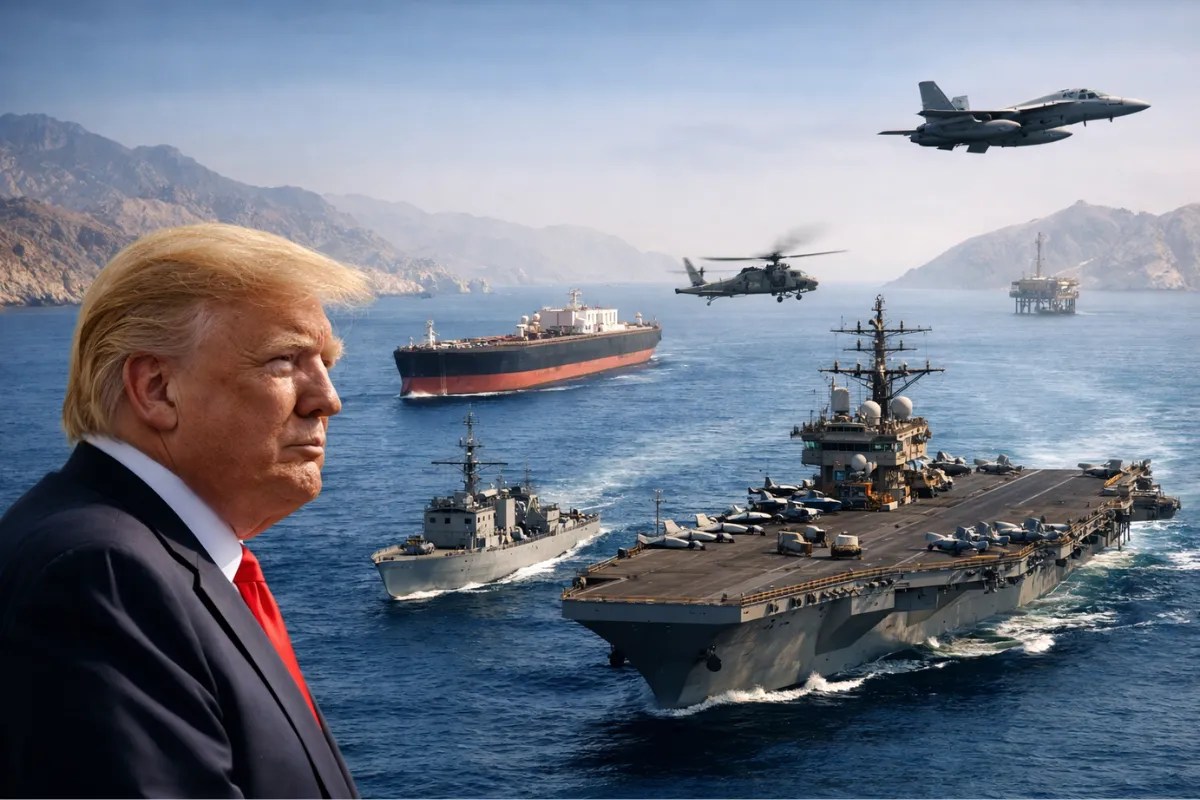
The arrival of the USS Abraham Lincoln carrier strike group in the Middle East is not a routine patrol or a simple show of force. It is a calculated tightening of the noose around the world's most sensitive maritime artery. By positioning fifteen high-capacity warships and specialized support vessels within striking distance of the Strait of Hormuz, the United States has moved past diplomatic posturing and into a phase of active containment. This deployment targets a specific vulnerability in global energy markets. Approximately 20% of the world’s petroleum passes through this twenty-one-mile wide gap. If the water stops moving, the global economy breaks.
While surface-level reports focus on the sheer number of hulls in the water, the real story lies in the integrated sensor web and the "kill chain" logistics these vessels bring to the Persian Gulf. This is a massive logistical gamble. The U.S. is betting that a concentrated naval presence can deter Iranian asymmetric warfare without accidentally sparking a regional conflagration that would send oil prices into a triple-digit tailspin. Learn more on a similar issue: this related article.
The Logistics of Naval Domination
Numbers tell part of the story, but the composition of the fleet tells the rest. The USS Abraham Lincoln (CVN-72) does not travel alone. It serves as the mobile airfield for the most advanced air wing in the Navy, including F-35C Lightning II fighters. These aircraft provide a stealth capability that traditional carrier wings lacked, allowing for deep-penetration strikes against coastal missile batteries long before a ship comes within range of shore-based defenses.
Accompanying the carrier are destroyers equipped with the Aegis Combat System. These ships are designed for one purpose: to create a multi-layered shield against the "swarm" tactics favored by the Iranian Revolutionary Guard Corps (IRGC). The IRGC relies on hundreds of fast-attack boats and low-cost suicide drones to overwhelm high-value targets. The U.S. response is a saturation of electronic warfare and rapid-fire kinetic interceptors. It is a high-stakes math problem where the Navy must prove it can shoot down $20,000 drones with $2 million missiles indefinitely. Additional journalism by BBC News highlights related perspectives on this issue.
Beyond the Carrier Strike Group
The fifteen-ship armada includes more than just the Lincoln’s immediate escorts. We are seeing a buildup of amphibious ready groups and independent "plug-and-play" destroyers that can operate in the shallow, cluttered waters of the Gulf. These smaller vessels are essential for mine-sweeping operations. Iran’s most effective weapon isn't a missile; it’s a bottom-dwelling mine that can be deployed from a civilian dhow.
By spreading these ships across the Arabian Sea and the Gulf of Oman, the U.S. is creating a defense-in-depth architecture. They are no longer just guarding the Strait; they are monitoring the entire supply chain from the loading docks in Kuwait and Saudi Arabia to the exit points in the Indian Ocean.
The Invisible War for the Chokepoint
Control of the Strait of Hormuz is as much about signals as it is about steel. The current deployment serves as a massive vacuum for intelligence. Every radar pulse from the Iranian coast, every radio transmission from a hidden bunker, and every movement of a mobile missile launcher is being mapped by the Lincoln’s electronic intelligence suites.
The U.S. is effectively building a digital twin of the Iranian coastline. This allows for "anticipatory targeting." If the IRGC prepares to move a Noor or Ghader anti-ship cruise missile into a firing position, the U.S. command knows within seconds. This level of surveillance is intended to strip away the element of surprise that smaller, regional powers rely on when facing a superpower.
The Asymmetric Threat
Iran knows it cannot win a traditional broadside-to-broadside naval battle. Instead, they have perfected the art of the "mosquito bite." They use the jagged geography of the Iranian coastline—full of coves, islands, and underwater ridges—to hide their assets.
The danger is the calculation of risk. The U.S. presence is so heavy that any minor tactical error by a local commander on either side could be interpreted as the start of a total war. For instance, if an Iranian fast boat approaches a U.S. destroyer too aggressively, the rules of engagement now lean toward lethal force. The Lincoln is there to ensure that if a fight starts, it ends quickly, but the presence of fifteen ships makes the "surface area" for a potential accident much larger.
The Global Energy Fallout
Wall Street and energy traders in London are watching the Lincoln more closely than they watch the Federal Reserve. The Strait of Hormuz is the world's most important "swing" point. If the passage is blocked, there is no immediate alternative. Pipelines through Saudi Arabia and the UAE exist, but they can only handle a fraction of the daily volume required to keep the lights on in Europe and Asia.
When the U.S. deploys a carrier, it is essentially providing a massive, taxpayer-funded insurance policy for global oil. Without these ships, the cost of insuring a tanker through the Strait would become prohibitive. Ships would stop sailing not because they were sunk, but because they were uninsurable.
China’s Silent Observation
While the U.S. and Iran are the primary actors, China is the most interested spectator. Beijing imports a staggering amount of its energy through this specific waterway. Ironically, the U.S. Navy is currently protecting the energy security of its primary global rival.
There is a growing school of thought in Washington that this burden is becoming unsustainable. Why should the U.S. bear the total cost and risk of securing the Strait when the primary beneficiaries are in the East? The current deployment might be one of the last times the U.S. provides this level of unilateral protection. We are seeing the beginning of a shift where the U.S. expects "partners" to put their own hulls in the water if they want their oil to keep flowing.
The Failure of Traditional Deterrence
For decades, the presence of a single carrier was enough to quiet the region. That era is over. The fact that the Pentagon felt the need to send fifteen vessels, including the Lincoln, suggests that the old methods of deterrence are losing their teeth.
Regional actors have spent years developing "carrier-killer" technologies. Submarines, long-range ballistic missiles, and autonomous underwater vehicles have turned the Persian Gulf into a lethal pond. The Lincoln is not just there to intimidate; it is there because it needs that many support ships just to survive in a modern high-threat environment.
The Hidden Cost of Readiness
This deployment comes at a massive cost to the U.S. Navy’s global posture. Every day the Lincoln spends in the Middle East is a day it is not in the South China Sea. The "Pivot to Asia" remains a theoretical goal while the reality of Middle Eastern instability continues to suck the oxygen out of the room.
Maintenance cycles are being pushed to the limit. Crew fatigue is a real factor. The ships are being run hard in high-salinity, high-heat environments that chew through hardware. This is a "surge" strategy, and surges cannot be maintained forever. The Pentagon is burning through its long-term naval readiness to solve a short-term geopolitical standoff.
Tactical Realities on the Water
To understand the intensity of this standoff, one must look at the specific geography of the Strait. At its narrowest, the shipping lanes are only two miles wide in each direction. These lanes are separated by a two-mile buffer zone. Large tankers have the maneuverability of a skyscraper and cannot easily dodge an incoming threat.
The USS Abraham Lincoln acts as a mobile command center for a "bubble" of security. This bubble extends hundreds of miles.
- Outer Ring: F-35s and E-2D Hawkeyes providing early warning.
- Middle Ring: Aegis-equipped destroyers hunting for missiles and drones.
- Inner Ring: Small-unit riverine craft and helicopters guarding the ships themselves.
If this bubble is breached, the political and economic consequences are irreversible. The loss of a single U.S. carrier would be a generational shift in global power dynamics. This is why the fleet is so large; it is not just about the mission, it is about the unthinkable cost of failure.
The Strategy of Forced Errors
The U.S. is currently employing a strategy of "maximum pressure" on the water. By occupying the space so aggressively, they are forcing the Iranian military to either back down or escalate. There is no middle ground left.
This creates a psychological burden on the IRGC. They are used to being the aggressor, using "grey zone" tactics to harass tankers. Now, they are staring down a wall of high-tech sensors and ready-to-fire interceptors. The U.S. has effectively taken the "grey" out of the zone. You either let the ships pass, or you start a war with a carrier strike group.
The Intelligence Gap
One overlooked factor is the role of regional allies like Oman and the UAE. While the U.S. ships are the visible muscle, the local intelligence networks provide the nuance. Underwater hydrophones, coastal lookouts, and human intelligence on the ground in Iranian port cities like Bandar Abbas are feeding data into the Lincoln’s combat systems.
This is a coalition of necessity. Even countries that don't want a war recognize that a closed Strait is a death sentence for their national budgets. They are providing the logistical "grease" that allows the U.S. fleet to remain on station for months at a time without returning to distant bases.
The Inevitable Friction
Despite the high-tech sensors and the massive firepower, naval warfare remains a business of human intuition and error. The Persian Gulf is one of the most crowded waterways on earth. Thousands of small fishing boats, merchant ships, and tugs crisscross the area daily.
Distinguishing a suicide boat from a legitimate fisherman at three in the morning is a nightmare for a twenty-year-old sonar technician. The Lincoln’s presence increases the chances of a "Black Swan" event—an unpredictable, high-impact incident that triggers a chain reaction.
We are currently in a state of armed observation.
The ships are not firing, but their radars are locked on. The missiles are not in the air, but the keys are turned. This is the most dangerous kind of peace. It is a peace built on the threat of total destruction, maintained by a fleet of fifteen ships that are essentially holding their breath.
The U.S. has demonstrated it can flood the zone with steel. What it hasn't demonstrated is an exit strategy that doesn't involve leaving a power vacuum or a burning sea. The Lincoln and its escorts are a temporary dam against a rising tide of regional instability. Eventually, the dam will have to be moved, and the water will find its level.
The deployment of the USS Abraham Lincoln proves that the U.S. still views the Strait of Hormuz as a domestic priority. As long as the global economy is fueled by carbon, the Pentagon will continue to treat these twenty-one miles of water as if they were off the coast of Florida. This isn't just a military maneuver; it's an admission that the world isn't ready for a post-oil security reality. If you want the oil, you have to send the carriers. There is no other way.