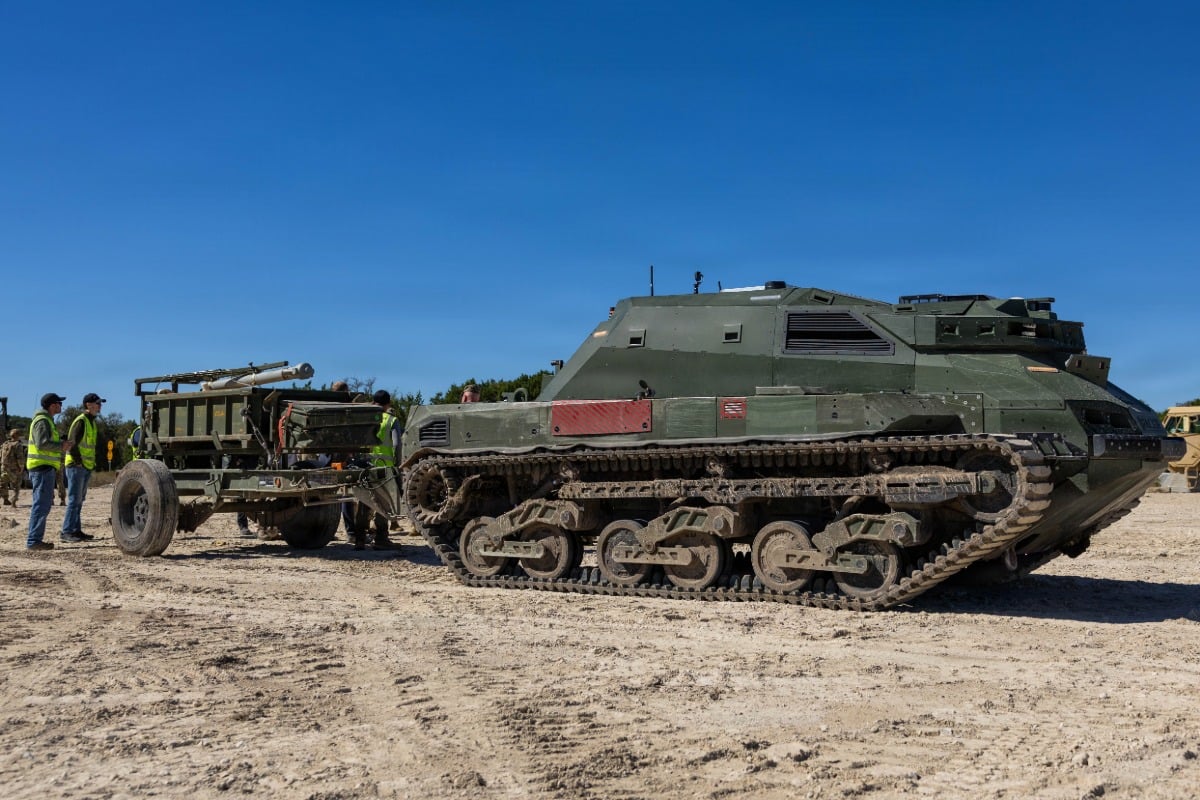
The United States military is sleepwalking into a strategic disaster. For years, the Pentagon has treated autonomous systems like shiny accessories—tools to help human soldiers carry out traditional missions a little faster or with a bit less heavy lifting.
That mindset is going to get a lot of people killed.
By treating drones and AI as mere supplements to existing combat formations, the American defense establishment is completely missing the point. We aren't just looking at upgraded hardware. We are standing on the edge of a fundamental shift in how wars are waged. If the U.S. military doesn't stop treating robots like high-tech pack mules and start building an entirely new way of fighting around them, it will find itself completely overwhelmed by a robotic blitzkrieg.
The warning signs are already here, and they aren't coming from think-tank theorists. They are coming from the mud of active combat zones and the brutal realities of modern military exercises.
The Illusion of the High-Tech Helper
Walk through any military expo or read through recent procurement logs, and you will see a recurring theme. The Army buys a robotic squad vehicle to carry rucksacks. The Air Force designs an uncrewed wingman to fly alongside a multi-million-dollar fighter jet.
This is what happens when you let old bureaucracies dictate the use of new technology. They try to fit the future into the organizational boxes of the past.
It is exactly the same mistake the French military made in the 1930s. They saw the invention of the tank and thought, "Excellent, a mobile shield to help our infantry walk forward safely." They scattered their armor across infantry divisions, using tanks as piecemeal support weapons. Meanwhile, German theorists like Heinz Guderian realized that the tank shouldn't support the infantry—the tank was the new center of gravity. They massed their armor into dedicated divisions, paired them with synchronized air support, and created a tempo of warfare that broke western Europe in weeks.
The Pentagon is making the French mistake all over again.
When you scatter drones across a traditional brigade, you don't actually change the speed at which that brigade can move, decide, and strike. You just make the existing, slow human loop slightly better informed.
The Reality of Hyper-Tempo Combat
The true power of autonomous hardware doesn't lie in stealth, armor, or firepower. It lies in tempo.
In a recent combat simulation at the Joint Readiness Training Center, the 13th Khartiia Brigade of Ukraine's National Guard and various U.S. Army test units proved just how devastating a compressed timeline can be. During these operations, drone sensors funneled over 25,000 spot reports directly to intelligence sections in a matter of days.
When humans try to sort through that much data, the system chokes. But when AI tools process that information, the planning cycle collapses from days to minutes. Units were able to push out complex operations orders in under half an hour—a process that normally takes a human staff half a day.
Now imagine that speed transferred directly to weapons systems.
A true robotic blitzkrieg won't feature a human officer sitting at a desk approving every target. It will consist of thousands of interconnected, autonomous systems communicating with each other at the speed of software. A reconnaissance drone spots an enemy position, instantly assigns a loitering munition to strike it, and directs a ground robot to exploit the gap—all in the span of three seconds.
If you are fighting that system with human-in-the-loop decision chains, you lose before your headquarters can even process the first radio transmission. You cannot out-think a machine that operates at the speed of light when your own decision cycle relies on a committee meeting.
The Failure of the Art of War Fallacy
There is a massive comfort blanket that military leaders like to wrap themselves in. They argue that machines lack intuition. They point out that large language models and neural networks don't truly understand three-dimensional space, terrain friction, or the psychological nuances of leadership.
They are right. Machines are terrible at the traditional "art of war."
But relying on that flaw as a defense strategy is incredibly dangerous. A robotic swarm doesn't need to understand the sublime beauty of a perfectly executed flanking maneuver. It just needs to flood the battlespace with so many low-cost, lethal dilemmas that the human defender running the "artistic" defense runs out of ammunition, time, and options.
Look at the stark math of modern attrition. A single American Patriot missile costs roughly 4 million dollars. The quadcopters and cruise missiles they are shooting down in places like Ukraine often cost less than a used car. You don't need a brilliant strategic mind to win a war when your opponent spends millions to defeat your thousands.
By failing to build mass-produced, expendable robotic strike units, the U.S. risks owning the world's most sophisticated, elite, and entirely extinct military force.
Rebuilding the Machine from Scratch
Fixing this requires more than just buying more drones. It requires a complete tearing down of how the military organizes itself.
First, we have to move past the concept of manned-unmanned teaming where the human is always the bottleneck. We need dedicated robotic vanguard units. These are formations where the primary combatants are entirely autonomous, and the humans sit miles back, managing the strategic intent rather than the tactical execution.
Second, the procurement system has to change. The Pentagon is designed to buy a small number of incredibly expensive platforms over a twenty-year development cycle. Robots are obsolete in twenty weeks. We need a military that treats software and disposable hardware like ammunition—bought in bulk, used constantly, and thrown away when the next iteration comes out.
If we don't make this leap, an adversary will. The next major conflict will not be won by the nation with the most advanced stealth fighters or the heaviest tanks. It will be won by the side that creates a seamless, autonomous web of machines that can execute a breakthrough before a human mind can even register that the attack has begun.
Stop trying to teach robots how to help soldiers. Start learning how to build an army out of them.
An excellent breakdown of this tactical evolution can be found in the analysis of Modern Military Operations and Autonomous Systems, which highlights how integrated software platforms are changing the timeline of modern battlefield command.