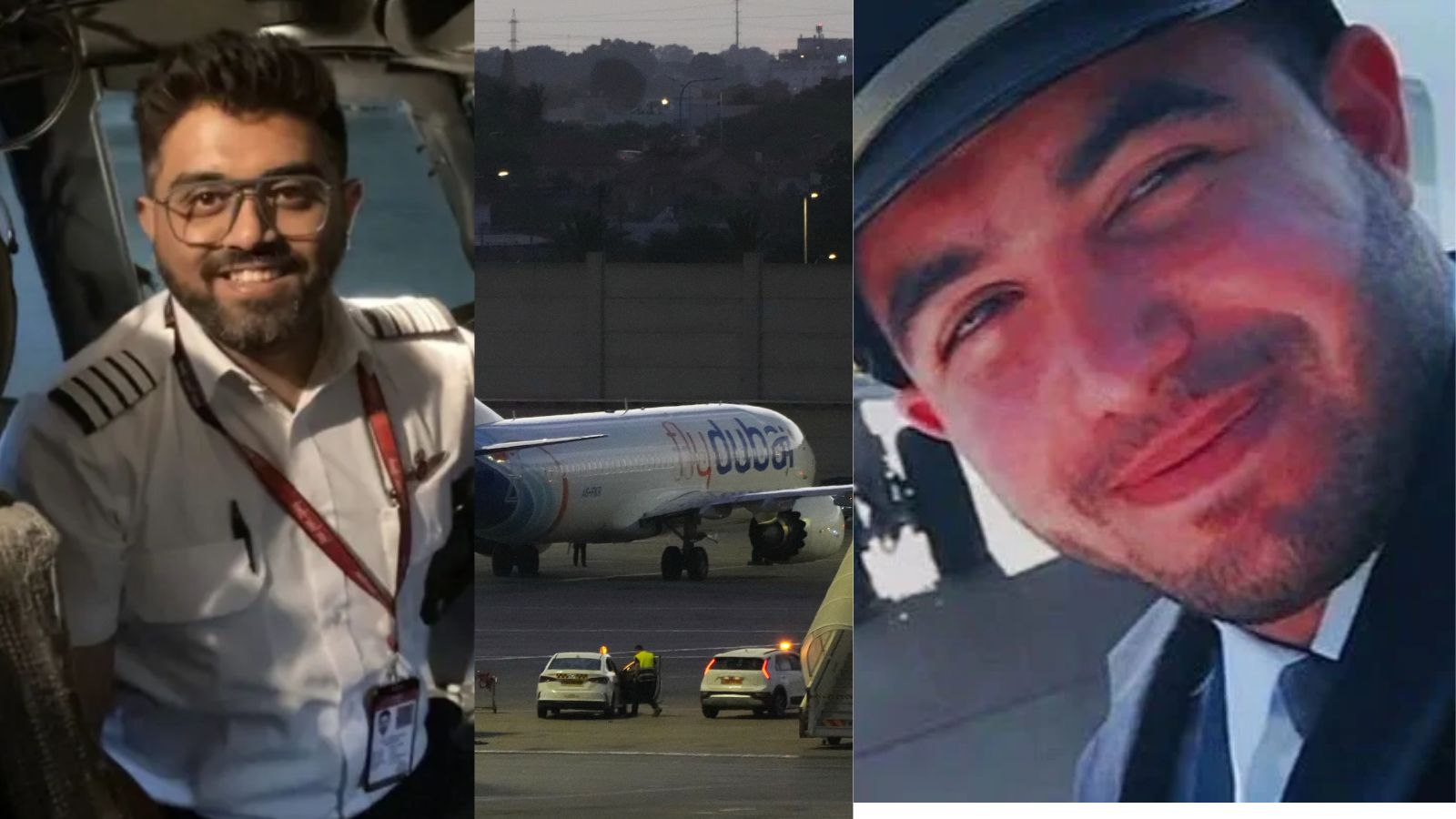
The cockpit of a commercial airliner is not merely a workplace. It is a cathedral of shared trust. When you sink into row twelve, clutching a lukewarm paper cup of coffee and watching the baggage handlers toss duffels against the belly of the fuselage, you are placing your life—and the lives of everyone you love—into an invisible contract. You assume that the two figures up front, bathed in the green and amber glow of primary flight displays, earned their seats through an unbroken chain of verified rigor. You assume the net holds.
Sometimes, the net has holes wide enough to fly an airplane through.
Consider the journey of Hamam al-Hammami.
To the casual passenger scanning the departure board at Dubai International Airport, a co-pilot is simply a uniform, a set of crisp epaulets, and a calm voice announcing cruising altitude over the intercom. But behind that uniform lies a sprawling, fragmented apparatus of global aviation compliance. Licensing authorities span continents. Flight schools operate under different jurisdictions, differing regulatory oversight, and varying degrees of institutional fatigue.
Hammami trained in the United Kingdom, New Zealand, and Australia. On paper, this reads like a passport stamped with elite credentials. It sounds rigorous. It sounds like a globetrotting pedigree designed to forge a pilot of exceptional adaptability.
It is also a vulnerability.
When a pilot’s training footprint is scattered across multiple sovereign regulatory bodies, the administrative burden of cross-checking credentials multiplies. Records travel slowly across international waters. Verification requests sit in bureaucratic inboxes. A system that relies on paper certificates and digital PDFs assumes good faith and administrative perfection at every single node.
In reality, administrative perfection does not exist.
Aviation safety is built upon the premise of redundancy. Dual engines. Dual hydraulic systems. Dual pilots. And crucially, dual verification of competence. Yet, when verification relies on disparate international civil aviation authorities talking to one another through bureaucratic channels, gaps inevitably form. A credential issued in one hemisphere is often accepted in another based on reciprocal trust rather than granular, line-by-line forensic auditing.
How does someone slip through? Not through a cinematic heist or a dramatic forgery. They slip through the mundane cracks. A missed notification. An ambiguous phrase in a training logbook. A certifying body assuming the previous school verified the psychological and technical baseline, while the previous school assumed the next one would catch any lingering deficiencies.
Responsibility gets diffused across oceans.
Imagine sitting in a briefing room in Auckland years ago. The rain is lashing against the tarmac outside. A young flight student is struggling with instrument meteorological conditions—flying solely by the glowing needles and artificial horizons of the instrument panel when the real world outside the windshield is reduced to a uniform, blinding grey soup. The instructor signs off on the checkride. The paperwork is filed. The box is ticked.
That single tick travels. It crosses the Tasman Sea to Australia, gets translated into a new civil aviation format, and eventually makes its way across the Indian Ocean to the Middle East. At each stop, the signature on the document carries weight. It says: This person can handle the worst day of your life at thirty-five thousand feet.
But what happens when the signature outruns the underlying capability?
This is the hidden fear that keeps safety inspectors awake at night. The aviation industry is reactive. Almost every major safety protocol—from cockpit voice recorders to mandatory crew resource management training—is written in the wreckage of past tragedies. We build regulations like tombstones, marking the exact spot where someone previously miscalculated.
When a case like Hammami’s comes to light, it exposes the friction points in a globalized labor market. Airlines need pilots. The demand for qualified flight deck crew members has surged across the globe as fleets expand to meet relentless passenger demand. Training pipelines are congested. Simulators are booked solid around the clock. In that pressure cooker, the temptation to streamline, to accept credentials at face value, and to move candidates through the pipeline becomes an institutional gravity.
Gravity always wins unless you push back.
The human element in all of this is profoundly fragile. A pilot is not just a collection of hours logged in a logbook. Hours can be accumulated while learning bad habits. Landings can be executed without mastering crosswind discipline. A license proves that you passed a test on a given Tuesday under specific conditions. It does not guarantee how you will react when the cockpit fills with smoke, the autopilot disengages with a piercing klaxon, and the ground is rushing up at six thousand feet per minute.
We rely on layers to protect us. The first layer is the training school. The second is the national aviation authority issuing the license. The third is the airline’s own internal vetting and recurrent simulator testing.
When one layer rots, the next must hold. If the training school rubber-stamps a marginal candidate, the licensing authority must catch it. If the licensing authority relies on automated reciprocity, the airline's rigorous standard operating procedures must act as a final sieve.
When all of them fail to connect, the safety net ceases to be a net. It becomes a sieve.
The story of Hamam al-Hammami is not merely an administrative anomaly. It is a cautionary tale about the illusion of borderless standardization. As long as aviation remains a global patchwork of sovereign regulators, airlines, and third-party training academies, cracks will remain.
The next time you board an aircraft and feel the surge of the turbines as the jet accelerates down the runway, remember the invisible architecture holding the sky together. It is not just titanium and jet fuel. It is human vigilance, bureaucratic integrity, and the refusal to let a single signature pass unexamined.
The door to the flight deck closes. The latch clicks shut. Inside, two human beings take the controls. We must demand that the world behind them was just as careful as the silence they keep.


