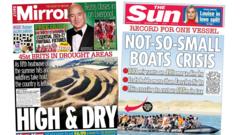
Every few months, the headlines follow a predictable, Pavlovian script. Tabloid editors dust off the apocalyptic fonts. We are told that forty-five million Britons are moments away from watching their lawns turn to dust while armada after armada breaches maritime borders unchecked. It is a masterclass in panic engineering. The lazy consensus among mainstream pundits frames these twin crises as sudden acts of God and malicious foreign agents crashing an otherwise functioning island.
Both premises are utter nonsense.
I have spent two decades dissecting infrastructure policy and resource management. I have watched successive administrations treat systemic rot as a public relations problem, tossing out emergency declarations like confetti while ignoring the foundational architecture of the state. The British public is being sold a false dichotomy of weather emergencies and border sieges because admitting the truth requires looking inward at decades of managerial cowardice.
Let us dismantle the panic.
The Myth Of The Thirsty Island
Look at the screeching about forty-five million people facing drought conditions. The standard narrative blames low rainfall and an overheated climate. It paints a picture of a parched nation desperately tilting its face to the heavens, waiting for relief that never comes.
The reality is far more damning. Britain is one of the most water-rich nations in Europe by volume of rainfall. The crisis is not a lack of water from the sky; it is a catastrophic failure of distribution and storage infrastructure run by private monopolies more interested in shareholder dividends than repairing leaking Victorian pipes.
Private water companies lose nearly three billion liters of treated drinking water every single day through preventable leakage. That is not a drought. That is a hemorrhage.
When utility executives stand before microphones pleading with citizens to stop watering their tomatoes while pumping raw sewage into chalk streams and failing to build a single major reservoir in thirty years, they are shifting the blame downward. They want the consumer to feel guilty for taking a shower so they can avoid the capital expenditure required to upgrade a crumbling grid.
Stop accepting the weather excuse. When a water company tells you the heavens failed, check their balance sheets and dividend payouts. The dry taps are man-made.
The engineering solution is neither mysterious nor unaffordable. It requires treating water infrastructure as a strategic national asset rather than a cash cow for private equity funds. Until the regulatory framework forces companies to invest rather than extract, every summer will bring the exact same manufactured panic about dry hoses and cracked earth.
The Border Theatre And The Channel Industry
Shift gaze from the reservoirs to the coastline, and the intellectual dishonesty reaches a fever pitch. The political class treats small boat crossings as an unpredictable natural disaster, an incoming tide of humanity that caught the Home Office flat-footed year after year.
This is a dangerous fairy tale.
Cross-Channel migration is not an unstoppable force of nature. It is a predictable market response created by restrictive legal pathways and fueled by organized crime syndicates who operate with near-impunity because state bureaucracy moves at glacial speeds. The government sets up a high-profile political circus every time a dinghy hits the water, trading in performative cruelty and endless legislative tweaks that accomplish nothing except generating headlines for the evening news.
The truth nobody in Westminster wants to admit is that the entire administrative apparatus designed to process asylum claims is deliberately under-resourced. A functional state would process applications in days, deport economic opportunists immediately, and grant swift status to those fleeing legitimate persecution. Instead, the system is kept in a state of perpetual backlog because a visible, unresolved border crisis is a potent political weapon for whichever faction happens to be losing the polls.
Imagine a scenario where the processing budget was multiplied tenfold and moved directly to continental ports, coupled with severe, unyielding asset freezes on every human-smuggling network operating across Europe. The boats would stop within a month. But solving the problem removes the political leverage, so the theater continues.
The Economics Of Managed Decline
Both the water crisis and the border standoff share a common ideological root: the normalisation of managed decline.
Britain has developed a fatal addiction to crisis management over systemic building. We spend billions treating symptoms while starving the underlying systems of competence. When infrastructure leaks or borders strain, the playbook remains identical.
- Commission a report that costs millions and changes nothing.
- Launch a high-drama media campaign blaming external forces.
- Implement a cosmetic policy tweak that sounds tough on breakfast television.
- Repeat next season when the ground dries or the weather warms.
This is not governance. It is political theater designed to keep the electorate distracted while the foundational pillars of the state quietly rust away.
The forty-five million Britons facing restrictions aren't victims of a hostile climate. They are hostages to an administrative class that has forgotten how to build, maintain, and execute. The small boats aren't an existential invasion; they are the predictable symptom of an international protection regime managed by career bureaucrats who treat human lives as leverage points in parliamentary debates.
Stop falling for the sirens. Stop buying the narrative that Britain is simply unlucky.
The infrastructure is broken because we allowed it to rot. The borders are chaotic because we chose to mismanage them. Until we demand total structural accountability instead of weeping over the morning papers, nothing will change.
The next time a headline screams about an emergency, look past the panic. Look at the balance sheet. Look at the incompetence. Then ask yourself who benefits from keeping you terrified.