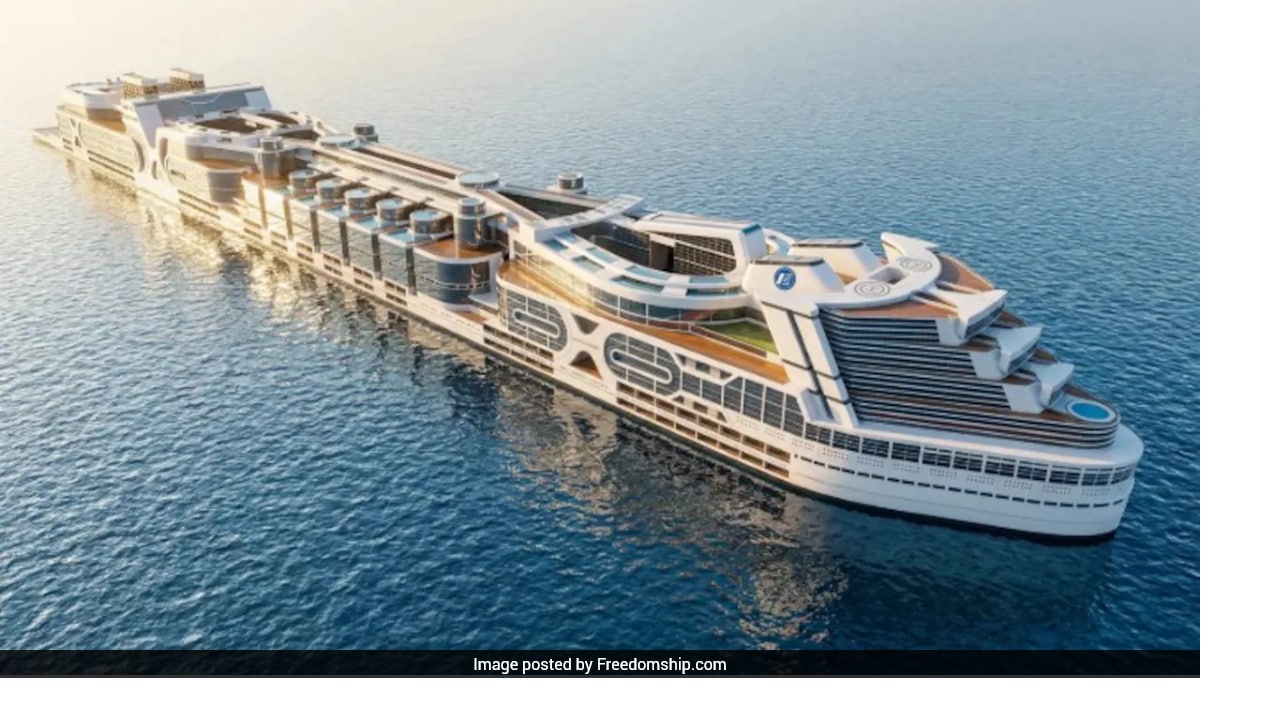
The internet went wild when Lazzarini Design Studio dropped the concept art for Pangeos. It’s a 15 billion dollar floating city shaped like a giant terrapin. Pictures of this massive turtle-shaped yacht filled everyone’s feeds. People instantly started dreaming of a nomadic life on the high seas. It looks like something straight out of a sci-fi blockbuster.
But let's be real for a second.
Building the world's largest ship isn't just about rendering shiny 3D models. It's an engineering nightmare that defies the current laws of maritime economics. While the concept of a floating city sounds incredible, the gap between a designer’s iPad sketch and actual ocean deployment is wider than the Atlantic. Pangeos promises to house 60,000 people in a self-sustaining luxury ecosystem. Yet, nobody is talking about how a structure this size would actually survive a rogue wave, let alone fund its own construction.
The Absolute Insanity of the Scale
To understand why this project faces such steep hurdles, you have to look at the sheer numbers. Pierpaolo Lazzarini designed Pangeos to stretch 550 meters (1,800 feet) long and 610 meters (2,000 feet) wide.
Think about that.
It’s wider than it is long. That completely flips traditional naval architecture on its head. The current largest cruise ships, like Royal Caribbean's Icon of the Seas, max out at around 365 meters long and roughly 50 meters wide. Pangeos would absolutely dwarf them. It’s not a ship. It's a literal island made of steel.
The design calls for a massive internal structure composed of 30,000 individual cells. These compartments are supposed to act as a giant floating basement, providing the buoyancy needed to keep the terrapin afloat. The draft requires about 30 meters of clearance. That means it can never dock at any existing port on Earth. It would have to remain perpetually at sea, anchored miles off the coast, or slowly cruising international waters.
Where on Earth Do You Build a Terrapin Ship
You can't just order a 600-meter-wide steel structure from your local shipyard. No facility exists that can handle these dimensions. Lazzarini’s proposal acknowledges this roadblock with a pretty radical solution. They want to create a brand-new shipyard specifically for the project.
The plan requires dredging a massive circular dam in Saudi Arabia. King Abdullah Port is the proposed site. The strategy involves building a square kilometer of sea wall, pumping out the water, and constructing the world's largest dry dock. Only then could construction on the hull even begin.
This setup introduces immense risk.
- The initial infrastructure cost would swallow billions before workers weld a single piece of the ship.
- Environmental impacts on the local coastline would be severe.
- Shifting global supply chains could stall the decade-long build time.
If funding dries up halfway through, you’re left with a giant, empty hole in the desert. Shipyards are built to build multiple ships over decades to recoup their costs. Constructing a single-use mega-dock for one vanity project breaks every rule of industrial manufacturing.
Powering a Floating City Without Burning the Planet
Keeping a town of 60,000 people alive requires an absurd amount of energy. Air conditioning, water desalination, waste management, and propulsion all demand constant power. Lazzarini claims Pangeos will be entirely green.
The concept relies on massive solar arrays covering the turtle’s shell. It also features wings designed to harvest energy from ocean waves as the ship moves. It sounds beautiful on paper.
In reality, the math doesn't quite check out. Wave energy technology is still in its infancy and notoriously unreliable in calm waters. Solar panels degrade rapidly in salty marine environments, requiring constant, expensive maintenance. To move a vessel that weighs millions of tons, even at a sluggish five knots, you need immense thrust. Relying solely on rooftop solar and wave kinetic energy to propel a structure with the aerodynamic profile of a shopping mall is wildly optimistic.
If the renewable energy systems dip below peak efficiency, the city faces a blackout. A blackout at sea isn’t just inconvenient. It’s deadly. Without power, desalination plants stop. Fresh water runs out in days. Waste treatment systems fail. Unless the final design incorporates a modular nuclear reactor or heavy hybrid backup systems, the green dream remains a fantasy.
The Legal and Social Wild West of International Waters
Let’s say someone writes a check for 15 billion dollars. The dock is dug, the steel is poured, and Pangeos floats out into the ocean. Who actually runs it?
Living in international waters sounds like a libertarian paradise. No taxes. No strict government overreach. But it also means no protection.
Pangeos would need to fly a flag of convenience, likely registering with a country like Panama, Liberia, or the Marshall Islands. That means the laws of that specific nation apply on board. But enforcing laws on a floating city of 60,000 citizens is an unsolved puzzle. You need a police force, a judicial system, and a jail.
Then there's the issue of geopolitical security. A giant, slow-moving, 15 billion dollar asset filled with wealthy residents is a massive target. International waters are plagued by modern piracy and geopolitical skirmishes. Pangeos would require its own private navy or sophisticated defense systems to ensure its citizens aren't held hostage by bad actors.
What Happens Next for the Terrapin Project
Right now, Pangeos exists purely as a crowdfunding dream and an NFT initiative. The designers are selling virtual spaces and tickets to a non-existent ship to raise awareness. It’s a classic tech-hype playbook.
If you're tracking the evolution of massive maritime projects, look at how the cruise industry handles scaling up. Watch the development of modular floating platforms used in offshore wind and oil exploration. Those industrial applications are where real engineering breakthroughs happen, not on design studio Instagram pages.
Keep an eye on the development of Saudi Arabia's other mega-projects like The Line. If those massive structural experiments succeed, it might signal a shifting appetite for high-risk, multi-billion-dollar architecture. Until then, treat Pangeos as an inspiring piece of art, not a realistic destination for your retirement. Don't buy a ticket for a voyage that doesn't have a shipyard yet. Instead, follow naval engineering forums and maritime classification society updates to see if anyone solves the actual physics of building a 600-meter-wide hull. That's where the real story unfolds.