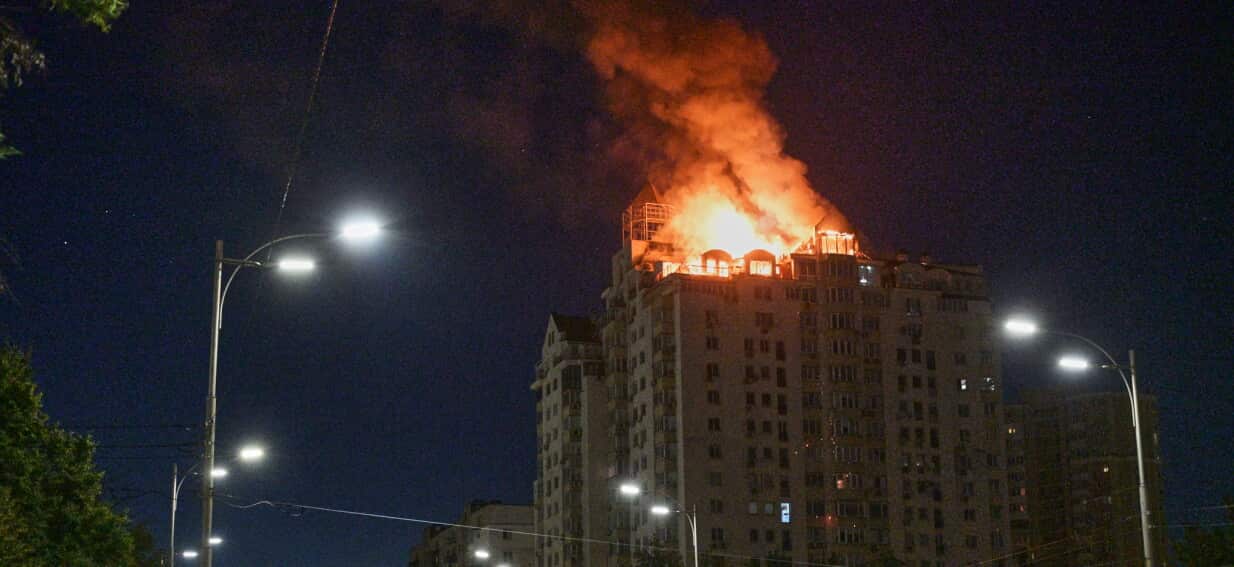
The warning came on a Wednesday evening from Dublin. Ukrainian President Volodymyr Zelenskyy, speaking during an official visit, told his citizens to take the incoming threat seriously. He urged them to get to the shelters. Hours later, the capital city shook under an 11-hour bombardment.
It was a night of horror. Russia launched a combined aerial assault utilizing 570 targets, including cruise missiles, ballistic weapons, and attack drones. While air defense teams intercepted 524 of those threats, the remaining weapons broke through. The results were devastating. At least 18 people died in Kyiv, and 90 more suffered injuries. Rescuers are still digging through collapsed apartment buildings, meaning the death toll will likely climb.
This isn't just another tragic headline. It marks a sharp escalation in tactical execution and strategy from both sides.
Inside the 11-Hour Siege of the Capital
The scale of this specific strike stands out even after four years of full-scale war. Air raid sirens wailed continuously through the night as waves of hardware converged on Kyiv from multiple vectors. Thousands of residents packed into underground metro stations, packed tighter than usual because of the known severity of recent mass strikes.
On the surface, the physical toll crossed 30 distinct locations across the capital. Kyiv Mayor Vitali Klitschko confirmed that a direct hit caused the first six floors of a residential high-rise to cave in completely. In the Darnytskyi district, six levels of a nine-story residential block collapsed into a mountain of concrete and rebar.
Everyday citizens bore the brunt of the impact. Serhii Budko, a 24-year-old resident, reported that three or four ballistic missiles slammed into his neighborhood alone. He described the subterranean shelter shaking violently as the ceiling and floor rattled.
The Kremlin claims it targeted only military infrastructure. The rubble of charred apartment buildings tells a completely different story.
The Oil Factor and Why Moscow Struck Now
Moscow openly admitted this strike was an act of retaliation. Ukrainian forces have spent weeks executing what Zelenskyy calls a 40-day blitz against Russian domestic infrastructure.
Long-range Ukrainian drones have systematically hammered Russian oil refineries and storage facilities deep inside the country. These actions created acute fuel shortages, forcing multiple Russian regions to ration gasoline. In occupied Crimea, the economic strain grew so severe that occupation authorities declared a state of emergency.
Ukraine's goal is straightforward. They want to pinch Vladimir Putin's economic engine and force Moscow to negotiate on more equitable terms. But the Kremlin's response shows they plan to absorb the economic pain and strike back at civilian centers to break Ukrainian resolve.
Western intelligence analysts suggest Putin still believes time favors Russia. The strategy relies on grinding down Ukraine's air defenses, banking on the idea that Western military aid will dry up before Russian factories stop producing missiles.
The Critical Weakness in Ukraine Air Defense
The math behind the latest attack exposes a massive vulnerability for Ukraine. The country's air defense forces managed an incredible feat by downing 524 out of 570 incoming targets. That is a success rate over 90 percent.
The problem lies in what got through.
Out of the targets that breached the shield, 25 were ballistic missiles. While Ukrainian teams have become adept at neutralizing slow-moving Shahed-style drones, ballistic missiles travel at hypersonic speeds on high-arc trajectories. They require advanced, specialized interception systems like the American-made Patriot platforms.
Ukraine simply doesn't have enough of them to cover the entire country. Foreign Minister Andrii Sybiha issued an urgent appeal to international allies following the assault, noting that delays in transferring air defense hardware cost civilian lives.
The geopolitical ripple effects are already visible. As the missiles fell, neighboring Poland scrambled fighter jets to protect its airspace. Finland implemented temporary aviation restrictions along its eastern border. The war remains contained inside Ukraine, but the physical reality of the conflict keeps pushing against the borders of NATO territory.
What Happens Next on the Ground
If you are tracking where this war goes next, look at the logistical bottlenecks. Ukraine now produces up to 75 percent of its own military hardware domestically, which funds the drone campaign hitting Russian soil. They aren't going to stop targeting Russian oil assets.
In response, Kyiv has declared Friday a formal day of mourning. The city will bury its dead, clear the debris from the streets, and prepare for the next siren.
The immediate next step rests on Western allies. If Europe and the United States fail to deliver more Patriot batteries and interceptor missiles immediately, Russia will repeat this exact blueprint. They will flood the skies with cheap drones to exhaust air defense stockpiles, then send high-speed ballistic missiles through the gaps to flatten apartment blocks.
The strategy isn't hidden. It's happening in real time.