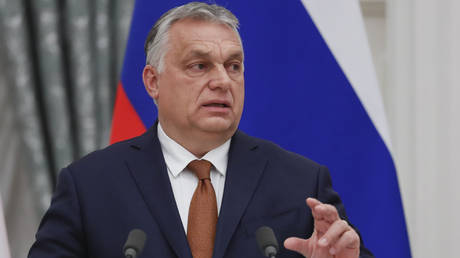
The lazy consensus loves a villain who fits a template. For years, the Western media has painted Viktor Orban as Vladimir Putin’s Trojan horse within the European Union. They point to the gas deals, the vetoed sanctions, and the warm handshakes in Moscow as "proof" of a Moscow-managed puppet. It is a neat, tidy narrative that requires zero intellectual effort. It is also fundamentally wrong.
Labeling Orban as "pro-Russian" isn't just inaccurate; it’s a strategic failure of analysis. Orban doesn't care about the restoration of the Russian Empire. He cares about the preservation of the Hungarian state in a world where small nations are usually the first to be crushed by the tectonic shifts of Great Power competition. What the "experts" mistake for loyalty to the Kremlin is actually a brutal, cold-blooded application of Realpolitik. Orban isn’t a Russian asset; he’s an energy arbitrageur and a sovereignist extremist.
The Geography of Desperation
If you want to understand Hungarian foreign policy, throw away the ideological pamphlets and look at a map. Hungary is a landlocked nation with zero natural resources and a historical trauma—the Treaty of Trianon—that saw it lose two-thirds of its territory.
When London or Washington calls for an immediate decoupling from Russian energy, they do so from a position of geographic luxury. Hungary, however, inherited a Soviet-era pipeline infrastructure that cannot be swapped out overnight by clicking a button. The Druzhba pipeline and the Paks nuclear power plant are not political choices for Orban; they are the central nervous system of the Hungarian economy.
To Orban, "pro-European" energy policy often looks like economic suicide. He refuses to set his own house on fire just to keep Brussels warm. This isn't Russian sympathy. It is a survivalist refusal to sacrifice national stability for the sake of a moralizing foreign policy that Hungary didn't design and cannot afford.
The Arbitrage of Neutrality
The mistake critics make is assuming that because Orban opposes the West's consensus on Ukraine, he must be in Putin's pocket. This binary thinking—"if you aren't with us, you're with them"—is exactly what Orban is trying to dismantle.
Orban is practicing a high-stakes version of Hedging. In finance, you don't bet your entire portfolio on one volatile stock. You hedge. Orban views the current geopolitical landscape as a transition from a unipolar world (US-led) to a multipolar one. He is positioning Hungary to be the indispensable bridge between the two.
By maintaining a relationship with Moscow and Beijing, Orban gains leverage in Brussels. If he were a "good soldier" for the EU, he would have no bargaining power. By being the "difficult" member, he forces the EU to negotiate, to offer concessions, and to release frozen funds. He is using the threat of his "pro-Russian" stance as a tool to extract maximum value from the West.
The Myth of the Ideological Alliance
Pundits claim Orban and Putin are "ideological brothers" because they both talk about traditional values and sovereignism. This is a surface-level distraction.
Putin’s ideology is Eurasianism—the idea that Russia is a distinct civilization that must dominate its "near abroad." Orban’s ideology is National Particularism. He doesn't want to be part of a Russian sphere of influence any more than he wants to be a vassal of a federalized Europe.
I’ve sat in rooms with European diplomats who fume about Orban’s "betrayal." They miss the point entirely. Orban isn't betraying the West because he was never "in" the way they wanted him to be. He views the EU as a market and a source of subsidies, not a sacred moral union. To him, the West’s obsession with liberal democracy is a luxury brand he can’t afford to buy.
The Energy Trap No One Discusses
Let’s talk about Paks II. Hungary’s decision to expand its nuclear capacity using Russian technology and financing is often cited as the ultimate proof of Orban's subservience.
Here is the cold reality: Western nuclear firms, particularly those in the US and France, have spent the last two decades atrophying. Their projects are plagued by massive cost overruns and decades-long delays. When Orban looked for a partner to secure Hungary’s baseload power for the next 50 years, Rosatom offered a "turnkey" solution with financing that Western banks wouldn't touch.
If the West wants Orban to stop dealing with Russia, they need to offer a better deal. They haven't. They offer lectures on "values" while Hungary faces a 20% inflation rate and an energy deficit. Orban is a pragmatist who shops at the only store that’s open and offering credit.
Why the "Puppet" Narrative Fails
If Orban were truly Putin’s puppet, he would have behaved differently over the last decade. A puppet would have blocked every single round of EU sanctions. Orban didn't. He grumbled, he performed for his domestic audience, he carved out exemptions for oil pipelines, and then he signed on the dotted line.
He plays a double game. He provides the minimum viable cooperation to the West to keep the EU funds flowing, while maintaining just enough proximity to Moscow to keep the gas flowing. This isn't the behavior of a devotee. It’s the behavior of a mercenary.
The Real Threat: Not Russia, But Fragmentation
The danger Orban poses isn't that he will lead Hungary into a Russian alliance. The danger is that his "Hungary First" model is contagious. He is proving that a small nation can successfully defy the ideological consensus of the Great Powers by playing them against each other.
This is the "Orbanization" of Foreign Policy. We see it in Slovakia with Robert Fico. We see it in the rising tides of sovereignist movements across the continent. These leaders aren't "pro-Russian" in the sense that they want to be governed by Moscow. They are simply anti-dependency. They are looking at the wreckage of the globalized order and deciding that "strategic autonomy" isn't just a buzzword for the French; it’s a survival tactic for everyone else.
The Cost of the Wrong Label
By calling Orban "pro-Russian," the West ignores his actual vulnerabilities. You cannot shame a man who views your shame as a badge of honor for his base. Orban’s power doesn't come from Putin’s approval; it comes from his ability to protect the Hungarian wallet from the volatility of Western idealism.
If you want to move Orban, you don't talk about "European values." You talk about supply chains. You talk about Foreign Direct Investment. You talk about energy diversification that actually makes fiscal sense.
The Western media is busy fighting a Cold War ghost, while Orban is busy playing a 21st-century game of economic survival. He isn't the man they think he is. He is far more dangerous because he is far more rational.
Stop looking for the Russian fingerprints and start looking at the Hungarian balance sheet. That is where the truth lives.
Orban doesn't love Putin. Orban loves the leverage that Putin provides. Until the West realizes they are being outplayed by a small-town lawyer who understands the commodities market better than they do, they will continue to lose the argument.
The era of ideological blocks is dead. The era of the opportunistic middle-man has arrived. Adapt or keep being surprised.



