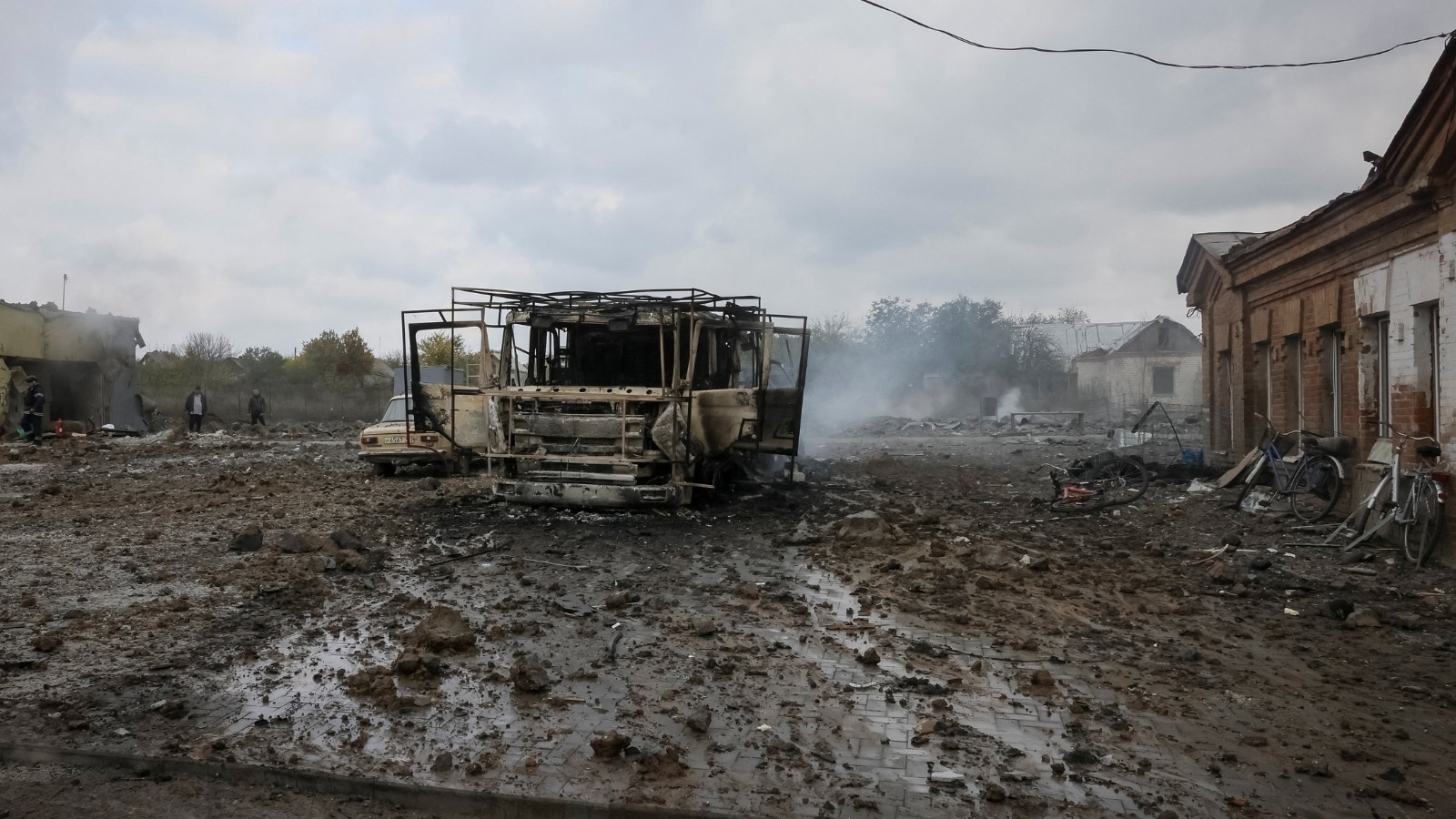
Counting incoming warheads is a mug’s game. Every time a massive barrage hits Ukrainian infrastructure right before a diplomatic summit, the headlines follow the exact same predictable script. They tally the drones, count the cruise missiles, map the blackouts, and frame the entire event as a crude display of brute-force intimidation designed to bring Kyiv to its knees before negotiators sit down at the table.
That reading is lazy. Worse, it completely misunderstands how modern coercion actually works.
When 365 missiles and drones streak toward power substations ahead of U.S.-brokered peace talks, the raw volume of ordnance is not the primary weapon. The psychological framing of inevitability is. Standard coverage treats a mass strike as a kinetic sledgehammer meant to break physical resistance on the spot. In reality, high-volume salvos timed to diplomatic calendars are sophisticated exercises in coercive bargaining—an effort to manipulate Western risk perception, drain air defense interceptors at an unsustainable exchange rate, and dictate the baseline terms of negotiation before a single diplomat opens a briefcase.
The Trap of the Body-Count Mentality
Mainstream war reporting suffers from an addiction to box scores. Journalists love clean, quantifiable metrics because numbers feel objective. Three hundred and sixty-five munitions launched. X percent intercepted. Y megawatts knocked offline.
Look closer at what happens when analysts focus exclusively on the size of the salvo rather than the mechanics of the grid and the economics of defense.
First, large numbers create an illusion of limitless capacity. A combined package of Shahed-type one-way attack drones, decoy airframes, and ballistic or cruise missiles looks terrifying on a graphic. Yet mixing cheap, slow-moving decoys with a smaller core of high-end ballistic missiles is an operational necessity, not a sign of infinite stockpiles. The decoys exist to saturate radar operators and force expensive surface-to-air batteries to expend scarce interceptors. When commentators lump cheap plywood-and-foam decoys into the same headline figure as hypersonic or quasi-ballistic missiles, they do the attacker’s propaganda work for them.
Second, focusing on the immediate blackout misses the actual engineering battle happening inside the energy sector. Power grids are not glass vases that shatter once and stay broken. They are dynamic, redundant networks. Over years of sustained bombardment, Ukrainian grid operators have become the world’s foremost experts in rapid load shedding, islanding damaged substations, and rerouting high-voltage transmission around cratered transformers.
I have watched energy infrastructure analysts misread every single winter campaign since 2022 by assuming that megawatts lost on Tuesday morning equal permanent strategic collapse by Friday afternoon. They treat a grid outage like a knockout punch when it actually functions more like a body blow in the eighth round. It hurts. It drains stamina. It forces difficult choices. It rarely ends the fight on its own.
The Real Math of Asymmetric Attrition
If the strikes aren't meant to cause instant total collapse, why burn through 365 munitions in a single coordinated wave right before talks in Washington or Geneva?
Follow the ledger, not the explosions.
Modern air defense operates on a brutal economic asymmetry. A one-way attack drone costs tens of thousands of dollars to assemble. A decoy costs even less. Meanwhile, a single Patriot PAC-3 interceptor costs several million dollars, and Western industrial bases can only manufacture a few hundred of them per year. Even mid-range interceptors from NASAMS or IRIS-T systems cost multiples of the targets they destroy.
When an attacker launches a massive mixed salvo ahead of peace talks, the goal is to force a localized interceptor famine. Every missile fired to protect a thermal power plant or a 750-kilovolt substation today is one less missile available to protect front-line troop concentrations or airfields tomorrow.
Imagine a scenario where a negotiator sits across from a counterpart knowing that their own air defense magazines have just been depleted by thirty percent in a single night, while the opposing side can replenish its cheap drone inventory within weeks. That negotiator’s leverage changes instantly. They aren't bargaining over territory anymore; they are bargaining over time and magazine depth.
This is the nuance that conventional reporting completely misses. The blackout in Kyiv or Kharkiv makes for dramatic evening news footage, but the real crisis happens inside logistics spreadsheets at NATO headquarters and the Pentagon. The strike isn't aimed at breaking the will of a grandmother sitting in a cold apartment in Odesa. Decades of military history—from the London Blitz to the air campaigns over North Vietnam—prove that bombing civilians and civilian utilities almost never triggers political surrender. Instead, it hardens public resolve and eliminates domestic political space for compromise.
Thomas Schelling, the Nobel Prize-winning economist who literally wrote the book on coercive diplomacy (Arms and Influence), drew a sharp distinction between brute force and coercion. Brute force takes what it wants by destroying the enemy’s capacity to resist. Coercion succeeds only when the target chooses to comply to avoid future pain—and crucially, when the target believes that complying will actually stop the pain.
Here is the fatal flaw in the standard narrative: if Russia’s strikes were purely about forcing Ukrainian citizens to beg their government for peace, they would be failing spectacularly. Public polling consistently shows that infrastructure attacks increase Ukrainian resistance to territorial concessions.
So who is the real audience for a 365-munition barrage right before U.S. peace talks?
Washington. And Brussels.
Coercing the Mediators, Not the Victim
When strikes escalate right before American diplomats convene peace talks, the target of the psychological operation is the Western political class.
The message sent via 365 warheads is simple: This war is escalating, Ukraine’s grid is unsustainable, your air defense stockpiles are finite, and unless you force Kyiv to accept our terms now, you will be stuck paying to rebuild a frozen, dark wasteland.
It is a classic escalation-to-de-escalate posture designed to exploit Western risk aversion. American and European policymakers hate open-ended financial commitments and unpredictable escalation ladders. By manufacturing a dramatic humanitarian and infrastructure emergency on the eve of negotiations, Moscow attempts to shift the burden of compromise onto Washington. Suddenly, U.S. envoys aren't asking how to secure a durable peace; they are asking how to stop the bleeding before winter sets in or before domestic political support for aid packages evaporates.
Most coverage falls straight into this trap. By framing the barrage as proof that Ukraine is helpless against overwhelming firepower, commentators amplify the exact sense of urgency and futility that the Kremlin wants Western negotiators to feel at the bargaining table.
Dismantling the Wrong Questions
If you look at what people actually search for after these attacks, the public is asking entirely the wrong questions—because media coverage has trained them to focus on symptoms rather than mechanics.
Why can't Western air defenses stop a 365-missile attack?
This question assumes that an airtight dome over an entire country is physically and financially possible. It isn't. Air defense is not an impenetrable shield; it is a probabilistic filter. Even the most advanced layered defense network in history—Israel’s multi-tiered system backed by U.S. naval assets—experienced leakers during high-volume ballistic salvos. Ukraine is roughly twenty-eight times the size of Israel. Protecting every power plant, substation, railway hub, and city across that landmass against simultaneous saturation attacks from multiple azimuths would require more surface-to-air batteries than exist in the entire Western alliance. Asking why 100 percent of incoming threats weren't stopped misunderstands basic geometry and radar physics.
Do infrastructure blackouts actually force governments to make peace?
No. Historically, strategic bombing of infrastructure almost never compels a nation to sign a disadvantageous peace treaty on its own. During World War II, the Allied Combined Bomber Offensive devastated German industrial output and civilian housing, yet German war production actually peaked in 1944, and the regime fought until Berlin was physically occupied. In Ukraine, power cuts impose severe economic costs—forcing businesses onto expensive diesel generators and shrinking GDP—but they do not collapse command-and-control networks. Military communications, air defense radars, and front-line logistics run on hardened, decentralized power sources completely separate from the civilian municipal grid.
Does attacking right before peace talks give Russia the upper hand?
Only if the other side believes the illusion. Militarily, expending hundreds of precision weapons on static civilian transformers yields diminishing returns. Every high-end cruise or ballistic missile fired at a substation is a missile not used to interdict ammunition depots, bridges, or armored staging areas near the front line. In pure operational terms, diverting scarce precision strike assets to political signaling ahead of diplomatic talks actually relieves pressure on defending combat brigades. It only becomes an advantage if Western diplomats panic and trade away permanent sovereign territory in exchange for a temporary pause in bombardments.
The Uncomfortable Reality of Grid Warfare
Admitting that conventional narratives get this wrong doesn't mean pretending the situation isn't dire. That would be equally dishonest.
There is a massive downside to underestimating these strikes, and anyone who has worked around critical infrastructure knows it: transformer attrition is cumulative.
You can patch a damaged transmission line in forty-eight hours. You cannot conjure a custom-built, 300-ton autotransformer out of thin air. High-voltage autotransformers take months to manufacture, require specialized electrical steel, and are extraordinarily difficult to transport and install under threat of drone surveillance. Even when Ukrainian engineers restore power within days of a massive strike, they are often doing so by bypassing safety redundancies and running remaining equipment closer to thermal failure limits.
Furthermore, decentralized energy solutions—like microgrids, distributed gas turbines, and battery storage—take years to scale to the level needed to replace centralized Soviet-era thermal and hydroelectric giants. While Western commentators love to talk about green microgrids making Ukraine "bomb-proof," physics doesn't care about buzzwords. You cannot run heavy metallurgy, rail transit, or dense urban heating systems off rooftop solar panels in January.
This is the real strategic race happening beneath the surface of the headlines. It isn't a race between missiles and diplomacy. It is a race between stockpile depletion on the offensive side and hardware exhaustion on the defensive side.
What Needs to Change in How We Analyze and Respond
If policymakers, analysts, and readers want to stop being manipulated by pre-summit barrages, the entire analytical framework needs to flip.
- Stop measuring air defense success by interception percentages. A 90 percent interception rate sounds great in a press release, but if the 10 percent that get through are Iskander-M ballistic missiles hitting the last three functioning turbines at a major power plant, the defense failed its operational objective. Measure success by megawatts preserved and interceptors conserved, not raw shoot-down ratios.
- Shift funding from expensive interceptors to cheap defeat mechanisms. Firing multi-million-dollar missiles at five-figure drones is a losing business model. Real strategic adaptation means flooding the zone with electronic warfare jammers, autonomous kinetic interceptor drones, acoustic detection grids, and radar-guided flak cannons like the German Gepard. Save the Patriot missiles strictly for ballistic threats.
- Decouple diplomatic timelines from kinetic theater. The worst mistake any negotiator can make is letting an adversary’s bombing schedule dictate the pace or agenda of talks. When an attack occurs 48 hours before a summit, the correct diplomatic response isn't urgent concession—it is an immediate, automatic increase in long-range strike authorizations or air defense deliveries to demonstrate that escalation yields negative returns.
- Harden the boring stuff. Nobody wins political points for funding blast walls, underground cabling, and mobile substation spares. Yet concrete blast barriers and rapid-replacement Soviet-compatible transformers save more lives and preserve more negotiating power than ten diplomatic communiqués condemning war crimes.
The Illusion of the Decisive Salvo
War is rarely decided by the loudest explosions on the front page.
The 365 missiles and drones launched at Ukraine’s power grid ahead of U.S. peace talks were designed to create a specific psychological snapshot: an unstoppable juggernaut battering a helpless grid just as the referee steps into the ring. It is theatre backed by high explosives.
When analysts repeat the raw numbers without dissecting the decoy ratios, the interceptor economics, or the coercive psychology aimed straight at Washington, they validate the strategy. They mistake noise for dominance.
Power grids can be rerouted, patched, and rebuilt. Territorial concessions signed away under the illusion of inevitability are permanent. Stop counting the missiles—start watching who blinks at the table.