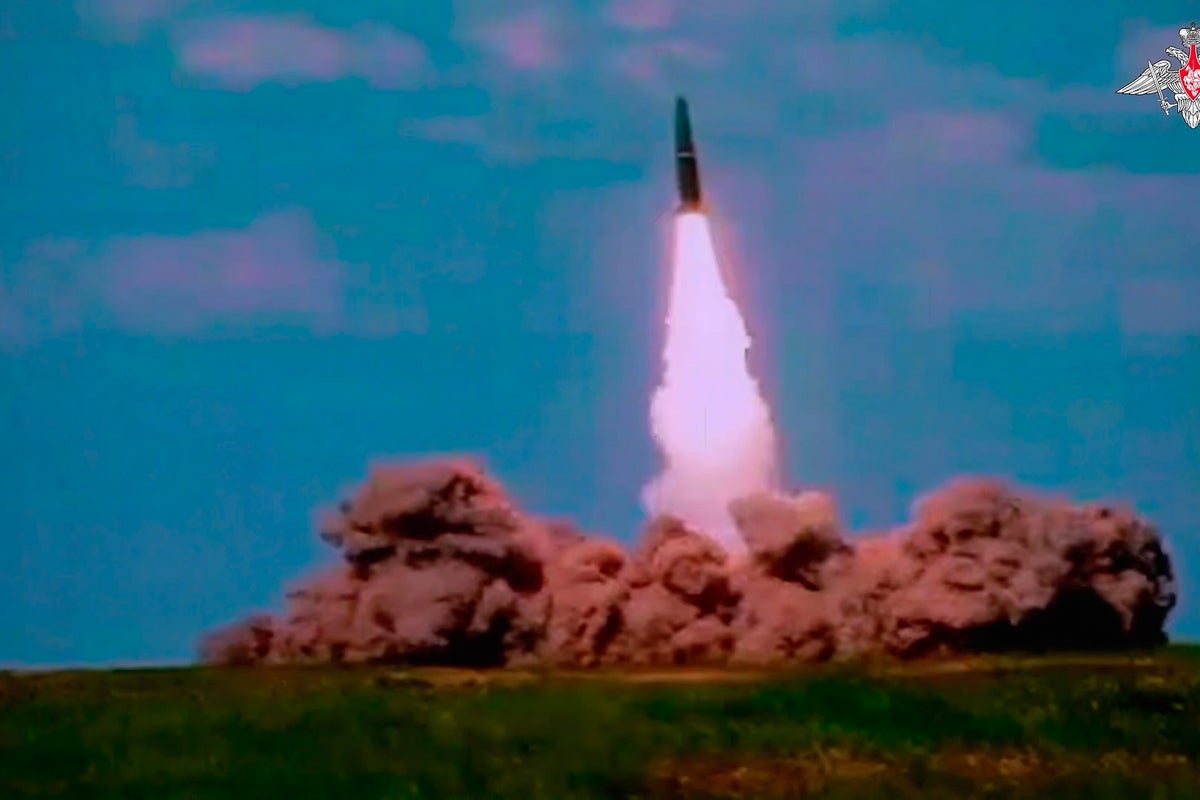
The traditional view of United Kingdom homeland defense relies on the geographic cushion of continental Europe and the maritime barrier of the North Sea. This layout is structurally obsolete. The intersection of accelerated polar ice regression, the expansion of Russia’s Northern Fleet infrastructure, and the deployment of atmospheric-skimming hypersonic delivery vehicles has shifted the strategic axis of Northern Europe. London and the critical national infrastructure of the United Kingdom are no longer in the deep rear of a European theater; they are directly exposed to a short-warning vector originating from the High North.
To evaluate this threat, analysts must look past the alarmist headlines of "unstoppable weapons" and focus instead on the structural mechanics of Arctic power projection, the exact physics of hypersonic flight profiles, and the specific architecture of Western defensive networks.
The Three Pillars of Arctic Strategic Expansion
Russia's actions in the High North are not random assertions of power. They are driven by an integrated economic and military strategy designed to offset conventional vulnerabilities elsewhere. This expansion is built on three distinct pillars.
The Economic Extraction Zone
The Yamal and Gydan peninsulas contain an estimated 75% of Russia’s untapped natural gas reserves, alongside critical deposits of rare earth elements. As access to traditional European energy markets remains restricted, the economic survival of the Russian state relies on extracting these resources and moving them eastward to Asian markets.
The Northern Sea Route (NSR) Monopolization
Climate projections indicate that the NSR—stretching from the Bering Strait to the Greenland-Iceland-United Kingdom (GIUK) gap—could be entirely ice-free during summer months by the 2030s. The Kremlin treats this corridor as an internal waterway rather than an international strait, using a network of upgraded bases to impose regulatory and military control over transit.
Bastion Defense Preservation
The Kola Peninsula hosts the core of Russia’s second-strike maritime nuclear deterrent: its fleet of nuclear-powered ballistic missile submarines (SSBNs). The primary military objective of the Russian Northern Fleet is the "Bastion Strategy"—creating a heavily defended zone that prevents NATO forces from entering the Barents Sea to track or target these submarines.
[Kola Peninsula Infrastructure]
       │
       ├─► Bastion Defense (SSBN Protection via Barents Sea Control)
       ├─► NSR Monopolization (Anti-Access/Area-Denial / A2AD Nodes)
       └─► Deep Strike Projection (Hypersonic/Cruise Missile Vectoring)
The Physics of the Threat: Hypersonic Mechanics vs. Conventional Ballistics
Discussions of hypersonic weapons often treat them as a single, uniform technology. In reality, evaluating the threat to targets like London requires distinguishing between the two primary classes of high-velocity delivery systems, as each interacts differently with Western defensive architectures.
Hypersonic Glide Vehicles (HGVs)
Systems like the Avangard are launched via ballistic missile boosters but detach at high altitudes to glide through the upper atmosphere (altitudes between 40 km and 100 km). Unlike standard ballistic warheads that follow a predictable parabolic arc, an HGV utilizes aerodynamic lift to alter its trajectory mid-flight. This flat, maneuverable flight profile creates a dual challenge: it stays below the optimal tracking horizon of early-warning radars designed for high-altitude ballistic trajectories, and it maneuvers around the predicted intercept points of mid-course missile defense systems.
Hypersonic Cruise Missiles (HCMs) and Aero-ballistic Systems
Systems like the Zircon and the air-launched Kinzhal (a modified Iskander design) operate at lower altitudes and shorter ranges. The primary threat vector here is compression of the decision-making window. Flying at speeds exceeding Mach 5 within the atmosphere, these weapons reduce the time between initial radar detection at the horizon and terminal impact to less than five minutes.
The strategic problem for the United Kingdom is not that these missiles possess magical, uninterceptable properties. The problem is the Detection-to-Engagement Bottleneck. Standard air defense networks are optimized for low-altitude, subsonic/supersonic cruise missiles, while strategic missile defense systems are optimized for high-altitude, predictable ballistic paths. Hypersonic vectors exploit the structural gap between these two defensive regimes.
The Arctic Strike Vector: Structural Vulnerabilities in Western Tracking
The geographic reality of a strike originating from the Arctic circle highlights major gaps in the current North Atlantic tracking architecture. For decades, the primary defensive line for the United Kingdom and its allies has been organized around the GIUK Gap, designed to detect subsurface and surface naval transits.
A modern air-breathing or gliding strike vector from the High North bypasses this setup entirely.
- Radar Horizon Limitations: Terrestrial radars are bound by the curvature of the earth. A hypersonic cruise missile or low-flying aero-ballistic missile launched from a maritime platform in the Norwegian Sea or an air platform over the Barents Sea remains hidden beneath the radar horizon until it is relatively close to the target.
- Sensor Saturation: The integrated air defense systems of Northern Europe are designed to handle threats arriving along a predictable east-to-west axis over Central Europe. An Arctic launch vectors threats down a north-to-south axis, crossing under-monitored approaches along the UK's northern and western coastlines.
- The Warning Time Equation:
$$T_{\text{warning}} = \frac{D_{\text{detection}}}{V_{\text{missile}}}$$
If a Mach 6 missile ($V \approx 2,040 \text{ meters per second}$) is detected by terrestrial radar at a distance of 400 kilometers ($D_{\text{detection}}$), the total available time for identification, command routing, target acquisition, and interceptor launch ($T_{\text{warning}}$) is approximately 196 seconds. This timeline breaks down traditional, human-in-the-loop command structures.
Systemic Constraints on the Russian Threat Matrix
An objective analysis must balance these structural vulnerabilities against the real industrial and operational constraints facing the Russian military. The capability to threaten London with hypersonic systems is limited by severe production bottlenecks.
The production of high-end precision guided munitions relies heavily on advanced microelectronics and specialized components. Sanctions and export controls have increased the friction and cost of acquiring these materials. While Russia has successfully maintained production lines through parallel import networks and component substitution, it cannot mass-produce hypersonic platforms at the scale required to overwhelm peer defense networks through volume alone.
Consequently, these weapons are scarce assets. In a conflict scenario, they would not be used for indiscriminate terror bombings of urban areas. Instead, they would be strictly rationed for high-value targets.
- Command and Control (C2) Nodes: Primary military headquarters and communications hubs.
- Key Naval Logistics Hubs: Facilities like HMNB Clyde (Faslane) or Devonport, aiming to disrupt submarine deployments and Western maritime reinforcement pathways.
- Air Defense Radars: Knocking out early-warning installations to clear paths for cheaper, subsonic cruise missiles or long-range one-way attack drones.
The Integrated Defense Response
To counter this northern flank vulnerability, the United Kingdom and its NATO allies cannot rely on simply buying more short-range, point-defense missile batteries. Patching the gap requires a fundamental redesign of the regional security architecture, focusing on three specific operational shifts.
First, space-based tracking layers must be expanded. Space-resolved tracking is the only way to eliminate the radar horizon problem. Deploying dense constellations of low-Earth orbit (LEO) satellites equipped with infrared sensors allows for continuous tracking of hypersonic glide vehicles and atmospheric missiles from their launch point, completely bypassing the limitations of ground-based radar.
Second, the defensive perimeter must be pushed further north. The admission of Finland and Sweden into NATO turns the Baltic and Nordic regions into a cohesive defensive buffer. Integrating the sensor networks of the UK, Norway, Sweden, and Finland creates a deep, multi-layered tracking zone that robs northern-vector attacks of their surprise element.
Finally, interceptor capabilities need to catch up. Point-defense systems like Sea Viper and Sky Sabre must be systematically upgraded to handle high-velocity, maneuvering targets during their terminal phase. Concurrently, the UK must invest in directed-energy weapons and electronic warfare systems capable of disrupting the delicate guidance systems of fast-moving missiles at a lower cost per engagement than traditional kinetic missiles.