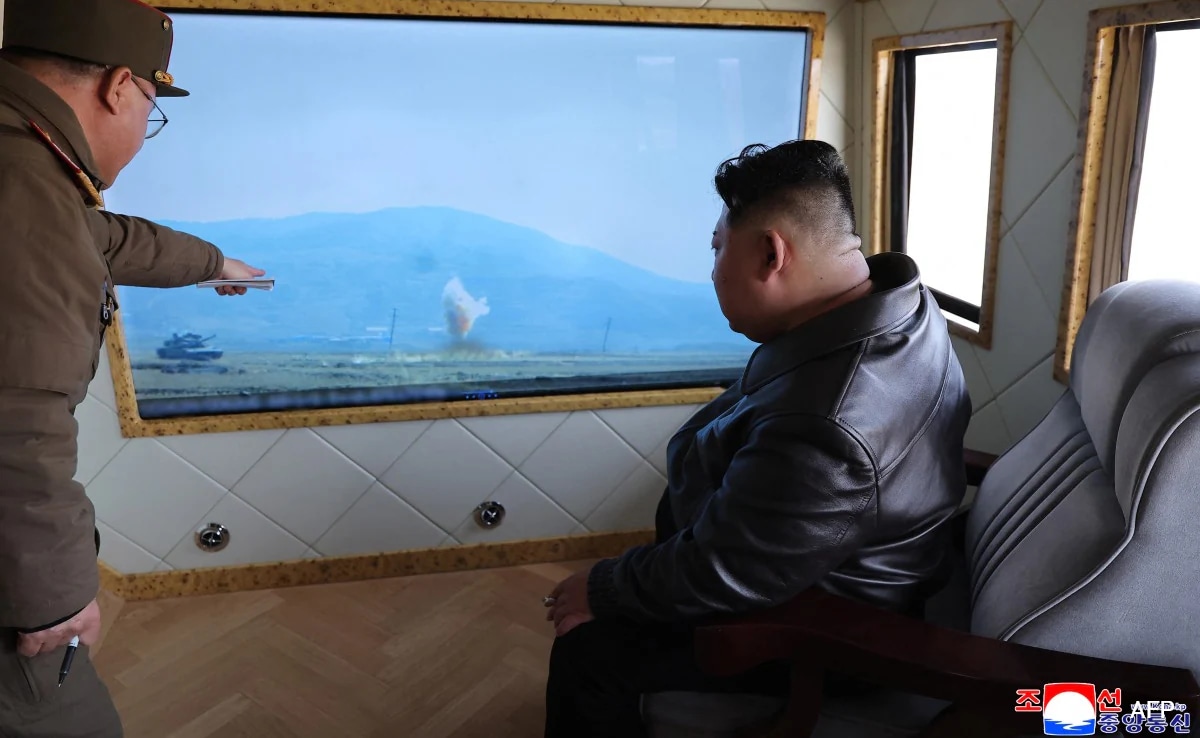
Pyongyang just stopped pretending its navy is a collection of rusting Cold War relics. On Sunday, April 12, 2026, Kim Jong Un stood on a pier and watched his most advanced warship, the Choe Hyon, fire a volley of strategic cruise and anti-ship missiles into the western seas. If you think this is just another "saber-rattling" headline, you're missing the shift. This isn't a mobile launcher hidden in a forest; it's a 5,000-ton destroyer proving it can strike targets from the water with "ultra-precision."
For years, the North Korean Navy was the neglected stepchild of the regime’s military. While the missile forces got the ICBMs and the glory, the sailors were stuck with 1950s-era hulls that wouldn't last ten minutes in a real fight. That era is over. The Choe Hyon represents a jump in tech that caught plenty of analysts off guard when it first appeared in 2025. Now, with this second major round of live-fire tests, it’s clear the ship isn't just a prop. It's a functional, lethal platform.
What actually happened during the test
State media (KCNA) didn't hold back on the specifics this time. We’re talking about two strategic cruise missiles and three anti-ship missiles launched from the Choe Hyon. The cruise missiles stayed in the air for 1,973 seconds—roughly 33 minutes—while the anti-ship variants clocked in at 1,960 seconds.
They weren't just shooting at empty water. The goal was to verify the "integrated weapons command system." Basically, they wanted to see if the ship's brain could talk to its muscles without glitching. According to the reports, the missiles hit their marks with "ultra-precision." More importantly, they were testing upgraded navigation and anti-jamming tech. In a real conflict, the U.S. and South Korea would flood the airwaves with electronic interference. Kim is betting his new hardware can cut through that noise.
The Choe Hyon is a different kind of threat
Don't let the "destroyer" label fool you into thinking this is a standard defensive ship. In North Korean terminology, "strategic" is almost always code for nuclear-capable. By putting these missiles on a 5,000-ton ship, Pyongyang is moving its nuclear deterrent away from predictable land-based silos and onto a mobile, maritime platform.
I've looked at the specs of the Choe Hyon, and it's a beast compared to their previous fleet.
- Tonnage: Around 5,000 tons, putting it in the same weight class as some serious regional players.
- Weaponry: It's designed to carry anti-air systems, anti-ship missiles like the Padasuri-6, and those long-range strategic cruise missiles.
- Origin: There's a lot of chatter among South Korean officials that this thing didn't just appear out of thin air. The design smells like Russian influence, especially in the hull and sensor integration.
Kim isn't stopping at one ship, either. During the Sunday briefing, he reviewed plans for a third and fourth destroyer already under construction. He's talking about building two major warships every year for the next five years. That’s an aggressive shipbuilding pace that signals a total pivot in their military strategy.
Why the Padasuri-6 matters
The anti-ship missiles tested are likely variants of the Padasuri-6 (Sea Eagle-6). This is an evolved version of the Russian Kh-35. It’s small, fast, and flies incredibly low to the water to avoid radar. If North Korea can launch these from a modern destroyer instead of a shaky patrol boat, it makes the "Northern Limit Line"—the disputed sea border—a much more dangerous place for the South Korean Navy.
The message behind the smoke
You have to look at the timing. This test happened just as regional tensions are hitting a boiling point. By showing off the Choe Hyon’s "rapid response readiness," Kim is telling Washington and Seoul that he has more than one way to ruin their day. If you take out the land-based launchers, you still have to find a destroyer hiding in the coastal archipelagos.
Honestly, the most concerning part isn't the missiles themselves—it's the command and control. If the Choe Hyon can successfully coordinate a multi-missile strike while under way, it means North Korea has solved the complex software and sensor problems that usually trip up smaller navies. They aren't just building ships; they’re building a modern naval system.
What you should watch for next
Forget the empty rhetoric about "total destruction." Watch the shipyards. If Kim actually delivers on a third and fourth destroyer by 2027, the naval balance in the Sea of Japan (East Sea) is going to look very different.
- Monitor the construction at Nampo: Satellite imagery of the Nampo Shipyard will confirm if those two extra destroyers are actually on the slips.
- Check for joint drills: Keep an eye out for any signs of the North Korean Navy training with Russia. If they start sharing tactical data, the Choe Hyon becomes ten times more dangerous.
- Watch the SLBM tests: If North Korea integrates its Pukguksong-class submarine-launched missiles with this new destroyer tech, they’ll have a true "blue water" nuclear threat.
The Choe Hyon test isn't a one-off event. It’s the opening act of a new naval doctrine. Stop thinking of North Korea as a landlocked artillery power and start paying attention to what they’re doing in the docks.