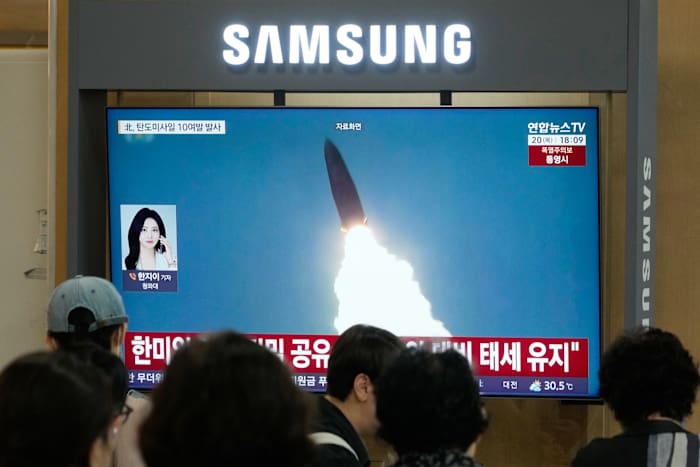
Ten short-range ballistic missiles streaked across the sky on Thursday, slamming into the eastern waters off North Korea. Pyongyang didn't wait long to answer a fresh diplomatic olive branch. Barely hours after US President Donald Trump signaled a desire to revive personal diplomacy and ordered a scaling back of joint military drills with South Korea, Kim Jong Un's regime answered with explosive displays of military hardware.
If you think this means doors to peace are permanently slammed shut, you're missing the calculated chess game happening behind the scenes.
The Missile Barrage and the Reduced Drills
The timing was precise. The launches erupted around 5 p.m. from the capital region of North Korea, sending roughly ten projectiles flying about 300 kilometers each toward eastern waters. South Korea's Joint Chiefs of Staff immediately ratcheted up surveillance alongside American and Japanese counterparts.
This fiery response followed a high-stakes diplomatic gamble by Washington. Trump announced he was ordering the Pentagon to substantially reduce the Ulchi Freedom Shield exercises—major annual military drills conducted alongside South Korean forces. Trump claimed the traditional exercises were inappropriate and hostile, pointing also to Seoul's refusal to back him regarding the war in Iran. In response, Seoul and Washington slashed the duration of the 11-day drills by half and canceled field training.
Pyongyang wasn't impressed. Or at least, they wanted the world to think so.
Kim Yo Jong Drops the Hammer
Enter Kim Yo Jong. The influential sister of the North Korean leader stepped up to deliver Pyongyang's official verdict on Trump's overture. She didn't mince words.
She dismissed the reduction of military drills as a cosmetic gesture, stating that their aggressive and provocative nature remained completely unchanged. She made it clear that if Washington expected gratitude or a quick return to negotiations based on a scaled-down exercise, they were sorely mistaken. Furthermore, she poured cold water on Trump's claims that direct communications were actively flowing between the two leaders.
Yet, veteran analysts noticed a glaring omission in her rant. She steered clear of the ultra-vitriolic insults that typically define North Korean state media. She even noted that personal ties between her brother and Trump remained excellent.
That single detail reveals everything. Pyongyang isn't closing the door on Trump; they're driving up the price of admission.
Why Kim Jong Un Holds the Upper Hand Now
Let's be realistic about how much geopolitical reality has shifted since Trump's first term ended in 2021. Back during the 2018 and 2019 summits in Singapore and Hanoi, Trump and Kim locked horns over nuclear dismantlement versus sanctions relief. Those talks ultimately collapsed because neither side would blink.
Today, Kim Jong Un sits in an entirely different league of strength. North Korea's nuclear arsenal has expanded dramatically, with Trump himself recently acknowledging that Pyongyang commands a massive stockpile of roughly 57 powerful nuclear weapons.
On top of a vastly modernized domestic weapons pipeline, Pyongyang has leaned heavily into a thriving strategic alliance with Moscow. Kim Yo Jong's public statements overtly championed Russia's actions in Ukraine while brushing off claims of troop deployments as baseless. North Korea no longer feels isolated or desperate for a quick deal with Washington. They have options. They have oil, diplomatic cover at the UN Security Council through Russia, and an entrenched nuclear status that they believe the world is slowly being forced to accept.
What Seoul and Washington Do Next
South Korea's presidential national security council immediately condemned the missile launches, urging an immediate halt to provocations. At the same time, South Korean President Lee Jae Myung navigated a complex tightrope, praising Trump's attempt to move beyond historic hostility while hoping it eventually paves a genuine path to a stable peace regime.
Beijing also entered the fray, with Chinese Foreign Minister Wang Yi urging Washington to drop its historic hostile policies and rebuild mutual trust.
The missile barrage proves that North Korea refuses to be wooed cheaply. If Trump genuinely wants another summit by autumn, he will have to contend with a regime that views minor adjustments to military exercises as mere window dressing. Pyongyang wants formal recognition as a nuclear state and sweeping sanctions relief, and ten short-range missiles fired into the sea are just their way of reminding the White House of the steep cost.