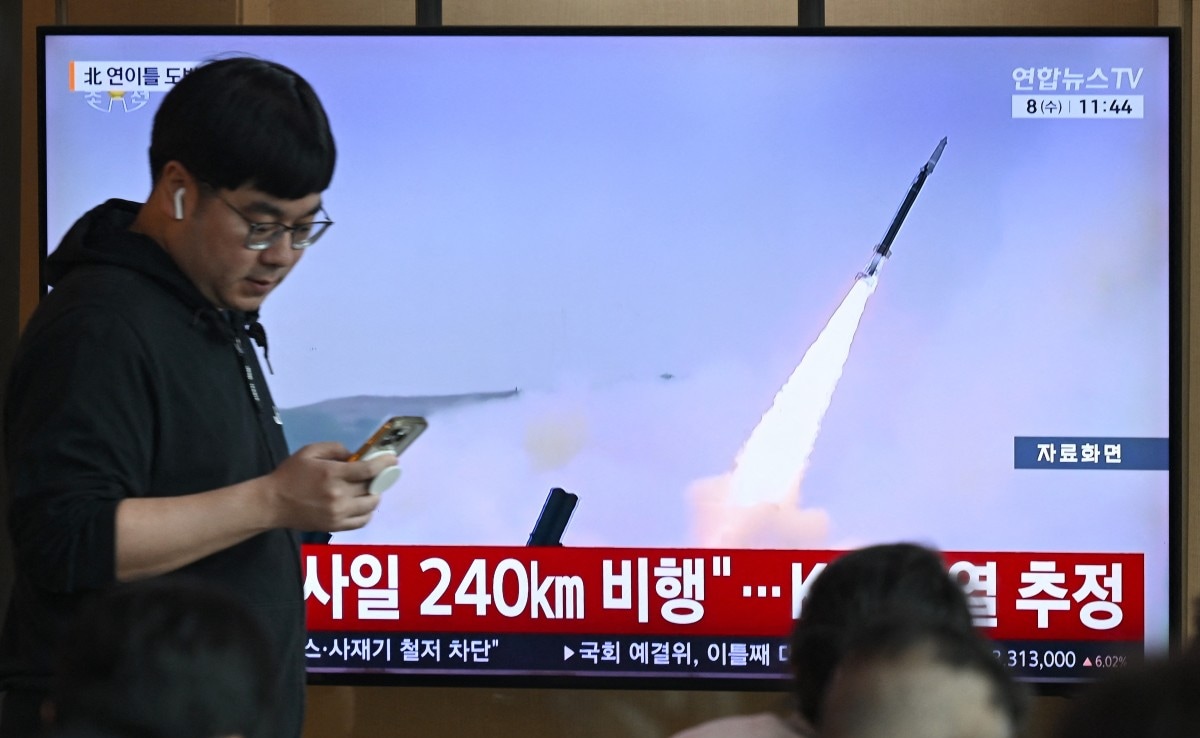
Pyongyang just raised the stakes in a way that should make every defense analyst in the West lose a little sleep. While the world was busy tracking trash balloons, Kim Jong Un’s engineers were firing off something far more sinister. North Korea recently claimed a successful test of what they call a multi-warhead missile. If you’re familiar with the jargon, they’re talking about MIRV (Multiple Independently targetable Reentry Vehicle) technology.
Think of it as a cosmic shotgun. Instead of one big missile carrying one big bomb, you’ve got one bus in space that drops off several independent warheads at different targets. South Korea’s military was quick to call "fake news" on this one, claiming the missile actually blew up in mid-air. But honestly, whether this specific flight was a success or a spectacular fireworks show doesn't matter as much as the intent. Pyongyang is telling us exactly what they want to do next: they’re coming for the U.S. missile defense shield.
The MIRV Threat and Why It Matters Now
If you want to understand why this is a big deal, you have to look at the math of missile defense. For decades, the U.S. and its allies have spent billions on interceptors designed to hit a bullet with a bullet. If North Korea launches one missile, we fire two or three interceptors at it. The odds are in our favor.
But MIRV technology flips the script. When a single North Korean Hwasong-16 or Hwasong-17 can suddenly release four, five, or six warheads—plus a handful of decoys—our defense systems get overwhelmed. It’s an economic and tactical nightmare. It's much cheaper for Kim to add another warhead to a missile than it is for the Pentagon to build three more interceptor batteries.
What happened in the latest tests
According to the state-run KCNA, the test focused on the separation and guidance of "individual mobile warheads." They even claimed the warheads were guided correctly to three separate targets.
- The Claim: Successful deployment of three warheads and a decoy.
- The Reality: South Korean thermal imaging showed a missile tumbling and disintegrating about 100 kilometers up.
- The Takeaway: Failures are just part of the R&D process. They’re learning.
Most experts, including those at the Carnegie Endowment for International Peace, have been expecting this move. It’s been on Kim’s "wish list" since the 2021 Party Congress. They’ve already checked off solid-fuel ICBMs and spy satellites. This is the last major hurdle to making their nuclear deterrent truly "un-stoppable."
Technical Hurdles Pyongyang Still Faces
Don't think they’ve mastered this yet. Building a MIRV isn't just about sticking more bombs on a rocket. It requires an insane level of precision and miniaturization. You need a "post-boost vehicle"—basically a small spacecraft—that can orient itself perfectly in the vacuum of space to release each warhead on a specific trajectory.
Then there’s the heat. These warheads have to survive the literal hell of re-entering the Earth's atmosphere at Mach 20. If your guidance system or heat shield is off by a fraction of a millimeter, the warhead burns up or misses by miles. We haven't seen definitive proof that North Korea has solved the atmospheric re-entry problem for multiple small warheads yet.
However, they’re getting help. Recent diplomatic hugs between Kim and Putin have sparked massive concerns that Russian missile "know-how" might be flowing into North Korea in exchange for artillery shells used in Ukraine. If Russia shares its MIRV secrets, North Korea’s development timeline doesn't just speed up; it skips entire years of trial and error.
The Decoy Factor
One detail people often overlook is the mention of "decoys." North Korea isn't just trying to hit us; they’re trying to trick us. By releasing balloons or metallic scraps alongside real warheads, they can make our radars see ten targets when only two are real.
This isn't just a "cluster bomb" in the traditional sense of a battlefield weapon. It’s a strategic shell game played at 15,000 miles per hour. If they can make a $100 decoy look like a nuclear warhead to a $50 million interceptor, they win the exchange.
What This Means for Global Security
We’re entering a phase where "strategic stability" is becoming a joke. If North Korea feels confident that their missiles can bypass U.S. defenses, they have less reason to hold back in a crisis. It emboldens them to take more risks on the peninsula, knowing the "nuclear umbrella" over Seoul and Tokyo might have holes in it.
You should expect more of these tests throughout 2026. They’ll likely move from these intermediate-range "failed" tests to full-scale ICBM launches on lofted trajectories. They need to prove to the world—and to themselves—that they can actually deliver.
Keep an eye on the Sea of Japan. The next time you see a "failed" launch reported, look closer. They aren't just failing; they’re iterating. Every explosion provides data that brings them one step closer to a multi-warhead reality.
If you're tracking this, start looking at regional defense upgrades. You'll see South Korea and Japan pushing for more advanced radar and more "lower-tier" defense systems to catch what the big interceptors miss. The arms race in East Asia just found its second gear, and it’s fueled by North Korean persistence and Russian technical scraps. Stay skeptical of the "total failure" headlines—Kim Jong Un is playing a long game, and he’s much closer to the finish line than most people want to admit.



