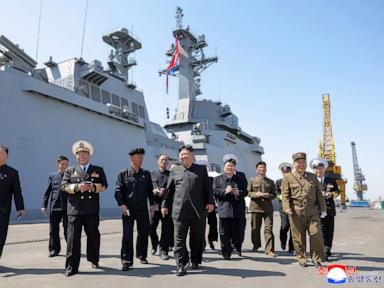
Pyongyang just hit the "launch" button again. Early Sunday morning, around 6:10 am local time, North Korea fired a volley of short-range ballistic missiles from the Sinpo area into the East Sea. It’s the fourth time they’ve done this in April alone. If you feel like you’re reading the same headline every week, it’s because you basically are. This marks the seventh major missile event of 2026.
But don't mistake frequency for insignificance. While the world's attention is currently fractured by the ongoing US-Israeli conflict with Iran, Kim Jong Un is making sure nobody forgets he has a seat at the big-boy table. These aren't just random temper tantrums; they're calculated technical and political signals sent from a coastal city known for its submarine pens.
The Sinpo connection and why 140 kilometers matters
The location of this launch is the first thing that should grab your attention. Sinpo isn't just any coastal town; it's the heart of North Korea’s submarine development. South Korea’s Joint Chiefs of Staff (JCS) tracked these projectiles flying a relatively short distance of roughly 140 kilometers (about 87 miles).
In the world of ballistic missiles, 140km is a sprint. It’s short enough to suggest two things. First, this could be a test of a new, highly mobile tactical system designed to carpet-bomb South Korean ports or airfields. Second, because it came from Sinpo, there’s a high probability we’re looking at a Submarine-Launched Ballistic Missile (SLBM) or a new "navalized" version of their KN-25 super-large multiple rocket launcher.
Just last week, the North was bragging about "cluster bomb warheads" and "electromagnetic weapon systems" designed to "reduce to ashes" targets within range. When they fire from Sinpo, they aren't looking at the US mainland—they're looking at the immediate neighborhood.
The geopolitical shadow of the Iran war
You can't look at these launches in a vacuum. Right now, the seven-week-old war between the US, Israel, and Iran is shifting the gravity of global security. Kim Jong Un watches the news too. He sees the pressure on Tehran’s nuclear program and wants to show that he’s already past the point of no return.
Former South Korean security adviser Kim Ki-jung put it bluntly: Pyongyang wants to prove that, unlike Iran, they already have the "self-defense" (read: nuclear) capabilities to make any intervention unthinkable. It’s a flex of leverage. With a planned summit between Donald Trump and Xi Jinping looming in May, Kim is effectively shouting from the sidelines to make sure he’s on the agenda. He doesn't want to be the forgotten nuclear power while the world deals with the Middle East.
What's actually changing on the ground
If you look past the "provocation" rhetoric from Seoul and Tokyo, the technical progression is what's actually scary. We’re seeing a shift from liquid-fueled missiles that take hours to prep to solid-fuel systems that can be fired in minutes.
- Mobility is King: The North recently showed off 50 new road-mobile launchers. You can't hit what you can't find.
- Precision Over Power: They’re no longer just trying to hit a city; they’re testing "self-steered precisely guided" systems that can allegedly ignore outside intervention.
- Saturation Tactics: By firing "multiple" missiles at once, they’re practicing how to overwhelm the missile defense systems (like THAAD and Aegis) that the US and South Korea rely on.
South Korea’s President Lee Jae Myung and the US administration have kept the door open for talks, but that door is looking pretty rusty. The North hasn't responded with diplomacy. Instead, they’ve responded by launching missiles on April 8, and now again on April 19.
The immediate fallout
Japan’s Prime Minister Sanae Takaichi was quick to jump on X (formerly Twitter) to confirm that the missiles fell outside Japan’s Exclusive Economic Zone. There’s no immediate danger to shipping, but the "crisis management protocols" are back in high gear.
The UN's nuclear watchdog, Rafael Grossi, recently warned about a new uranium enrichment facility in the North. Combine that with today's launch, and it's clear the "irreversible" nuclear status Kim Jong Un claimed last month isn't just talk.
What you should do next
Don't wait for the next "breaking news" alert to understand the stakes.
- Watch the Sinpo shipyards: Keep an eye on satellite imagery reports from outlets like 38 North. If a new submarine starts sea trials, the flight distances of these missiles will suddenly get a lot longer.
- Monitor the May Summit: The Trump-Xi meeting in China next month will be the real barometer. If North Korea isn't a primary talking point, expect the launches to get bigger and louder.
- Track the tech, not the trash talk: Ignore the "reduce to ashes" rhetoric. Focus on the fuel types and launcher mobility. Solid fuel and road-mobile launchers are the real "game-changers" that actually shift the balance of power in the region.
The pattern is set. Kim Jong Un is using the East Sea as a laboratory, and the world's distraction as a shield.


