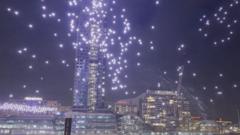
The air above Sydney Harbour usually tastes of salt and anticipation on a winter Sunday night. Hundreds of families had gathered along the waterfront, wrapped in heavy wool coats and thick scarves, their breath blooming in the crisp June chill. Children sat on their parents' shoulders, pointing up at the empty, dark expanse above the water. They were waiting for the magic to begin.
For weeks, the city had been alive with the Vivid Sydney festival, a celebration of light, music, and ideas that transforms the concrete metropolis into a canvas of neon and wonder. The crown jewel of the event was the drone show.
To the human eye, a drone light show looks like sorcery. Hundreds of tiny, illuminated aircraft dance in perfect, mathematically dictated harmony. They form giant, glowing whales swimming through the atmosphere. They morph into swirling galaxies. They trick the brain into believing that the night sky has been tamed, rewritten by human code.
But code is a fragile thing.
Consider a hypothetical engineer standing in the command tent that night, whom we will call Marcus. Marcus knows the reality behind the spectacle. He knows that what the crowd sees as a seamless ballet is actually a high-stakes wrestling match between invisible radio frequencies. Every single drone is a computer, relying on a delicate, invisible thread of GPS data and radio commands to know exactly where it is in three-dimensional space. If that thread snaps, the illusion shatters.
The show began beautifully. A fleet of five hundred drones rose from their launch pads, a swarm of artificial fireflies climbing into the dark. The crowd gasped. Up they went, shifting into vibrant hues of electric blue and magenta.
Then, the sky faltered.
It started with a subtle shudder. A few lights flickered out of sync. To the untrained eye, it might have looked like a transition, a deliberate pause in the choreography. But Marcus would have felt his stomach drop. On the monitoring screens, error logs would have started cascading in a waterfall of red text.
Suddenly, the orderly formation dissolved. Dozens of glowing points of light abandoned the pattern. They did not fly away; they simply quit.
Like shooting stars stripped of their grace, they began to fall.
Plumet.
One by one, and then in clusters, the drones dropped straight down into the black, icy waters of the harbor. Parents pulled their children closer. The collective murmur of the crowd shifted from awe to a quiet, bewildered shock. Plop. Plop. Plop. The expensive machines hit the water near the Overseas Passenger Terminal, swallowed instantly by the tide.
It was a technological heart attack in real-time.
The Illusion of Absolute Control
We live in an era where we have become dangerously comfortable with the idea of total technological mastery. We look at our smartphones, our self-driving features, and our synchronized drone shows, and we subconsciously believe we have conquered the chaos of the physical world.
We haven't.
What happened in Sydney was a stark reminder of the invisible vulnerabilities that underpin our modern world. Early reports pointed toward a software glitch, a sudden and catastrophic loss of the primary control signal. When a drone used in these massive displays loses its positioning data or its connection to the central brain, it faces a binary choice programmed by its creators: fly blind and risk colliding with a skyscraper or a human being, or execute an emergency kill-switch maneuver.
The software chose the water.
In the world of aviation and public safety, this is actually a victory. The system worked exactly as it was designed to work in a worst-case scenario. The drones didn't rogue-fly into the crowd. They didn't smash into the historic sails of the nearby Sydney Opera House. They took the only safe exit available to them.
They drowned themselves.
But knowing that a failure mode worked as intended does little to soften the eerie feeling of watching millions of dollars of sophisticated technology plunge helplessly into the ocean. It exposes the thin veneer of our digital sophistication. We build these breathtaking, complex networks, but we are always just one corrupted line of code, one rogue radio frequency, or one software anomaly away from total collapse.
Imagine the sheer complexity of coordinating hundreds of airborne nodes. Each drone must constantly calculate its distance from its neighbors down to the centimeter. They are constantly talking, constantly listening. Now, imagine a single burst of localized electromagnetic interference, or a minor bug in a firmware update that miscalculates battery voltage or wind resistance. The system doesn't just degrade gracefully; it fails spectacularly.
The Ghost in the Machine
The aftermath of the crash was met with a bizarre mix of corporate damage control and public fascination. Divers were dispatched into the murky depths of Sydney Harbour the following morning, tasked with retrieving the waterlogged corpses of the tech fleet. Each drone represents thousands of dollars in hardware, but more importantly, they represent data. Technicians needed to dissect the physical units to understand exactly why the digital ghost had abandoned the machine.
For the spectators who watched from the shoreline, the event lingered long after the remaining drones were landed safely and the sky was left empty. It wasn't just that a show had been ruined. It was the sudden realization of how little we understand the things we rely on for our entertainment, our infrastructure, and our future.
We treat technology like magic until it breaks.
When a bridge collapses, we understand the physics of failure—steel twists, concrete cracks. It is tangible. But when a fleet of drones falls out of the sky due to a software glitch, the failure is ghostly. It exists in the realm of logic gates and invisible frequencies. It is an error you cannot see, touching a world you cannot feel, producing a catastrophe you cannot ignore.
There is a lesson here that goes far beyond a ruined festival attraction in Australia. As we push further into automation—as we contemplate skies filled with delivery drones, automated air taxis, and autonomous logistics networks—the stakes rise exponentially. A glitch in a light show results in a spectacular splash and some embarrassed executives. A glitch in an automated transit network is a matter of life and death.
The ocean now holds the salt-crusted remains of dozens of machines that, just moments before their demise, were convincing thousands of human beings that we had finally conquered the stars.
The harbor was quiet by midnight. The ripples from the impacts had long since smoothed over, reflecting nothing but the static, reliable yellow glow of the city's streetlights. The digital stars were gone, leaving behind only the cold, ancient water, stubbornly indifferent to our algorithms.