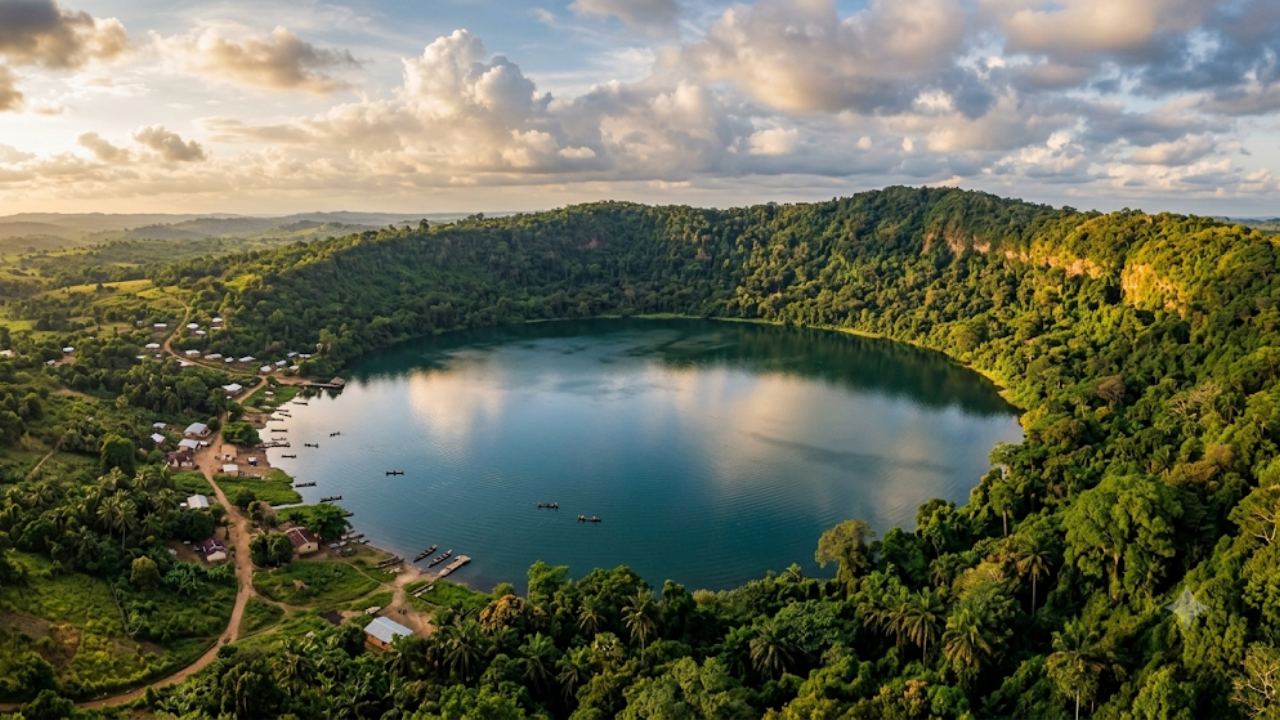
A heavy mist hangs over the water at dawn, blurring the line where the lake ends and the forested hills of the Ashanti region begin. If you stand on the shore of Lake Bosumtwi, you hear the soft slap of water against wood. Fishermen slide across the surface on flat planks called paduas. They do not use modern boats. They do not use metal nets. For centuries, the local people have treated this water with a quiet, protective reverence.
To the casual traveler, it looks like a paradise. A peaceful, circular sanctuary hidden away in Ghana. Don't miss our previous coverage on this related article.
But beneath the stillness lies a violent history. Everything here was born from chaos.
The Fire in the Clouds
One million years ago, the sky broke. If you want more about the history here, Travel + Leisure provides an excellent summary.
Picture an ordinary afternoon in the West African jungle. Birds chirping, primates moving through the canopy, insects buzzing in the humid heat. Then, a blinding flash. A meteor weighing millions of tons, traveling faster than a bullet, tore through the atmosphere. It struck the earth with the force of thousands of atomic bombs.
The impact was instantaneous and catastrophic. Shockwaves rippled through the crust. The ground melted. Billions of tons of rock vaporized into the upper atmosphere, raining down across the continent and splashing glass droplets as far away as the ivory coast and the deep ocean floor. When the dust finally settled, a gaping, smoldering scar remained in the earth. A crater nearly seven miles wide and hundreds of feet deep.
Over centuries, rains filled the void. Nature reclaimed the edges, throwing a green blanket of tropical rainforest over the jagged rim. The scar became a lake.
For the Ashanti people who eventually settled around its perimeter, the lake became sacred. It is the place where souls say goodbye to their god, Asase Yaa. Because of this spiritual connection, traditional laws forbade the use of iron hooks or modern boats on the water. The taboo preserved the lake, keeping it pristine for generations.
But the meteor did more than just dig a deep hole for a sacred lake. It reshaped the very wealth of Ghana.
Shaking the Vaults of the Earth
Ghana has always been synonymous with gold. Centuries ago, traders called it the Gold Coast. European empires fought bloody wars to control its shores, drawn by the shimmering dust traded by the Ashanti Kingdom. Even today, the country stands as one of the top gold producers on the planet.
Most people assume this gold is just a lucky accident of geography. But geologists digging into the rocks around Lake Bosumtwi discovered a strange pattern. The impact of the meteor acted like a massive cosmic hammer, smashing into an area already rich in ancient, deep-seated minerals.
Think of the earth's crust as a secure vault. The gold was locked away miles beneath the surface, tightly bound in hard, ancient stone. No human could reach it. No natural erosion could expose it quickly enough.
Then came the meteor.
The sheer force of the collision shattered the vault. The intense heat liquefied the surrounding rock, while the pressure cracked the deep crust, creating a massive network of underground fractures. Hydrothermal fluids—scalding hot water loaded with minerals—rushed upward through these new pathways. As the fluids cooled in the fractures, they deposited thick veins of quartz packed with high-grade gold.
The asteroid did not bring gold from outer space. Instead, it acted as a master locksmith, breaking open the earth and pushing the wealth upward, closer to human hands.
A Legacy Written in Gold and Stone
Today, the area surrounding the crater is a patchwork of small communities and mining operations. Miners work the red dirt, filtering out the precious yellow metal that was unlocked by a cosmic accident a million years ago. They labor in the shadow of the crater rim, often unaware that their livelihoods were dictated by a rock flying through the void of space before humans even walked the land.
It is a strange paradox. A place born from total planetary destruction has become a source of life, spirituality, and immense wealth for the people who call it home.
The mist on Lake Bosumtwi begins to lift as the sun climbs higher. The fishermen on their wooden pads move silently across the water, casting their nets into the depths of a crater born from fire. Beneath them lies a mile of sediment, hiding the twisted, shocked rocks that tell the story of the day the sky fell. Above them, the green hills stand guard over Africa's secret treasury, a monument to the moment destruction turned into creation.